

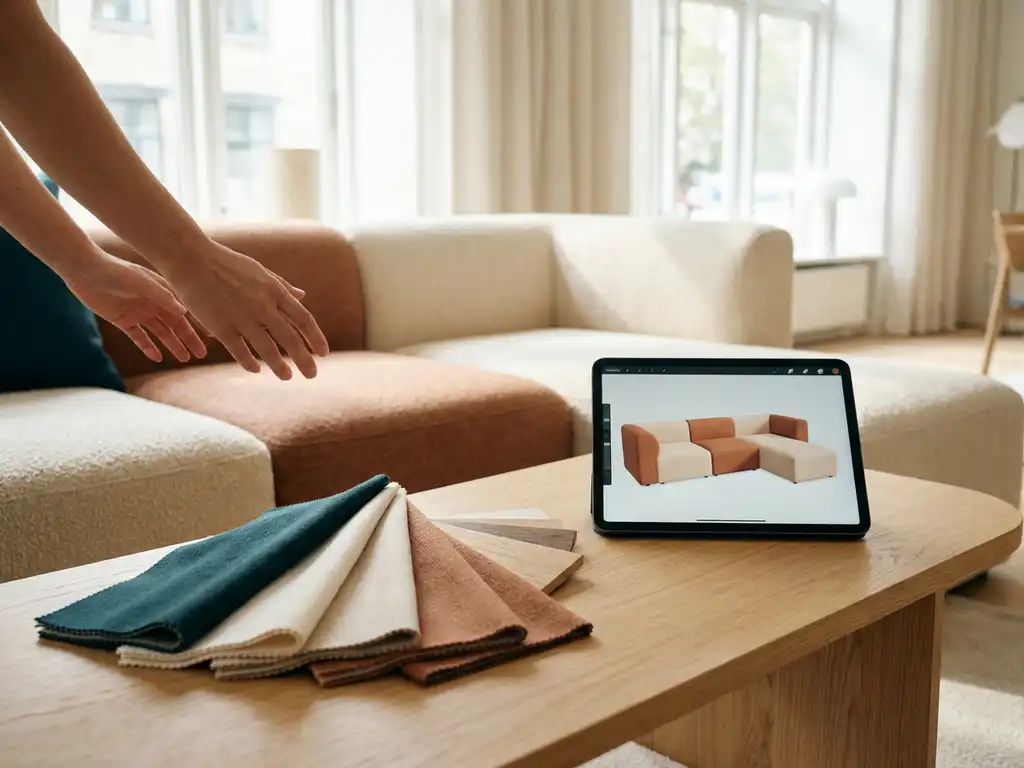
A product configurator improves the buying experience by letting customers build and visualise exactly what they want before they commit to a purchase. Instead of guessing how a sofa will look in a particular fabric or whether a wardrobe will fit a specific space, shoppers interact with the product directly, making choices that feel personal and informed. The sections below unpack the most common questions buyers and businesses have about how online product configuration actually works.
What does a product configurator actually do for customers?
A product configurator gives customers direct control over product choices — material, colour, size, finish, and more — and immediately shows them the result. Rather than reading a specification sheet or imagining the outcome, the shopper sees a real-time visual update with every selection they make. This transforms a passive browsing experience into an active, guided buying journey.
For products with many possible combinations, this is especially powerful. A customer configuring a sectional sofa, for example, can select the fabric, leg finish, and module layout and instantly see a photorealistic image of their specific configuration. The decision no longer requires imagination or trust — it requires only a few clicks.
Beyond the visual element, a well-built configurator also handles pricing logic in the background, so the customer always sees an accurate price as they build. This removes friction at checkout and reduces the back-and-forth that often slows down complex purchases. The result is a buying experience that feels both personal and transparent.
Why do shoppers abandon complex product decisions online?
Shoppers abandon complex product decisions online primarily because of uncertainty. When a customer cannot clearly visualise what they are ordering, or when the configuration process feels overwhelming, the safest option is to do nothing. This is especially true for high-involvement purchases like furniture, where the stakes of getting it wrong feel high.
Several specific friction points drive abandonment:
- Too many options without visual guidance — dropdown menus and text descriptions do not communicate how a product actually looks in a chosen variant
- Fear of making the wrong choice — without seeing the result, customers worry about colour mismatches, sizing errors, or style clashes
- Lack of context — a product shown in isolation does not help a customer judge whether it suits their space
- Unclear pricing — if the final price is only revealed at checkout, customers hesitate long before they get there
A visual product configurator addresses each of these barriers directly. By making the outcome visible at every step of the decision, it replaces uncertainty with confidence — and confidence is what converts browsers into buyers.
How does a configurator reduce product returns?
A configurator reduces product returns by closing the gap between what a customer expects and what they actually receive. Most returns in the furniture and home decoration industry happen not because a product is defective, but because it looks different in person than it did online. When the customer has built and visualised their exact configuration before ordering, that gap shrinks significantly.
When a shopper selects a fabric swatch from a static image, they are making an educated guess. When they configure a product in 3D and view it in augmented reality inside their own room, they are making an informed decision. The product they receive is the product they designed — there are no surprises.
This has a meaningful commercial impact. Fewer returns mean lower logistics costs, less restocking effort, and less waste. For manufacturers and retailers, this is one of the clearest and most measurable benefits of investing in a 3D product configurator. It also builds customer trust, since buyers who receive exactly what they ordered are far more likely to purchase again.
What’s the difference between a product configurator and a product customiser?
A product configurator and a product customiser are often used interchangeably, but they describe different levels of functionality. A product customiser typically allows surface-level personalisation — adding a name, choosing from a fixed set of colours, or uploading a logo. A product configurator handles structural complexity, managing interdependent choices, business rules, and pricing logic across potentially millions of combinations.
The distinction matters in practice. A customiser might let you pick a cushion colour. A configurator lets you choose the sofa frame, the module configuration, the fabric category, the specific fabric within that category, the leg material, and the leg colour — and ensures that every combination shown is one that can actually be produced and priced correctly.
For businesses selling configurable or made-to-order products, a true configurator is essential. It is not just a front-end visual tool; it connects to business logic, production rules, and pricing engines in a way that a simple customiser cannot. The visual layer is what customers see, but the configurator engine underneath is what makes the experience reliable and scalable.
Which types of products benefit most from a configurator?
Products that benefit most from a configurator are those with multiple interdependent variables, high visual impact, and significant purchase commitment. Furniture is the clearest example, but the principle applies broadly across home decoration, kitchen systems, modular storage, lighting, flooring, and any product where the customer’s specific combination of choices determines the final look, fit, and price.
The strongest candidates share a few common characteristics:
- High number of variants — products available in many materials, colours, sizes, or configurations that cannot all be photographed individually
- Considered purchases — items where the customer invests time in the decision and wants to feel certain before buying
- Custom or made-to-order production — products built to specification rather than picked from a warehouse shelf
- Strong visual component — items where appearance is central to the buying decision
For these product types, a visual product configurator does not just improve the experience — it makes the product genuinely sellable online at scale, without requiring a physical showroom or an extensive sample library.
How does a product configurator integrate with existing sales channels?
A product configurator integrates with existing sales channels through APIs and standard data connections that link it to the tools a business already uses — including webshops, PIM systems, ERP platforms, and CMS environments. This means the configurator does not operate as a standalone island; it shares product data, pricing, and order information with the broader tech stack.
In practice, this integration works across multiple touchpoints:
- E-commerce platforms — the configurator embeds directly into a product page, so the customer configures and adds to cart without leaving the shop
- Retail and dealer networks — the same configuration tool can be deployed across multiple retail partners, ensuring consistent brand presentation regardless of location
- In-store sales tools — sales staff use the configurator on a tablet or screen to guide customers through options during a showroom visit
- PIM and ERP systems — product data, rules, and pricing flow from existing systems into the configurator, reducing duplication and keeping everything in sync
This omnichannel capability is one of the most commercially significant aspects of a well-built configurator. A business that deploys the same configuration experience across its website, its dealer network, and its physical stores creates a consistent buying experience that reinforces brand trust at every touchpoint.
How iONE360 helps with the buying experience
We built iONE360 specifically to solve the challenges described throughout this article — for manufacturers, brands, and retailers in the furniture, home, and decoration sectors. Our platform brings together everything needed to create a compelling, confidence-building buying experience in one integrated solution:
- Interactive 3D product configuration — customers build their exact product and see a photorealistic result in real time, across millions of possible combinations
- Augmented reality viewing — shoppers place configured products in their own space using AR, removing the last barrier to commitment
- Automatic packshot generation — high-quality product images are generated automatically for every configuration, eliminating costly photoshoots
- Room planning tools — customers combine and arrange multiple products in a virtual room, building confidence in their complete purchase
- Seamless system integration — iONE360 connects to existing PIM, ERP, CMS, and webshop environments through open APIs, fitting into the tech stack rather than replacing it
- Omnichannel deployment — the same platform serves the webshop, the dealer network, and the showroom floor, ensuring consistent brand presentation everywhere
With more than 45 years of industry experience behind us and recognition from Gartner, the Red Dot Award, and the A’ Design Award, we understand the specific complexity of configurable products in this market. If you are ready to see what a furniture configurator can do for your sales process, get in touch with our team for a personalised demo.