

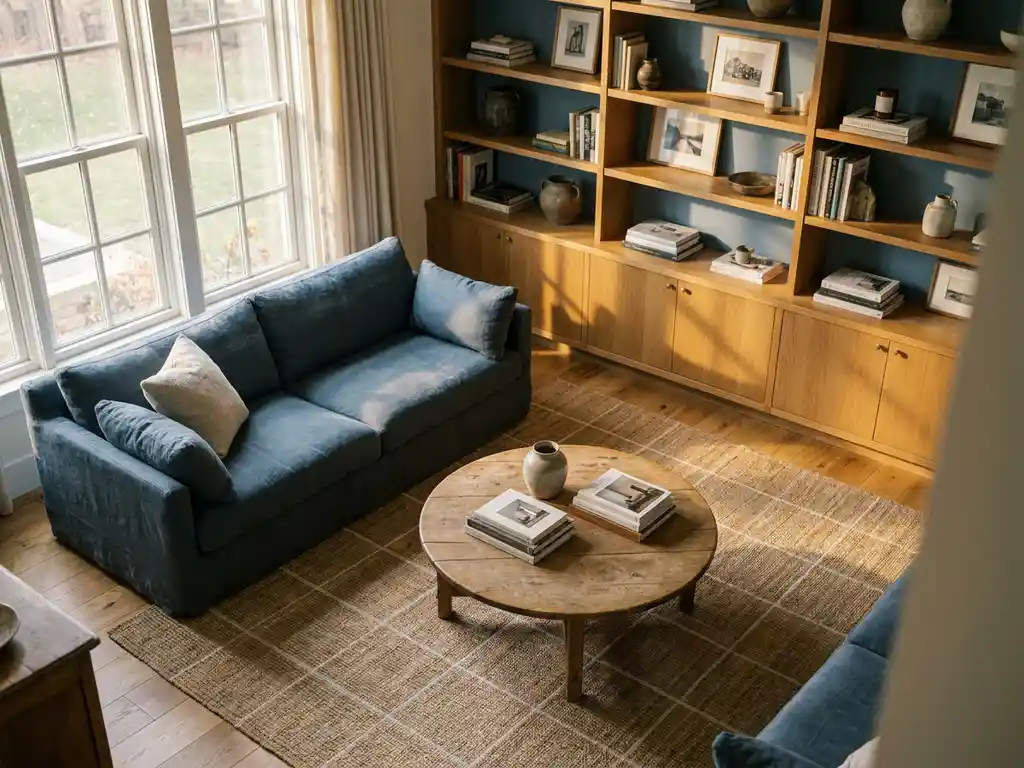
A room planner increases average order value for furniture brands by encouraging customers to think beyond a single piece and furnish an entire space. When shoppers can visualise how a sofa, coffee table, rug, and shelving unit look together in their own room, they naturally add more items to their basket. The effect is measurable: showing products in a realistic environment can increase buying intent by up to 64%. The sections below break down exactly how this works, which product categories benefit most, and what results you can realistically expect.
How does a room planner actually influence purchase decisions?
Room planning software influences purchase decisions by removing the single biggest barrier in furniture buying: uncertainty. When a customer can place a sofa in a digital version of their living room, adjust the dimensions, swap the fabric, and see how it sits next to their existing pieces, they stop second-guessing and start committing. The tool shifts the mental state from “I think this might work” to “I can see this working.”
This confidence effect is not accidental. 3D room planning software creates an emotional connection between the customer and the finished space. They are no longer buying a product in isolation; they are buying a vision of their home. That emotional investment makes them more likely to complete the purchase and more open to adding complementary products along the way.
For furniture brands specifically, this matters because the purchase cycle is long and considered. Customers research extensively before buying. A room planner keeps them engaged on your platform rather than bouncing between competitors’ sites, and it gives your sales team a powerful conversation tool in-store or online.
What specific features drive higher order values in a room planner?
The features that most directly lift average order value in a room planning software tool are those that make it easy to add, configure, and visualise multiple products together in a single session. The more seamlessly a customer can build out a complete room, the more likely they are to purchase the full composition rather than a single item.
The most impactful features include:
- Multi-product arrangement: The ability to place and rearrange several furniture pieces simultaneously encourages customers to think in sets rather than individual products.
- In-context product configuration: Configuring colour, fabric, size, and finish directly within the room view means customers see the exact product they want, reducing hesitation.
- Real-time pricing and lead times: Displaying prices and availability as customers configure removes friction at the decision point.
- Decoration layers: Adding flooring, wallpaper, curtains, and accessories extends the basket beyond core furniture into higher-margin accessory categories.
- Direct-to-cart functionality: A single “order as configured” action from within the room view eliminates the steps between inspiration and purchase.
- Zoom and rotate controls: Full camera manipulation builds confidence in the product and the room layout before any money changes hands.
Together, these features create a buying journey where the natural next step is always “add one more piece” rather than “leave and think about it.”
How does a room planner reduce returns and abandoned carts?
Room planning software reduces returns by ensuring customers know exactly what they are buying before they buy it. The most common reason furniture gets returned is that it does not fit the space, clashes with existing pieces, or looks different in reality than it did in a flat product image. A 3D room planner eliminates each of these problems at the source.
Abandoned carts in furniture e-commerce are almost always caused by doubt. Customers fill their basket, then pause because they are not sure the dimensions are right or whether the colour will work. A room planner answers both questions visually, in real time, before the customer reaches checkout.
The practical impact works in two directions:
- Pre-purchase confidence: Customers who have placed a product in their room and seen it from multiple angles are far less likely to be surprised when it arrives. Fewer surprises mean fewer returns.
- Reduced decision paralysis: When a customer can see the complete picture, including scale, proportion, and colour harmony, they have fewer reasons to abandon the purchase. The room planner answers the “but what if” questions that typically stall a sale.
- Accurate configuration capture: When the room planner is connected to a product configurator, the exact specification the customer designed is passed directly to the order. There is no manual re-entry and no risk of ordering the wrong variant.
- Consistent expectations across channels: Whether a customer uses the room planner online or in-store, they see the same photorealistic output. This consistency means the product that arrives matches what was shown, every time.
Which furniture product categories benefit most from room planning tools?
The furniture categories that benefit most from 3D room planning software are those where scale, proportion, and combination with other products are critical to the buying decision. The more a product’s success depends on how it fits within a space, the more a room planner moves the needle.
The highest-impact categories are:
- Sofas and seating: Scale relative to the room and compatibility with existing furniture are the primary purchase concerns. A room planner resolves both instantly.
- Dining sets: Customers need to visualise the table and chairs together, with enough clearance around them. This is almost impossible to judge from a product page alone.
- Bedroom furniture: Wardrobes, beds, and storage units need to fit specific wall dimensions. Room planning tools that allow customers to input their actual room measurements are especially valuable here.
- Home office and storage: Modular and configurable storage systems with many possible combinations are a natural fit for room planning, where customers can build their ideal configuration and see the result before ordering.
- Rugs, flooring, and soft furnishings: These are classic add-on categories that customers often forget until they see a room looking incomplete without them. A room planner surfaces these upsell opportunities naturally.
Configurable products, in particular, see the strongest uplift. When a customer can adjust a product’s dimensions, finish, and fabric while simultaneously seeing it in their room, the combination of configurator and room planner creates a buying experience that is genuinely difficult to replicate in a physical showroom.
How does a room planner integrate with existing e-commerce and sales systems?
A well-built room planning tool integrates with your existing e-commerce and sales systems through standard APIs and data connections, meaning it works within your current tech stack rather than replacing it. The key integration points are your product catalogue, your pricing and availability data, your PIM or ERP system, and your webshop or checkout flow.
In practice, integration means that product data, including configurations, prices, and lead times, flows into the room planner automatically. When a customer completes their room design and clicks to order, the configured product specifications pass directly to the cart without manual re-entry. This eliminates errors and keeps the customer experience seamless from inspiration to purchase.
For brands operating across multiple channels, a room planner can be deployed consistently across the webshop, in-store kiosks, and dealer platforms. This omnichannel consistency is particularly valuable for manufacturers who sell through retail partners: every retailer presents your products in the same high-quality, brand-aligned environment, without requiring additional investment per location.
What results can furniture brands realistically expect from a room planner?
Furniture brands that implement room planning software can realistically expect improvements across three areas: higher average order values, lower return rates, and stronger conversion at the point of purchase. The exact numbers vary by brand, catalogue complexity, and how deeply the tool is integrated into the buying journey, but the direction of impact is consistent across the industry.
The most reliable outcomes include higher basket sizes, because customers who use room planning tools naturally add complementary products. Fewer returns follow from better pre-purchase visualisation. Conversion rates improve because uncertainty, the primary reason furniture shoppers abandon purchases, is addressed directly by the tool. And sales teams, both online and in-store, become more effective because they have a visual tool that helps customers reach decisions faster.
For brands with large configurable catalogues, the operational benefits are equally significant. Automatically generated visuals mean you no longer need a photoshoot for every product variant. One platform can serve your entire catalogue, across all configurations, without the cost and delay of traditional product photography.
How iONE360 helps furniture brands grow with room planning
We built our room planning software specifically for the furniture and home furnishings industry, backed by more than 45 years of sector expertise. Our platform gives furniture brands a practical, scalable way to deliver everything described in this article, without the complexity of stitching together separate tools.
Here is what we offer in one integrated platform:
- A bespoke, white-labeled room planner built specifically for your brand and catalogue
- HomeDecoHub, our ready-to-use room planning marketplace, powered by the same proven configurator software
- In-room product configuration with real-time pricing, lead times, and direct-to-cart ordering
- Full decoration layers including flooring, wallpaper, curtains, and accessories to maximise basket size
- Seamless integration with your PIM, ERP, CMS, and webshop through standard APIs
- Omnichannel deployment across your webshop, in-store, and dealer network from a single platform
The result is a buying experience that converts browsers into buyers, increases order values, and reduces returns, all while cutting your dependence on costly, slow product photography. Ready to see what this looks like for your catalogue? Get in touch with our team and we will show you exactly what is possible.
Frequently Asked Questions
How long does it typically take to implement a room planner on a furniture brand's website?
Implementation timelines vary depending on catalogue size and the depth of integration required, but most furniture brands can expect a fully functional room planner to go live within a few weeks to a couple of months. The most time-intensive part is typically preparing and uploading 3D product data, not the technical integration itself. Working with a platform that already supports standard API connections to common PIM, ERP, and e-commerce systems significantly shortens the process.
Do customers actually use room planners, or do most shoppers skip them?
Engagement rates are consistently higher than most brands expect, particularly when the room planner is prominently placed within the product discovery journey rather than buried as a secondary feature. Customers who are in the consideration phase — already interested but not yet committed — are especially likely to use the tool because it directly answers the questions holding them back. Brands that integrate the room planner as a core part of the buying flow, rather than an optional add-on, see the strongest adoption and the clearest impact on conversion.
What 3D product data do we need to get started, and what if our catalogue isn't fully digitised yet?
At minimum, you need accurate 3D models of your products along with configuration data covering dimensions, materials, finishes, and variants. If your catalogue is not yet fully digitised, it is practical to start with your best-selling or highest-margin lines and expand from there. Many room planning platforms, including those built specifically for furniture, offer onboarding support to help brands build out their 3D asset library progressively, so you do not need a complete catalogue before going live.
Can a room planner work for smaller furniture brands, or is it only cost-effective at scale?
Room planning tools are increasingly accessible to mid-sized and growing brands, not just large retailers with enterprise budgets. The key is choosing a platform that is priced and structured for your catalogue size and traffic levels. For smaller brands, the return on investment case is often strongest in return rate reduction and average order value uplift, both of which have a direct and measurable impact on margin even at lower sales volumes.
How do we measure whether our room planner is actually driving results?
The most direct metrics to track are average order value for sessions that included room planner use versus those that did not, conversion rate among room planner users, and return rates segmented by whether a room planner was used during the purchase journey. Most room planning platforms provide session analytics, and these can be combined with your existing e-commerce data to build a clear picture of impact. Setting a baseline before launch and reviewing results at 30, 60, and 90 days gives you a reliable read on performance.
What is the biggest mistake furniture brands make when rolling out a room planner?
The most common mistake is treating the room planner as a standalone feature rather than integrating it deeply into the purchase flow. When the tool sits in isolation — disconnected from live pricing, real-time availability, or direct-to-cart functionality — it becomes an inspiration tool that does not convert. The brands that see the strongest results are those that connect the room planner directly to their product catalogue and checkout, so the path from designing a room to placing an order is as short and seamless as possible.
Can a room planner also support our in-store sales team, or is it primarily an online tool?
A well-built room planner is equally powerful in a physical retail environment. In-store, it gives sales associates a visual tool to help customers make faster, more confident decisions — replacing the guesswork of trying to imagine how a piece will look at home. When the same platform is deployed consistently across your webshop and in-store kiosks, customers can even start a room design online and continue it in-store with a sales associate, creating a joined-up experience that supports the entire purchase journey regardless of channel.