

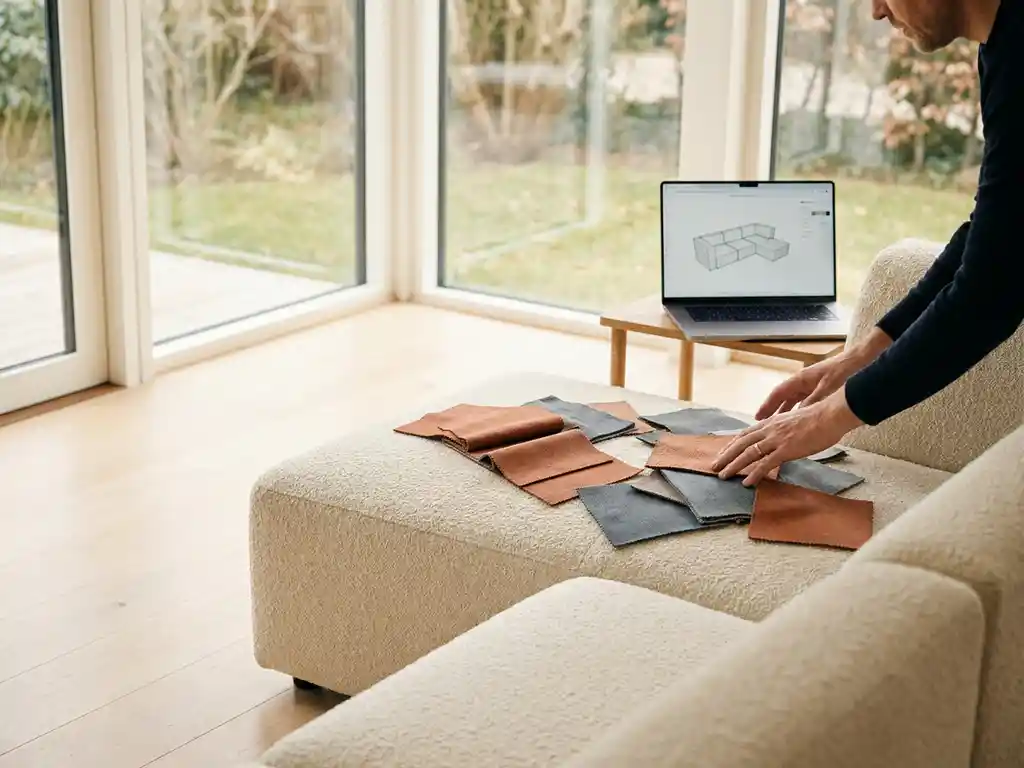
A visual product configurator is a software tool that lets customers build and personalise a product in real time, seeing every change rendered visually as they make it. Instead of reading a list of options, the customer interacts directly with a live 3D or photorealistic representation of the product. For manufacturers and retailers selling customisable goods, this transforms the buying experience from guesswork into confident decision-making. The sections below unpack how these tools work, which products benefit most, and what to look for when evaluating one.
How does a visual product configurator work?
A visual product configurator works by connecting a product’s configurable attributes, such as size, material, colour, and finish, to a real-time rendering engine. When a customer selects an option, the visual output updates instantly to reflect that choice. The configurator enforces business rules behind the scenes, so only valid combinations are ever presented.
The process typically runs in three layers working together. A data layer holds the product logic: which options exist, which combinations are valid, and how pricing changes with each selection. A rendering layer translates those selections into a visual output, whether that is a 3D model, a photorealistic packshot, or an augmented reality view. An integration layer connects the configurator to back-end systems such as a PIM, ERP, or e-commerce platform, so the configured product flows directly into an order without manual re-entry.
For complex products, the configurator can manage thousands or even millions of possible combinations while keeping the customer journey simple. Rather than presenting every option at once, a well-designed configurator guides users through a step-by-step process, surfacing only the choices that are relevant at each stage.
What types of products benefit most from a visual configurator?
Products that are highly customisable, visually driven, or difficult to evaluate from a standard photograph benefit most from a visual configurator. This includes furniture, sofas, kitchens, flooring, curtains, lighting, and other home and decoration products where colour, material, and dimension choices significantly affect how the final product looks and fits.
The clearest candidates share a few common traits:
- Multiple configurable attributes: Products with combinations of size, colour, fabric, finish, or component choices that are hard to communicate through static images alone.
- High purchase consideration: Items where the customer needs confidence before committing, because the product is expensive, personalised, or difficult to return.
- Wide variant ranges: Product lines where photographing every possible combination is impractical or cost-prohibitive.
- Context-dependent decisions: Products that only make sense once the customer can visualise them in their own space, such as a sofa in a specific fabric or a dining table in a particular finish.
Beyond furniture and interiors, visual configurators are also used effectively in automotive accessories, outdoor furniture, modular storage systems, and made-to-measure textiles. Wherever a product has meaningful visual variation and the buying decision depends on seeing the result, a configurator adds genuine value.
What’s the difference between a visual configurator and a standard product page?
A standard product page presents fixed content: a set of photographs, a description, and a list of available variants. A visual product configurator is interactive. The customer actively builds the product and sees the result update in real time. The core difference is the shift from passive browsing to active configuration.
On a standard product page, a manufacturer selling a sofa in twelve fabrics and three sizes would need 36 separate images to show every combination accurately, and even then the customer is mentally assembling the result rather than seeing it. A visual configurator renders the exact combination the customer has selected, eliminating that gap between imagination and reality.
This distinction has practical consequences beyond the visual experience:
- Accuracy: The customer sees precisely what they are ordering, reducing mismatched expectations and returns.
- Scalability: Adding a new fabric or finish requires updating the 3D asset library once, not commissioning a new photoshoot for every product variant.
- Sales guidance: A configurator can enforce rules that prevent invalid combinations, removing a common source of order errors.
- Engagement: Interactive tools keep customers on the page longer and increase the likelihood of purchase.
What features should a visual product configurator include?
A strong visual product configurator should include real-time 3D rendering, a guided step-by-step configuration flow, business rule enforcement, automated image generation, augmented reality viewing, and seamless integration with existing business systems. Together, these features make the tool useful for both the end customer and the teams managing it internally.
When evaluating product configuration software, look for the following capabilities:
- Real-time 3D visualisation: Every selection should update the visual output instantly, without page reloads or delays.
- Automated packshot generation: The configurator should be able to produce high-quality product images automatically for use in catalogues, webshops, and marketing materials, removing the need for manual photoshoots per variant.
- Augmented reality (AR): Customers should be able to place the configured product in their own space using a smartphone or tablet, without requiring an app download.
- Room planning tools: For furniture and interiors, the ability to combine and arrange multiple products in a virtual room adds significant value to the buying decision.
- Business rule and pricing logic: The configurator must handle complex constraints, such as which materials are available in which sizes, and update pricing dynamically as options are selected.
- Back-end content management: Internal teams should be able to add new products, update configurations, and manage assets without developer involvement for every change.
- System integration: Connectivity with PIM, ERP, CMS, and e-commerce platforms ensures configured orders flow through the business without manual re-entry.
How does a visual configurator affect conversion and returns?
A visual product configurator improves conversion rates by reducing the uncertainty that causes customers to hesitate or abandon their purchase. When buyers can see exactly what they are ordering, including in their own space via AR, they make decisions faster and with greater confidence. The same clarity that drives conversion also reduces returns, because expectations match reality.
The mechanism is straightforward. Uncertainty is one of the most consistent barriers to purchase, particularly for high-consideration products like furniture. A customer who cannot visualise how a sofa will look in their living room, or who is unsure whether a fabric will match their existing decor, is likely to delay or abandon the decision. A visual configurator removes that friction by making the outcome visible before the purchase is made.
On the returns side, the most common driver of furniture returns is a product that looks different from what the customer expected, whether in colour, scale, or finish. When the configurator renders the exact product the customer ordered, that gap closes significantly. Fewer returns also mean lower logistics costs, less product waste, and a better customer experience overall.
Beyond individual transactions, a visual configurator supports higher average order values. When customers can see combinations working together in a room planner, they are more likely to add complementary items to their order rather than purchasing a single piece in isolation.
How iONE360 helps with visual product configuration
We built iONE360 specifically for manufacturers and retailers in the furniture, home, and decoration industries who need to present complex, customisable products at scale. Our platform combines everything described in this article into a single, web-based solution: real-time 3D product configuration, automated packshot generation, AR viewing, and a room planner, all integrated with your existing PIM, ERP, and e-commerce systems.
Here is what that means in practice:
- Handle millions of product variants through a guided, step-by-step buying experience that prevents invalid combinations and updates pricing automatically.
- Generate high-quality product images automatically for every configured variant, eliminating the cost and delays of traditional photoshoots.
- Let customers view configured products in their own space via AR, directly in the browser, with no app required.
- Give your retail partners and sales teams the same consistent, branded configuration experience across every channel and location.
- Integrate with your existing tech stack so configured orders flow directly into your back-end systems without manual re-entry.
With more than 45 years of industry experience and recognition from Gartner, the Red Dot Award, and the A’ Design Award, we understand the specific challenges of selling configurable home products. If you are ready to see what a visual product configurator can do for your catalogue and conversion rates, get in touch with our team to discuss your situation.