

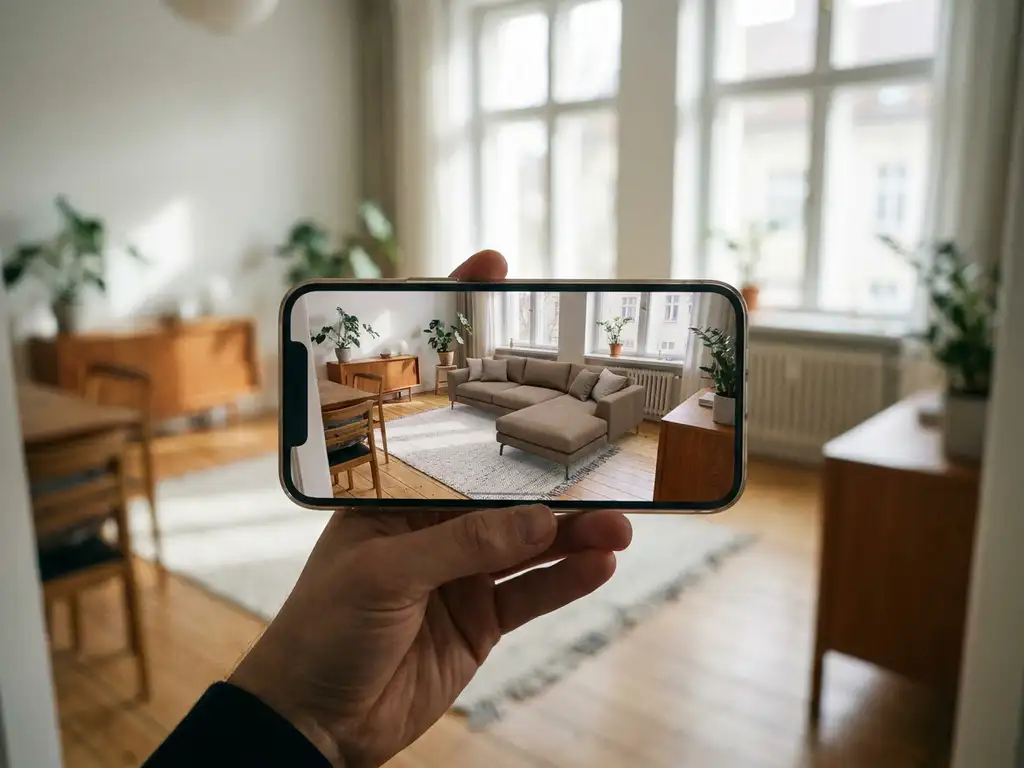
Yes, you can take a photo of a room and use it as the basis for a design in an app. Most modern room design apps let you either upload a photo or scan your space to place furniture, experiment with layouts, and visualize how different pieces look before you buy. The experience ranges from basic photo overlays to fully interactive 3D environments depending on the platform you use.
For shoppers, this technology removes a lot of the guesswork from furnishing a home. For retailers and furniture brands, it has become one of the most powerful tools available to drive confident purchasing decisions. Below, we unpack the most common questions about how these tools actually work and what to expect from them.
What can room design apps actually do with a photo?
A room design app can use your photo as a visual backdrop to place, resize, and rearrange virtual furniture within your actual space. More advanced platforms go further, letting you swap out flooring, change wall colors, add curtains or wallpaper, and configure individual furniture pieces in real time, all layered on top of your original room image.
The simplest apps work by detecting the floor plane and perspective in your photo, then anchoring 3D furniture models to those reference points. The result is a rough but useful preview of how a sofa or dining table might fit in your room.
More sophisticated room planning software takes this further by combining photo-based visualization with a full product configurator. That means you are not just placing a generic sofa in the image. You are placing the exact sofa you intend to buy, in the fabric, color, and size you have chosen, with the correct price attached. This level of detail is what separates a basic design app from a genuine sales tool.
How does augmented reality furniture placement work?
Augmented reality (AR) furniture placement works by using your device’s camera and motion sensors to map the physical dimensions of a room in real time. The app identifies flat surfaces like floors and walls, then anchors a 3D furniture model to those surfaces so it appears to occupy real space as you move your phone or tablet around.
The key steps in the process are:
- Surface detection: The app scans the room through the camera and identifies horizontal and vertical planes.
- Scale calibration: Using depth sensors or visual cues, the app estimates distances so furniture appears at the correct size relative to the room.
- Model rendering: A photorealistic 3D model of the product is placed on the detected surface and rendered in real time as you move the camera.
- Interaction: You can reposition, rotate, and, on some platforms, configure the product (changing color, fabric, or dimensions) while keeping it anchored in your space.
AR placement is particularly valuable for large furniture purchases where scale and proportion matter most. Seeing a corner sofa or a wardrobe in your actual room, at actual size, gives a level of confidence that no product photo can match.
What’s the difference between a room scanner and a room photo app?
A room scanner builds a precise 3D model of your space by measuring dimensions and mapping surfaces using your device’s sensors, while a room photo app simply uses a static image as a backdrop for placing furniture. Scanners produce more accurate spatial data; photo apps are faster and require no special hardware beyond a standard smartphone camera.
Room scanners are best suited for situations where accuracy matters, such as planning built-in furniture, checking whether a large piece will fit through a doorway, or creating a floor plan for an entire room renovation. The trade-off is that scanning takes more time and the results depend on lighting conditions and device capability.
Photo-based apps are more accessible and work well for a quick visual check or for exploring different styles. Many modern platforms combine both approaches, letting users start with a photo and then refine the layout using measured room data if they need more precision.
For furniture retail specifically, the photo-based approach tends to win on ease of use, which directly affects how many customers actually engage with the tool. A room design experience that takes 30 seconds to start will always outperform one that requires a five-minute scanning process.
Which types of products can be configured in a room design app?
Most room design apps support sofas, chairs, tables, beds, and storage furniture. More advanced 3D room planning tools extend this to include configurable products with complex options, such as modular sofas with interchangeable sections, custom wardrobes with adjustable interiors, dining tables in variable sizes, and upholstered pieces in dozens of fabric and color combinations.
The range of configurable products depends entirely on the underlying software. Basic apps work with fixed 3D models that look the same regardless of what you choose. Platforms built around a product configurator engine can handle products with:
- Multiple size and dimension variants
- Fabric, leather, or material selections across hundreds of options
- Modular components that can be combined in different arrangements
- Complex business rules that prevent incompatible combinations
- Real-time pricing that updates as the configuration changes
This level of configurability is what makes room design tools genuinely useful for furniture brands with large, customizable product ranges. A customer who can build their exact sofa and then place it in their living room is far more likely to complete a purchase than one who is looking at a generic placeholder image.
How do retailers and brands use room design tools to sell furniture?
Retailers and furniture brands use room design tools to reduce purchase hesitation, increase average order value, and minimize returns. By letting customers visualize products in their own space before buying, these tools address the single biggest barrier in furniture e-commerce: uncertainty about whether a piece will look right and fit properly.
In practice, brands integrate room planning tools into their websites and in-store displays in several ways. Online, the tool sits alongside the product detail page, letting shoppers drop an item into a room scene the moment their interest is piqued. In-store, sales staff use tablet-based room planners to help customers build out a full room layout during a showroom visit, which naturally leads to larger basket sizes.
Showing products in a realistic room environment has a measurable effect on buying intent. When customers can see a complete, styled room rather than a product on a white background, they are more likely to add complementary items to their order, from a coffee table to a rug to a set of cushions.
Brands also use room planning tools to maintain consistent visual presentation across their entire dealer and retail network. Instead of relying on each retailer to photograph and display products correctly, the brand provides a single digital tool that presents every product in the right context, in the right configuration, every time.
What should you look for in a room design and product configurator platform?
The most important factors in choosing a room design and product configurator platform are visual quality, configurability depth, integration capability, and scalability across your full product range. A platform that looks impressive but cannot handle your most complex products, or that cannot connect to your existing systems, will create more problems than it solves.
Key questions to ask when evaluating platforms include:
- Can it handle your most complex products, including all variants, business rules, and pricing logic?
- Does it integrate with your PIM, ERP, CMS, and webshop without heavy custom development?
- Is the 3D output photorealistic enough to replace or reduce traditional product photography?
- Can it be white-labeled and deployed consistently across your retail or dealer network?
- Does the vendor have proven references in the furniture and home furnishings industry?
- Is it web-based, requiring no app download from the end customer?
Industry experience matters more than it might seem. A platform built for general e-commerce will struggle with the specific complexity of furniture, where a single sofa model can have millions of valid combinations. Platforms developed specifically for the home furnishings sector understand these constraints and have built their architecture around them.
How iONE360 helps with room design and furniture configuration
We built iONE360 specifically to solve the challenges furniture brands and retailers face when trying to present complex, configurable products online and in-store. Our platform combines a powerful 3D room planning tool with a full product configurator, so customers are not just arranging furniture in a virtual room. They are configuring the exact product they want to buy, seeing the correct price, and ordering it directly from within the experience.
Here is what makes iONE360 the right choice for furniture and home furnishings brands:
- Two flexible room planning paths: A bespoke, white-labeled room planner built for your platform, or HomeDecoHub, our ready-to-use room planning marketplace.
- Full product configurability in the room planner: Configure sofas, wardrobes, dining sets, and more with all fabric, color, size, and component options available in real time.
- Seamless system integration: Connects with your PIM, ERP, CMS, and webshop so product data, pricing, and availability are always accurate.
- AR visualization included: Customers can place configured products in their own space using augmented reality, directly from the browser with no app download required.
- Automatic packshot generation: High-quality product images are generated automatically for every configuration, eliminating the need for costly traditional photoshoots at scale.
- Built on 45 years of furniture industry expertise: Developed by the Dutch Colijn Group, iONE360 understands the complexity of furniture product ranges and is built to handle it.
If you are ready to give your customers the confidence to buy and your sales team the tools to close more deals, we would love to show you what iONE360 can do. Get in touch with our team to start the conversation.
Frequently Asked Questions
How accurate is AR furniture placement when it comes to real-world sizing?
AR furniture placement is generally accurate enough for confident purchasing decisions, but precision depends on your device’s sensors and lighting conditions. Newer smartphones with LiDAR scanners (such as recent iPhone Pro models) deliver significantly better depth accuracy than older devices relying purely on visual cues. As a rule of thumb, always cross-check the app’s size reading against your room’s actual measurements with a tape measure before finalizing a large purchase.
Do customers need to download an app to use AR room planning tools?
Not necessarily — and this distinction matters a lot for conversion rates. Many modern room planning platforms, including iONE360, are fully web-based, meaning customers can launch the AR or room planning experience directly from a browser without installing anything. App-based tools add friction to the journey, and any extra step between interest and engagement risks losing the customer entirely.
What are the most common mistakes furniture brands make when implementing a room design tool?
The most frequent mistake is treating the room planner as a standalone feature rather than integrating it deeply with product data, pricing, and the checkout flow. A room design tool that shows generic or outdated product models, displays incorrect prices, or disconnects from the purchasing journey creates confusion rather than confidence. Brands also underestimate the importance of 3D asset quality — low-resolution or inaccurate models undermine trust in the entire experience.
How long does it take to get a room design tool up and running on a furniture brand's website?
Implementation timelines vary depending on the platform and the complexity of your product range, but a realistic expectation is anywhere from a few weeks to a few months. The main variables are how many products need to be converted into 3D models, how complex your configuration rules are, and how deeply the tool needs to integrate with your existing PIM, ERP, or e-commerce platform. Choosing a vendor with ready-made integrations and furniture-specific expertise significantly shortens this timeline.
Can room design tools handle products with a very large number of configuration options without slowing down?
Yes, but only if the platform was built to handle that level of complexity from the ground up. General-purpose configurators often struggle with furniture products that have hundreds of fabric choices, modular components, and pricing rules that interact with each other. Platforms purpose-built for the furniture industry architect their engines specifically around these constraints, ensuring real-time rendering and accurate pricing even when a single product has thousands of valid combinations.
How do room planning tools affect return rates for online furniture purchases?
Visualizing a product in your own space before buying directly addresses the two most common reasons for furniture returns: the piece looked different in person than expected, and it didn’t fit the space as anticipated. By giving customers an accurate sense of scale, color, and proportion before they commit, room planning tools have been shown to meaningfully reduce return rates — a significant operational and cost benefit for retailers beyond just the uplift in conversion.
Is a room design tool useful for in-store sales, or is it mainly an online feature?
Room design tools are highly effective in-store, often even more so than online. Sales associates equipped with a tablet-based room planner can walk a customer through building out an entire room during a showroom visit, visualizing how different pieces work together and configuring each product to the customer’s exact preferences. This consultative approach naturally increases basket size, as customers can see a complete, styled room rather than making isolated product decisions.