

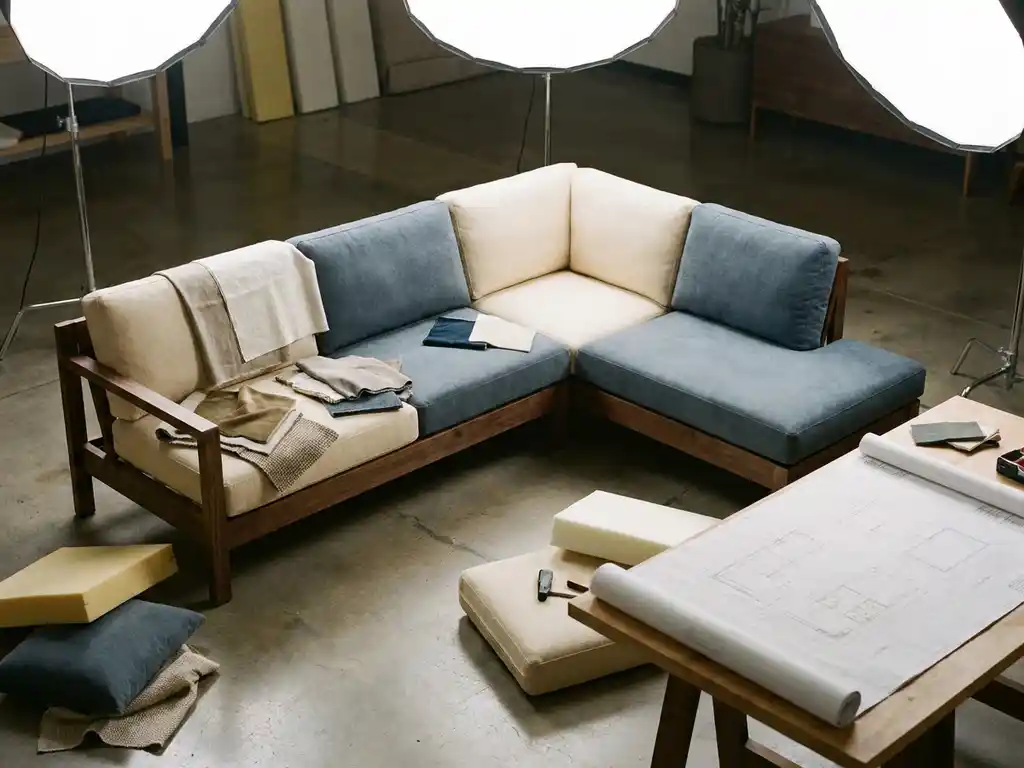
A product configurator and a product builder are not the same tool, even though the terms are sometimes used interchangeably. A product configurator is a system designed to manage complex customisation logic, business rules, and pricing across thousands or millions of product variants. A product builder is typically a simpler, front-end tool that lets users assemble or personalise a product with limited logic behind it. The distinction matters most when you sell configurable products at scale, such as furniture, kitchens, or upholstered seating. The questions below unpack exactly where the two tools diverge and which one fits your situation.
Which use cases does each tool actually solve?
A product configurator solves the challenge of selling complex, customisable products where every choice a customer makes affects availability, price, compatibility, and production. A product builder, by contrast, solves a simpler challenge: letting users personalise a product visually, usually by selecting colours, adding text, or swapping components, without enforcing deep logic or connecting to back-end systems.
Think of it this way. A product builder is well suited to a T-shirt shop where a customer picks a colour and adds a name. A product configurator is built for a sofa manufacturer where a customer selects a frame, a fabric from hundreds of options, a leg finish, a modular layout, and a delivery specification, and every combination must be validated, priced correctly, and passed to production.
The practical use cases break down like this:
- Product builder: Personalised gifts, print-on-demand products, simple apparel customisation, basic product variants
- Product configurator: Furniture and upholstery, kitchens and fitted interiors, modular shelving, configurable lighting, custom windows and doors, B2B industrial products
If your product has more than a handful of variants and those variants affect price or production, a product builder will quickly reach its limits.
How does a product configurator handle business rules and pricing?
A product configurator handles business rules and pricing through a rules engine that validates every combination a customer selects in real time. This means certain options can be locked, hidden, or required based on earlier choices, and the price updates automatically as each selection is made, reflecting the exact configuration rather than a generic starting price.
This is where the gap between a configurator and a product builder becomes most visible. A product builder typically applies a flat price or simple add-on pricing. A configurator can handle tiered pricing, volume discounts, material surcharges, dimensional pricing, and dealer-specific price lists, all simultaneously.
In practice, a furniture manufacturer might have a sofa available in 400 fabrics, each with a different price band, across five frame sizes, with optional extras that are only compatible with certain frames. A rules engine ensures a customer can never select an incompatible combination, and the quoted price is always accurate. This reduces order errors significantly and removes the need for a sales rep to manually check every quote.
What role does 3D visualisation play in a product configurator?
3D visualisation in a product configurator allows customers to see exactly what they are buying as they configure it, in real time. Every change in fabric, colour, size, or component is reflected immediately in a photorealistic 3D rendering, removing the uncertainty that typically leads to hesitation, abandoned baskets, or returns after delivery.
For furniture and home decoration brands, this is particularly valuable because customers are making high-consideration purchases. They need to see how a sofa looks in a specific fabric before committing to a four-figure order. Static photography cannot scale across thousands of variant combinations, but a 3D product configurator generates those visuals automatically from a single 3D model.
Beyond the customer-facing experience, 3D visualisation also enables the automatic generation of packshot images for use in webshops, catalogues, and retail partner materials. This eliminates the need for repeated photoshoots every time a new fabric or finish is introduced, which is a significant cost saving for manufacturers with large and frequently updated product ranges.
A product builder may include basic visual feedback, such as a colour swatch swap on a flat image, but it does not typically offer the depth of real-time 3D rendering, augmented reality previews, or room planning that a purpose-built configurator provides.
Can a product builder integrate with ERP, PIM, or e-commerce systems?
Most product builders offer limited integration capabilities, typically covering basic webshop connectivity and little else. A product configurator, especially one built for enterprise use, is designed to integrate deeply with ERP, PIM, CMS, and e-commerce platforms, ensuring that configuration data, pricing, stock rules, and order details flow automatically between systems.
This integration layer is what transforms a configurator from a visual tool into a genuine sales and operations asset. When a customer completes a configuration, the output can be passed directly to an ERP system as a structured order, to a PIM as a new product variant record, or to a webshop as a confirmed basket item with all specifications attached.
For furniture brands operating across multiple retail partners and channels, this connectivity is essential. Without it, every configured order requires manual re-entry somewhere in the process, which introduces errors and slows fulfilment. A well-integrated online product configurator removes that friction entirely.
When should a furniture brand choose a configurator over a product builder?
A furniture brand should choose a product configurator over a product builder when its products involve complex customisation, when pricing varies by configuration, or when the brand needs to present its full range consistently across multiple sales channels. If any of those conditions apply, a product builder will not have the depth to support the business.
Specifically, choose a configurator when:
- Your products have more than a few dozen variants that affect price or production
- You sell through dealers or retail partners who need consistent, brand-accurate product presentation
- Your sales team currently spends significant time manually checking or correcting customer quotes
- You want to reduce dependency on physical samples and expensive photoshoots
- You need configuration data to flow directly into your ERP or order management system
- You want to offer augmented reality or room planning as part of the buying experience
A product builder remains a reasonable choice for brands with simple personalisation needs and no requirement for back-end system integration. But for most furniture and home furnishing manufacturers, the complexity of the product range and the expectations of modern buyers make a full product configurator the more practical long-term investment.
How iONE360 helps with product configuration for furniture brands
We built iONE360 specifically for manufacturers and retailers in the furniture, home, and decoration sectors who need to present complex, configurable products beautifully and sell them efficiently. Our platform handles exactly the challenges described throughout this article, and it does so within a single, web-based solution that requires no downloads and integrates with your existing systems.
Here is what iONE360 delivers in practice:
- Real-time 3D visualisation that updates instantly with every configuration choice, across all fabric, colour, and size variants
- A rules engine that enforces compatibility and pricing logic across millions of possible combinations
- Automatic packshot generation that eliminates the need for photoshoots when new variants are introduced
- Augmented reality and room planning tools that give customers confidence before they buy
- Deep integration with ERP, PIM, CMS, and e-commerce platforms, so configured orders flow directly into your operations
- A guided, step-by-step sales process that works equally well on your webshop, in-store, and across your dealer network
The result is higher conversion rates, larger order values, fewer returns, and a consistent brand experience across every channel. If you are evaluating whether a furniture configurator is the right fit for your product range, we would be glad to show you what is possible. Get in touch with our team to request a demo.