

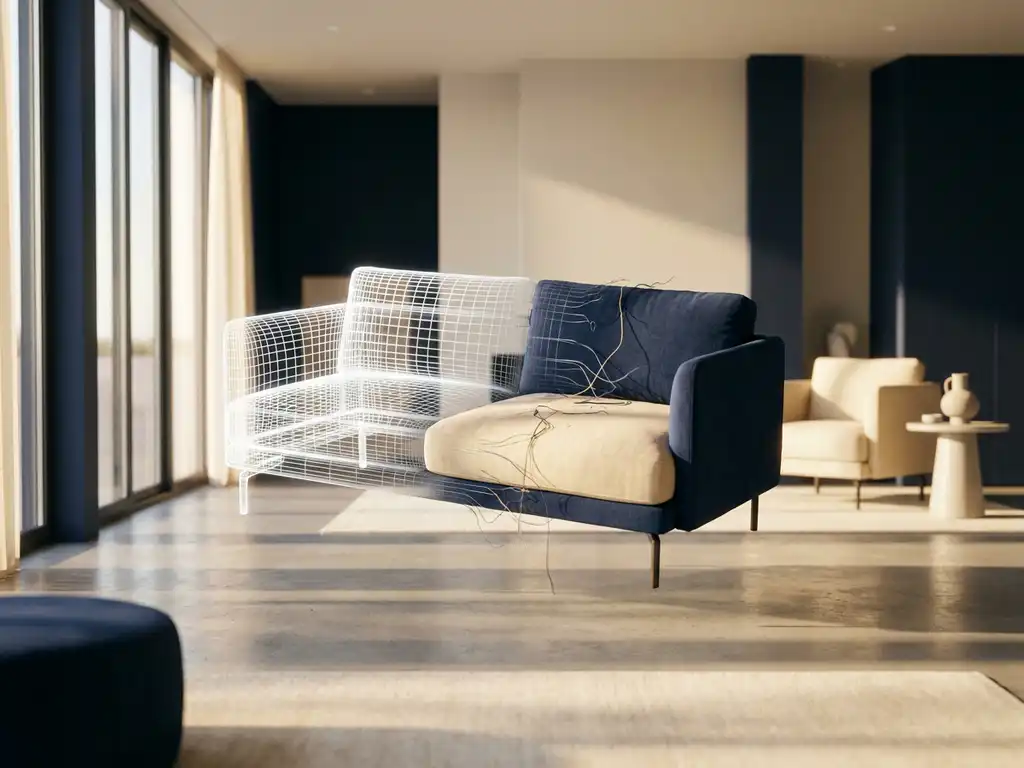
A furniture visualizer is a digital tool that allows customers to see and interact with furniture products in realistic 3D environments before making a purchase. These sophisticated platforms use advanced rendering technology to create photorealistic images and interactive experiences, enabling customers to visualize how furniture will look in their actual spaces through web browsers or mobile apps.
What is a furniture visualizer and how does it work?
A furniture visualizer is a 3D software platform that creates interactive, photorealistic representations of furniture products. It works by converting product data and specifications into detailed 3D models that customers can rotate, customize, and place in virtual room environments through their web browser or mobile device.
The technology operates through several integrated components. First, 3D modeling software creates detailed digital representations of furniture pieces, capturing textures, materials, and proportions with precision. These models are then rendered using advanced graphics engines that simulate realistic lighting, shadows, and material properties. The visualization engine processes customer inputs in real time, instantly updating colors, fabrics, sizes, and configurations as users make selections.
Modern furniture visualizers also incorporate room planning software that allows customers to design complete spaces. Users can upload photos of their rooms or choose from preset environments, then drag and drop furniture pieces to create layouts. The software calculates spatial relationships, ensuring furniture fits properly and looks natural within the chosen environment.
What’s the difference between 2D and 3D furniture visualization?
2D furniture visualization displays static, flat images from fixed viewpoints, while 3D visualization creates interactive, dimensional models that customers can rotate, zoom, and view from any angle. 3D technology provides spatial depth, realistic lighting effects, and the ability to see how products look in actual room environments.
Traditional 2D visualization relies on professional photography or digital renderings that show furniture from predetermined angles. While these images can be high quality, they’re limited in scope and require separate photos for each color, fabric, or configuration option. Customers must use their imagination to understand how pieces will look from different perspectives or in their specific spaces.
3D visualization transforms this experience by creating fully dimensional models. Customers can orbit around furniture pieces, examine details from above or below, and see how different materials catch light. The technology also enables real-time customization where color and fabric changes appear instantly without loading new images. This interactive approach reduces uncertainty and builds confidence in purchasing decisions.
How does furniture AR visualization enhance the shopping experience?
Furniture AR visualization allows customers to place virtual furniture directly into their real spaces using smartphone cameras, providing accurate scale representation and spatial context. This technology eliminates guesswork about size and fit while enabling customers to see exactly how products will look in their actual rooms before purchasing.
AR technology works by using device cameras to capture the customer’s real environment, then overlaying 3D furniture models onto the live camera feed. Advanced AR systems use spatial recognition to detect floors, walls, and existing furniture, ensuring virtual pieces are properly anchored and scaled within the space. Customers can walk around virtual furniture, view it from different angles, and even move pieces to try various arrangements.
The shopping experience becomes more engaging and confident when customers can visualize products in context. AR eliminates common concerns about whether a sofa will fit through doorways, if a dining table is the right size for the room, or how a new piece will coordinate with existing decor. This increased confidence typically leads to higher conversion rates and fewer returns, as customers make more informed purchasing decisions.
What types of furniture can be visualized with 3D technology?
3D technology can visualize virtually any type of furniture, from simple single-piece items like chairs and tables to complex modular systems like kitchen cabinets and built-in storage solutions. The technology handles both standard catalog items and highly customizable products with multiple configuration options, materials, and finishes.
Living room furniture translates particularly well to 3D visualization. Sofas, sectionals, coffee tables, and entertainment centers benefit from the ability to show different fabric options, configurations, and arrangements. Customers can see how modular seating connects, compare leather versus fabric options, and understand scale relationships between pieces.
Bedroom and dining furniture also work excellently in 3D environments. Bed frames with different headboard styles, dining sets with various chair options, and storage solutions with multiple drawer configurations become easy to explore and customize. Office furniture, outdoor pieces, and even complex items like adjustable desks or reclining mechanisms can be accurately represented and demonstrated through interactive 3D models.
Why do furniture businesses need visualization technology?
Furniture businesses need visualization technology to overcome the inherent challenges of selling large, expensive products that customers cannot easily return or exchange. This technology reduces purchase hesitation, decreases return rates, increases average order values, and provides competitive advantages in an increasingly digital marketplace.
The furniture industry faces unique selling challenges compared to other retail categories. Products are typically high-value purchases that customers expect to keep for years. Size, style, and color matching with existing decor are critical factors that traditional product photos cannot adequately address. Visualization technology bridges this gap by providing the detailed, contextual information customers need to make confident decisions.
Operational benefits extend beyond customer experience. Businesses can reduce photography costs by generating unlimited product images from 3D models. Sales teams can demonstrate products more effectively, and customer service inquiries about product details decrease when customers can explore items thoroughly online. The technology also enables businesses to showcase their full catalog without physical inventory limitations, expanding sales opportunities without increasing overhead costs.
How iONE360 helps with furniture visualization
We provide comprehensive visual commerce solutions specifically designed for the furniture industry, combining advanced 3D product configuration, photorealistic rendering, and integrated room planning capabilities. Our platform handles complex customizable products with millions of possible variations while maintaining seamless integration with existing business systems.
- Advanced 3D furniture configurator with real-time customization and pricing
- Automated high-quality product image generation eliminating photography costs
- Integrated AR experiences that work directly in web browsers without app downloads
- Comprehensive room planning tools for complete space design
- Seamless integration with PIM, ERP, and e-commerce platforms
- White-label solutions that maintain your brand identity across all touchpoints
Built on over 45 years of furniture industry expertise, our platform transforms how customers interact with your products while streamlining your content creation and sales processes. Ready to see how visualization technology can transform your furniture business? Explore our showcases to see the technology in action, or contact us for a personalized demonstration tailored to your specific needs.
Frequently Asked Questions
How long does it typically take to implement a furniture visualization platform?
Implementation timelines vary based on catalog size and complexity, but most furniture businesses can launch their visualization platform within 4-8 weeks. This includes 3D model creation, system integration, and staff training. Businesses with extensive catalogs or complex customization options may require 10-12 weeks for full deployment.
What's the typical ROI for investing in furniture visualization technology?
Most furniture retailers see a 15-25% increase in conversion rates and a 30-40% reduction in returns within the first six months of implementation. The technology typically pays for itself within 8-12 months through increased sales and reduced photography costs, with ongoing benefits including lower customer service costs and expanded showcase capacity.
Can customers use AR visualization on any device, or do they need specific hardware?
Modern AR visualization works on most smartphones and tablets without requiring special apps or hardware. Web-based AR technology uses device cameras and works directly through browsers on iOS and Android devices manufactured within the last 3-4 years. No additional downloads or specialized equipment are needed for customers.
How accurate are the size and scale representations in AR furniture visualization?
High-quality AR systems provide accuracy within 1-2% of actual product dimensions when properly calibrated. The technology uses device sensors and spatial recognition to ensure furniture appears at correct scale relative to the customer’s room. However, accuracy depends on good lighting conditions and following proper setup instructions.
What happens to existing product photography investments when implementing 3D visualization?
Existing photography doesn’t become obsolete but rather complements 3D visualization in a multi-channel approach. Many businesses continue using traditional photos for marketing materials while leveraging 3D models for interactive experiences. Over time, 3D-generated images can reduce ongoing photography costs for new products and variations.
How do you handle complex furniture with moving parts or mechanisms in 3D visualization?
Advanced 3D platforms can demonstrate moving parts like reclining chairs, extendable tables, or modular components through animated sequences and interactive controls. Customers can trigger animations to see how mechanisms work, view products in different positions, and understand functionality before purchasing.
What level of technical expertise does my team need to manage a furniture visualization platform?
Most modern visualization platforms are designed for non-technical users and require minimal training. Basic content management tasks like updating prices, adding new fabric options, or creating room scenes can typically be handled by existing marketing or e-commerce staff after a brief training period. Technical support is usually provided by the platform vendor.