

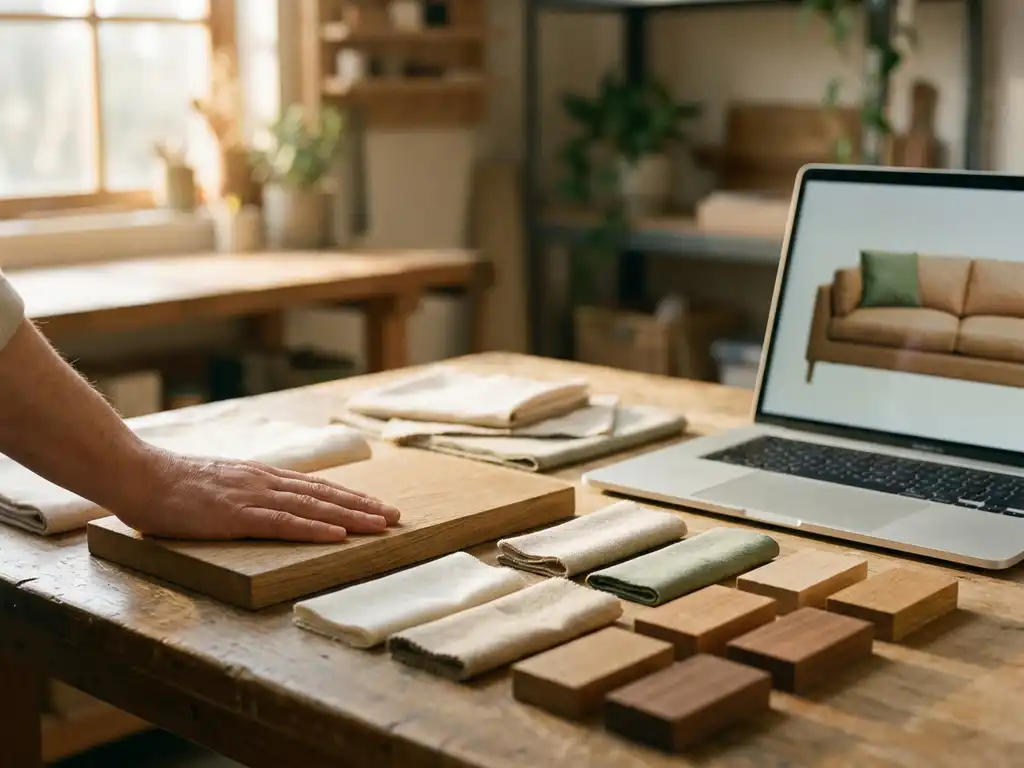
A product configurator supports sustainable product choices by helping customers make more informed, confident decisions before they buy. When shoppers can visualise exactly what they are ordering, in the right colour, material, and size, they are far less likely to order the wrong product, return it, or discard it. This reduces waste at every stage of the product lifecycle. The sections below explore the specific ways configurators drive more sustainable outcomes, from reducing returns to replacing physical samples.
How does a product configurator reduce product returns?
A product configurator reduces returns by eliminating the most common cause: the gap between what a customer expected and what actually arrived. When buyers can see a photorealistic 3D representation of their exact configuration, including fabric, finish, dimensions, and colour, there is far less room for disappointment. Fewer surprises at delivery means fewer return requests.
Returns are one of the most environmentally costly parts of retail. Each return involves repackaging, reverse logistics, and often a product that cannot be resold as new. In the furniture and home furnishings sector, where items are bulky and fragile, the environmental and financial cost of a single return is significant.
A 3D product configurator addresses this at the source. Rather than relying on flat product photography that may not represent all variants accurately, customers interact with the actual product they are about to order. They can change the upholstery, adjust the leg finish, and view the result from multiple angles before confirming. The decision is made with full visual information, which builds confidence and reduces regret-driven returns.
Industry experience consistently shows that businesses implementing visual configurators see measurable reductions in return rates. The mechanism is straightforward: better information leads to better decisions, and better decisions lead to fewer returns.
What role does 3D visualisation play in sustainable buying decisions?
3D visualisation plays a central role in sustainable buying decisions by giving customers the clarity they need to choose correctly the first time. When a shopper can see a product rendered realistically in the right configuration, placed in a room context that mirrors their own space, they make more deliberate and considered choices rather than impulse purchases they later regret.
Sustainable shopping is not only about the materials a product is made from. It is also about whether the product gets used, kept, and valued over time. A purchase made with full visual confidence is more likely to be a purchase that lasts.
3D visualisation also reduces the need for physical marketing materials. Traditional product photography requires a studio shoot for every variant combination. A single sofa with ten fabric options and four leg finishes could require dozens of separate photoshoots. With 3D rendering, all those variants are generated digitally, eliminating the travel, energy, and waste associated with physical production.
Augmented reality (AR) takes this a step further by allowing customers to place a product virtually in their own home before buying. Seeing a piece of furniture at actual scale in an actual room removes the guesswork around fit and proportion, two of the most common reasons shoppers return furniture.
How does configure-to-order manufacturing reduce overproduction?
Configure-to-order manufacturing reduces overproduction by ensuring that products are only made once a specific customer order has been confirmed. Rather than producing large volumes of standard configurations in advance and hoping they sell, manufacturers build exactly what each customer has specified. This eliminates the inventory risk that leads to unsold stock, markdowns, and ultimately waste.
Overproduction is one of the most significant sources of waste in the furniture and home goods industry. When manufacturers guess which colours, fabrics, and sizes will sell, they inevitably get some of those guesses wrong. Products that do not sell are discounted, stored, or disposed of, each outcome carrying an environmental and financial cost.
A product configurator enables a true configure-to-order model by making the full range of options available to customers digitally. Instead of limiting the catalogue to what can be held in stock, manufacturers can offer thousands of combinations and only produce what is ordered. This shift in model is both commercially and environmentally beneficial.
For retailers and brands operating across multiple channels, this model also reduces the pressure to maintain large physical showrooms stocked with every variant. A digital configurator replaces the physical inventory on display with an interactive experience that covers the full catalogue without requiring a single additional square metre of floor space.
Can a product configurator replace physical product samples?
A product configurator can substantially reduce the need for physical product samples, though it rarely eliminates them entirely. For many configurable products, particularly in the furniture and upholstery sector, customers still value touching a fabric or seeing a finish in person. However, the number of physical samples required drops significantly when customers can first narrow down their choices using a visual configurator.
Physical sample libraries are expensive to produce, distribute, and maintain. Fabric swatches, finish chips, and material boards are sent to retailers, updated with each new collection, and eventually disposed of when ranges change. The environmental cost of producing and shipping samples at scale across a dealer network is considerable.
When customers use a 3D configurator to explore options visually, they arrive at the sample stage with a much shorter shortlist. Instead of requesting twelve fabric swatches, they might request two. This reduction in sample volume lowers production costs, reduces logistics, and cuts the waste generated when outdated samples are retired.
For some product categories, particularly those where colour accuracy in digital rendering is very high, customers are increasingly comfortable making final decisions without a physical sample at all. As rendering technology continues to improve, the gap between a digital preview and physical reality narrows further.
Which industries benefit most from configurators for sustainability?
The industries that benefit most from configurators for sustainability are those selling complex, customisable products where variant combinations are large, returns are costly, and overproduction is a real operational risk. Furniture and home furnishings sit at the top of this list, but the benefits extend to any sector where customers configure products before purchase.
In the furniture industry, the combination of high customisation, bulky logistics, and expensive materials makes sustainable product choices particularly high-stakes. A sofa returned because the fabric was not what the customer expected represents a significant waste of materials, labour, and transport. A configurator directly addresses this.
Other sectors where configurators deliver sustainability benefits include:
- Kitchen and bathroom manufacturing, where modular designs involve hundreds of component combinations and errors in ordering are costly to reverse
- Lighting and home accessories, where colour and finish options are numerous and photoshoots for every variant are impractical
- Outdoor and garden furniture, where seasonal production cycles make overproduction especially wasteful
- Flooring and wall coverings, where customers struggle to visualise how a product will look in their specific space without a room planning tool
What these sectors share is a mismatch between the complexity of the product range and the limitations of traditional sales tools. A configurator closes that gap by making the full range accessible, visualisable, and orderable without requiring physical stock of every option.
How iONE360 helps with sustainable product choices
We built iONE360 specifically to address the challenges that furniture and home furnishings businesses face when selling configurable products at scale. Our platform combines a visual product configurator with 3D rendering, augmented reality, and an integrated room planner, giving customers everything they need to make confident, informed choices before they order.
Here is what that means in practice for sustainability:
- Fewer returns because customers see exactly what they are ordering, in their chosen configuration, before confirming
- Reduced overproduction by enabling a configure-to-order model across your full product catalogue
- Lower sample costs and waste by replacing physical sample libraries with high-quality digital representations of every variant
- Less dependency on physical photoshoots through automatically generated packshot images for every configuration
- Scalable across your entire dealer and retail network without requiring additional physical investment per location
iONE360 integrates with your existing PIM, ERP, and webshop systems, so the transition to a digital-first, configure-to-order approach fits within your current infrastructure. If you are ready to reduce waste, lower return rates, and give your customers a better buying experience, get in touch with our team to see what iONE360 can do for your product range.