

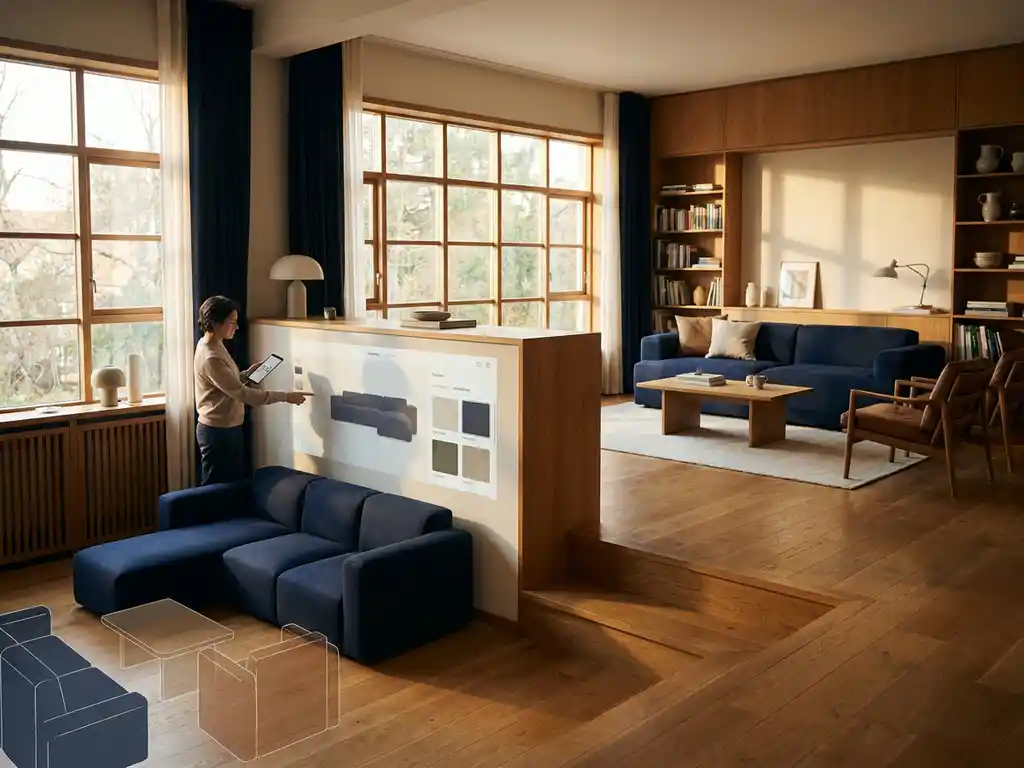
Room planners and product configurators serve different purposes in the furniture industry. A room planner helps customers visualize complete spaces and arrange multiple furniture pieces together, while a product configurator allows detailed customization of individual items like fabric, color, and size options. Both tools enhance the buying experience but focus on different aspects of furniture selection.
What is a room planner and how does it work?
A room planner is a digital tool that allows customers to create floor plans, arrange furniture layouts, and visualize complete living spaces in 2D or 3D. Users can drag and drop furniture pieces, adjust room dimensions, change wall colors, and see how different items work together in their intended space.
Modern room planning software creates realistic 3D environments where customers can walk through virtual rooms, rotate the camera for different viewing angles, and experiment with various furniture combinations. Advanced platforms also include features for adding wallpaper, flooring, lighting, and decorative elements to create comprehensive room designs.
The software works by providing pre-loaded furniture catalogs, measurement tools, and rendering engines that create photorealistic visualizations. Customers start with room templates or create custom floor plans, then populate the space with products from the available catalog. The tool calculates spatial relationships, ensures proper scaling, and shows how natural light affects the overall design.
What is a product configurator and what does it do?
A product configurator is a software tool that enables customers to customize individual furniture pieces by selecting specific options like materials, colors, dimensions, and features. It shows real-time visual updates and pricing as customers make selections, ensuring they see exactly what their customized product will look like.
Product configurators handle complex business rules and pricing calculations behind the scenes. When a customer selects a leather sofa in burgundy with chrome legs, the system automatically updates the 3D visualization, adjusts the price based on material costs, and checks availability for that specific combination. This process works even when products have millions of possible variations.
The configurator integrates with inventory management systems, manufacturing workflows, and e-commerce platforms. Once customers finalize their selections, the system generates detailed specifications for production, creates high-quality product images for marketing, and processes the order with exact customization details. This automation reduces errors and speeds up the entire sales-to-delivery process.
What’s the main difference between room planners and product configurators?
The main difference lies in scope and purpose. Room planners focus on spatial design and multiple product arrangements within complete environments, while product configurators concentrate on detailed customization of individual items. Room planners answer “how will this look in my space?” while configurators answer “how can I personalize this product?”
Room planners excel at showing relationships between multiple furniture pieces, helping customers understand scale, proportion, and style coordination across entire rooms. They’re ideal for customers furnishing complete spaces or planning major room updates. The emphasis is on layout, flow, and overall aesthetic harmony.
Product configurators dive deep into single items, offering extensive customization options that can result in thousands or millions of product variations. They handle complex pricing rules, material combinations, and manufacturing constraints. Configurators are essential for brands offering made-to-order or highly customizable furniture where every customer’s needs are unique.
Which tool is better for furniture retailers and manufacturers?
Neither tool is inherently better, as they serve different business needs and stages of the customer journey. Room planners excel at inspiring customers and showcasing multiple products together, while configurators maximize revenue from individual product sales through detailed customization options.
Room planners work best for retailers with extensive furniture collections who want to increase average order values by encouraging customers to purchase complete room sets. They’re particularly valuable for showroom displays, online inspiration galleries, and customers who need help visualizing how pieces work together. Room planners also reduce returns by helping customers make more informed spatial decisions.
Product configurators are essential for manufacturers offering customizable furniture or retailers selling made-to-order products. They’re ideal when products have multiple material options, size variations, or complex feature combinations. Configurators increase profit margins by enabling premium customizations and reduce manufacturing errors by capturing exact customer specifications.
Can room planners and product configurators work together?
Yes, room planners and product configurators can integrate seamlessly to create comprehensive visual commerce experiences. This integration allows customers to plan entire rooms while customizing individual products within those spaces, combining the benefits of both tools in a single workflow.
Integrated platforms let customers start with room planning to establish layout and style direction, then dive into detailed product configuration for specific pieces. For example, a customer might arrange a living room layout, then customize the sofa’s fabric and the coffee table’s finish while seeing how these choices affect the overall room design. The system maintains visual consistency and updates pricing across all configured items.
This combined approach addresses the complete customer journey from inspiration to purchase. Customers get the spatial confidence that comes from room planning plus the personalization satisfaction from product configuration. For businesses, integration means higher conversion rates, larger order values, and fewer returns because customers make fully informed decisions about both space and products.
How does iONE360 help with room planning and product configuration?
We offer an integrated visual commerce platform that combines advanced room planning with sophisticated product configuration capabilities. Our solution addresses both spatial design needs and detailed product customization within a single, powerful system.
Key benefits of our integrated approach:
- Seamless workflow from room planning to product configuration
- Real-time 3D visualization with photorealistic rendering
- Automatic pricing updates across configured products
- Integration with existing business systems and e-commerce platforms
- White-label customization options for brand consistency
Our platform handles complex business rules and millions of product variations while maintaining fast performance and intuitive user experiences. Built on 45 years of furniture industry expertise, we understand the unique challenges manufacturers and retailers face in showcasing configurable products.
Ready to transform your furniture visualization experience? Explore our showcases to see the platform in action, or contact us to discuss how our integrated room planning and configuration tools can boost your sales and reduce returns.
Frequently Asked Questions
How long does it typically take to implement room planning and product configuration tools?
Implementation timelines vary based on catalog size and customization requirements, but most businesses can launch basic functionality within 4-8 weeks. Complex integrations with existing systems or extensive product catalogs may take 3-4 months. The key is starting with core products and expanding gradually rather than trying to configure everything at once.
What happens if customers create room designs with products that are out of stock?
Modern integrated platforms connect with real-time inventory systems to show availability status and suggest alternatives. When configured products become unavailable, the system can automatically recommend similar items with comparable features, or notify customers about expected restock dates while preserving their design preferences.
Do these visualization tools work on mobile devices and tablets?
Yes, leading platforms are built with responsive design to work across all devices. While complex room planning may be easier on larger screens, mobile users can still browse configured products, make basic customizations, and view 3D visualizations. Many customers start designs on mobile and complete purchases on desktop.
How do you handle pricing when products have thousands of possible configurations?
Advanced configurators use rule-based pricing engines that automatically calculate costs based on material selections, size modifications, and feature combinations. The system applies business rules for volume discounts, premium materials, and manufacturing complexity to show accurate pricing in real-time as customers make selections.
Can customers save and share their room designs and product configurations?
Most platforms include save and share functionality that lets customers create accounts to store multiple room designs and product configurations. They can share designs via email or social media, and sales teams can access saved configurations to provide personalized follow-up and support throughout the buying process.
What's the biggest mistake businesses make when implementing these tools?
The most common mistake is trying to configure every product variation from day one instead of starting with bestsellers and gradually expanding. This leads to delayed launches and overwhelming complexity. Start with 20-30 core products, ensure they work perfectly, then systematically add more configurations based on customer demand and usage data.
How do these tools integrate with existing e-commerce platforms and ERP systems?
Quality platforms offer APIs and pre-built connectors for major e-commerce systems like Shopify, Magento, and custom solutions. They can sync product data, pricing, and inventory while sending configured product specifications directly to manufacturing and fulfillment systems. This integration eliminates manual data entry and reduces order errors.
Related Articles
- How are home décor companies successfully using 3D product configurators?
- What data does a product configurator collect from users?
- What's the difference between 2D and 3D room planning software?
- Can small furniture businesses afford 3D configurators?
- Can a 3D product configurator integrate with ERP systems?