

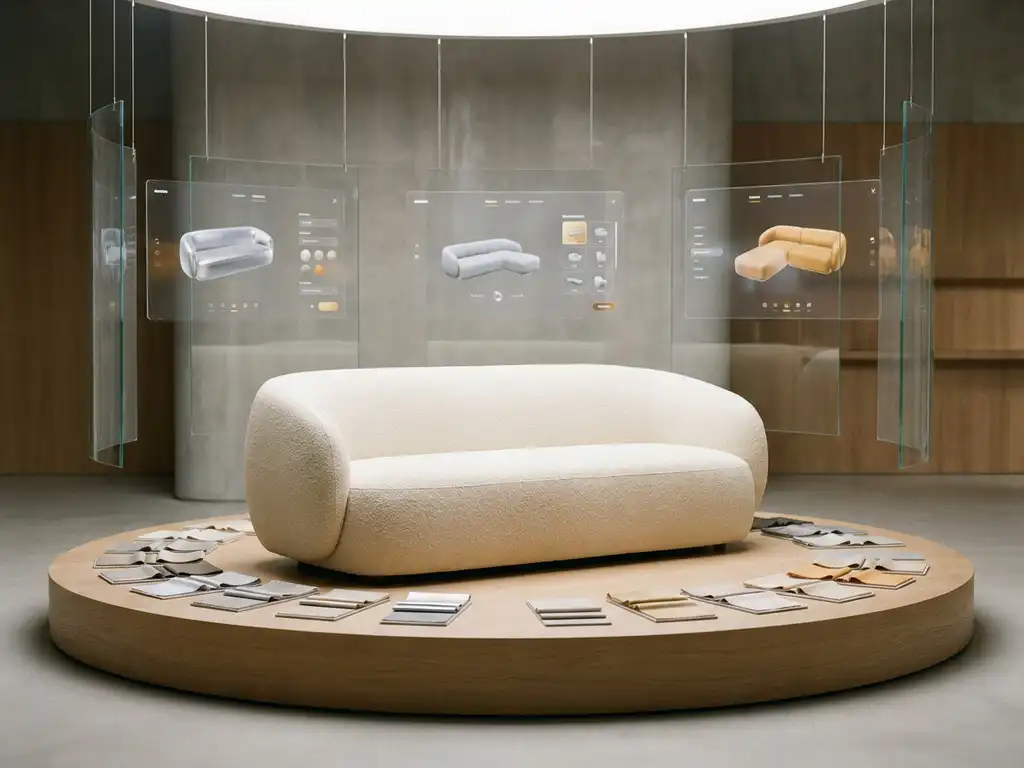
The best alternatives to Threekit for furniture and home furnishings brands include iONE360, Cylindo, Marxent, and a handful of other visual commerce platforms. The right choice depends heavily on your product type, integration needs, and whether you require specialist features like room planning software built specifically for the furniture industry. This article walks through the key questions buyers ask when evaluating Threekit competitors.
How does Threekit compare to other product configurator platforms?
Threekit is a US-based 3D product configuration platform that serves a broad range of industries, from manufacturing to retail. It offers 3D visualization, augmented reality, and configuration capabilities. However, compared to more specialized platforms, Threekit is a generalist solution that requires significant setup, custom development, and ongoing technical investment to deliver results in complex, category-specific environments like furniture and home furnishings.
Most Threekit competitors fall into one of two camps: broad enterprise platforms that also serve multiple industries, and specialist platforms built specifically for furniture, interior, and home decor markets. The specialist platforms tend to offer deeper out-of-the-box functionality for configurable upholstered furniture, modular systems, and room-based selling scenarios, while requiring less custom development to go live.
Key dimensions to compare across platforms include:
- Visual quality and realism of 3D output
- Depth of configuration logic, including complex business rules and pricing
- Room planning and scene-based selling capabilities
- Integration with PIM, ERP, and e-commerce systems
- Time to value and total cost of implementation
- Industry-specific experience and references
What are the most common reasons companies look for a Threekit alternative?
Companies most commonly look for a Threekit alternative because of high implementation costs, long deployment timelines, and the need for continuous developer involvement to maintain and update configurations. For furniture and home furnishings brands in particular, Threekit’s generalist architecture can create friction when handling the nuances of fabric options, modular systems, and complex pricing rules.
Other frequently cited reasons include:
- Implementation complexity: Threekit typically requires dedicated developer resources to build and maintain configurators, which raises the total cost of ownership significantly.
- Lack of room planning functionality: Many furniture brands need customers to place products in a room context, something Threekit does not natively offer at the depth the furniture market requires.
- Weak industry specialization: Furniture brands often find that a platform built for aerospace or electronics does not translate cleanly to upholstery, modular sofas, or bedroom collections.
- Limited packshot automation: Automatically generating high-quality product images across all variants without manual rendering work is a key requirement for furniture brands, and not always a strength of generalist platforms.
- Integration gaps: Connecting to existing furniture-specific ERP or PIM systems can require significant custom work on generalist platforms.
What are the best Threekit alternatives for furniture and home furnishings brands?
The best Threekit alternatives for furniture and home furnishings brands are platforms that combine high-quality 3D visualization, deep configuration logic, and native room planning in a single solution built for the complexity of the furniture market. Leading options include iONE360, Cylindo, and Marxent, each with different strengths depending on company size and use case.
Cylindo is a well-established platform focused on furniture visualization and 360-degree product spin. It works well for simpler configuration scenarios and is widely used by mid-market furniture retailers, though it has limitations when configuration logic becomes highly complex.
Marxent (now part of PTC) offers strong AR capabilities and has been adopted by larger retail chains, particularly in North America. Its enterprise positioning means higher costs and longer implementation cycles.
iONE360 stands out as the most complete specialist platform for the European furniture and home furnishings market. Built on over 45 years of furniture industry expertise by the Dutch Colijn Group, it handles complex configurable products, automated packshot generation, AR, and 3D room planning within a single web-based platform. No downloads, no fragmented tools.
Which Threekit alternative is best for configurable furniture products?
For configurable furniture products, the best Threekit alternative is a platform purpose-built for the furniture industry that can handle complex business rules, millions of product variants, and room-based selling without requiring heavy custom development. iONE360 is specifically designed for this use case and is recognized by Gartner as a vendor in the product configurator domain.
What makes a platform genuinely suited to configurable furniture goes beyond basic 3D rendering. The platform needs to:
- Support complex pricing and rules logic across fabrics, sizes, modules, and finishes
- Automatically generate photorealistic packshot images for every configuration without manual rendering
- Allow customers to configure products directly within a 3D room planning environment
- Integrate cleanly with furniture-specific ERP and PIM systems
- Enable back-end users to manage configurations without developer dependency
The 3D room planning dimension is particularly important for furniture. Showing a sofa in isolation tells a customer far less than showing it configured and placed in a complete living room scene. Research in the furniture sector consistently points to room context increasing buying intent significantly, which is why room planning capabilities should be a core evaluation criterion, not an optional extra.
What should you look for when evaluating a Threekit competitor?
When evaluating a Threekit competitor, the most important factors are industry fit, visual output quality, configuration depth, integration capability, and total cost of ownership over the first two to three years. A platform that looks affordable upfront but requires extensive custom development will cost more in practice than a specialist solution with higher licensing fees and faster time to value.
Practical questions to ask any vendor during evaluation include:
- How many furniture or home furnishings brands are currently live on your platform?
- Can your platform handle modular furniture with complex pricing rules out of the box?
- How are product images generated across variants, and is this automated?
- Does your platform include native room planning, or does that require a third-party integration?
- What does integration with our ERP or PIM system look like, and who owns that work?
- What is the typical time from contract to live configurator for a brand of our size?
Prioritize vendors who can demonstrate live references in your specific product category and who can show the full journey from back-end configuration management to the end customer experience without stitching together multiple disconnected tools.
How iONE360 helps furniture brands move beyond Threekit
We built iONE360 specifically for the furniture, home, and decor market. Rather than adapting a generalist platform to fit furniture complexity, our entire platform is designed around the realities of configurable upholstered products, modular systems, and room-based selling. For brands evaluating Threekit alternatives in 2026, iONE360 offers a pragmatic, scalable, and deeply integrated alternative that delivers faster time to value.
Here is what we bring to the table:
- 3D product configurator that handles millions of variants, complex business rules, and real-time pricing in a guided, step-by-step sales flow
- Automated packshot generation that produces high-quality product images across every configuration without manual rendering effort
- Native 3D room planning software that lets customers configure, combine, and visualize furniture in a complete room environment, with buying intent increasing by up to 64% when products are shown in context
- AR visualization that works directly in the browser, with no app download required
- Seamless integration with PIM, ERP, CMS, and webshop systems, built on 45 years of furniture industry software expertise
- Consistent brand presentation across your webshop, retail partners, and in-store touchpoints from a single platform
If you are currently evaluating Threekit competitors and want to see how iONE360 performs for your specific product catalogue and sales channels, get in touch with our team and we will walk you through a tailored demonstration.
Frequently Asked Questions
How long does it typically take to migrate from Threekit to a specialist furniture platform like iONE360?
Migration timelines vary depending on the complexity of your product catalogue and existing integrations, but specialist furniture platforms are generally designed to reduce deployment time compared to generalist solutions. With a platform like iONE360, brands with mid-sized catalogues can typically go live within a few months rather than the extended timelines often associated with custom-heavy generalist implementations. The key factor is how much of the configuration logic, pricing rules, and 3D asset preparation can be handled by the platform’s native tooling rather than bespoke development work.
Do I need to rebuild all my 3D assets if I switch from Threekit to another platform?
Not necessarily, though asset compatibility depends on the formats supported by your new platform and the quality of your existing 3D models. Most specialist furniture platforms accept standard 3D file formats such as OBJ, FBX, or glTF, so existing assets can often be reused or adapted rather than rebuilt from scratch. That said, switching platforms is also a good opportunity to audit your asset library for quality and completeness, particularly if you want to take advantage of automated packshot generation across all product variants.
Can a furniture brand use one of these platforms for both its own webshop and its retail partner channels?
Yes, and this is an important capability to evaluate during your vendor selection process. The strongest specialist platforms support omnichannel deployment, meaning the same configured product experience and 3D assets can be delivered consistently across your direct webshop, retail partner sites, and even in-store kiosk touchpoints from a single back-end. iONE360, for example, is built to maintain consistent brand presentation across all sales channels from one platform, which eliminates the duplication of effort and inconsistency that comes from managing separate tools per channel.
What is the biggest mistake furniture brands make when evaluating product configurator platforms?
The most common mistake is evaluating platforms based on upfront licensing cost alone without accounting for total cost of ownership over two to three years, including implementation, custom development, ongoing maintenance, and internal resource requirements. A generalist platform with a lower headline price can easily become the more expensive option once developer time, integration work, and delayed go-live costs are factored in. Always ask vendors for a realistic estimate of the full implementation scope and who owns each part of that work before making a final decision.
Is 3D room planning really necessary, or is a standalone product configurator enough for most furniture brands?
For many furniture categories, particularly sofas, living room furniture, and bedroom collections, room planning capability has moved from a nice-to-have to a genuine commercial differentiator. Research in the furniture sector consistently shows that customers who can visualize a product in a complete room context convert at significantly higher rates and return products less frequently, because they have greater confidence in how the piece will look and fit in their own home. If your product range includes items customers typically buy as part of a wider room setup, a standalone configurator without room context is likely leaving measurable revenue on the table.
How do these platforms handle fabric and material options with thousands of variants?
This is one of the most demanding technical requirements in the furniture industry, and it is where specialist platforms have a clear advantage over generalist solutions. Purpose-built furniture configurators are designed to manage thousands of fabric, finish, and material combinations with real-time visual updates, accurate pricing logic, and automated image generation across every valid variant. When evaluating vendors, ask specifically how material libraries are managed in the back end, whether pricing rules can be applied per material or module, and whether the platform can automatically generate packshot images for every combination without manual rendering intervention.
What integration capabilities should I prioritize when choosing a Threekit alternative?
The integrations that matter most for furniture brands are typically connections to your ERP system for pricing and stock data, your PIM system for product information and asset management, and your e-commerce platform or webshop for the front-end customer experience. Beyond these core integrations, consider whether the platform can push consistent product data and imagery to retail partner portals and whether the integration work is handled by the vendor or left to your internal team. Specialist furniture platforms with deep industry experience will typically have pre-built connectors or established integration patterns for the systems most commonly used in the furniture sector, significantly reducing custom development requirements.