

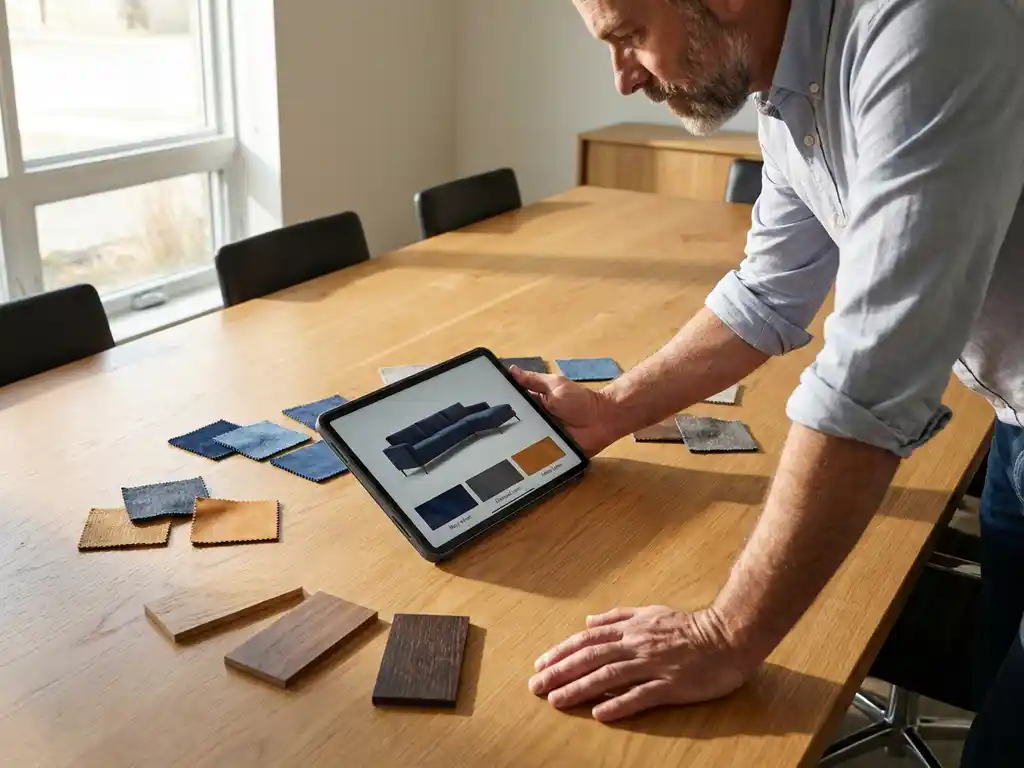
Yes, manufacturers should invest in furniture visualizer tools because they dramatically reduce product photography costs, increase customer confidence in purchasing decisions, and enable scalable visual content across all product variants. These tools generate high-quality 3D visuals automatically while supporting complex customization options that traditional photography cannot match.
Is expensive product photography draining your marketing budget?
Traditional furniture photography costs manufacturers thousands per product shoot, yet it only captures a fraction of available configurations. When you offer products in multiple colors, fabrics, and sizes, photographing every combination becomes financially impossible. A single sofa line with 20 fabric options and 5 sizes would require 100 separate photoshoots. Instead of this costly approach, manufacturers can implement visualization technology that generates unlimited product variations from a single 3D model, cutting photography expenses by up to 80% while showing customers exactly what they want to see.
Is limited visual content killing your conversion rates?
Customers abandon purchases when they cannot visualize how furniture will look in their space or in their preferred configuration. Without comprehensive visuals, your sales team struggles to demonstrate product options effectively, leading to longer sales cycles and lost opportunities. Room planning software solves this by letting customers see products in realistic room settings, configure options in real-time, and gain confidence in their choices before buying.
What are furniture visualizer tools and how do they work?
Furniture visualizer tools are 3D software platforms that create photorealistic images and interactive experiences from digital product models. They generate unlimited product variations, enable real-time customization, and display furniture in realistic room environments without physical photography.
These tools work by converting product specifications into detailed 3D models that can be manipulated in real-time. When a customer selects different fabric colors, wood finishes, or dimensions, the software instantly updates the visual representation. Advanced systems integrate with product information management systems to ensure pricing and availability remain accurate across all configurations.
The technology supports complex business rules and pricing structures, handling products with millions of possible variations. Users can rotate products 360 degrees, zoom in on details, and place items in realistic room settings. Some platforms also offer augmented reality features, allowing customers to see how furniture looks in their actual space using their smartphone camera.
Why are furniture manufacturers switching to visualization technology?
Manufacturers are adopting visualization technology because it eliminates the scalability limitations of traditional photography while improving customer experience and reducing operational costs. The technology enables consistent brand presentation across all sales channels and supports complex product customization at scale.
Traditional product photography cannot keep pace with modern furniture manufacturing. When manufacturers offer customizable products, photographing every possible combination becomes logistically impossible and financially prohibitive. Visualization technology generates these images automatically from 3D models, enabling manufacturers to showcase their complete product range without additional photography costs.
The shift also addresses changing customer expectations. Today’s furniture buyers expect to see products in context, customize options in real-time, and feel confident about their purchases before buying. Visualization tools meet these expectations while providing sales teams with powerful demonstration capabilities that traditional catalogs cannot match.
What’s the ROI of investing in furniture visualization tools?
Furniture visualization tools typically deliver ROI within 12-18 months through reduced photography costs, increased conversion rates, and decreased return rates. Manufacturers commonly see 20-40% increases in online conversion rates and 15-25% reductions in product returns due to improved customer confidence.
The cost savings from eliminating traditional photography shoots add up quickly. A manufacturer spending $50,000 annually on product photography can reduce this expense by 70-80% while generating significantly more visual content. Additional savings come from reduced sample inventory requirements and lower showroom space needs.
Revenue increases stem from improved customer experience and expanded sales capabilities. When customers can visualize products in their preferred configurations and room settings, they make purchasing decisions faster and with greater confidence. Sales teams can demonstrate more options effectively, leading to higher average order values and improved closing rates.
How much does furniture visualization software cost to implement?
Furniture visualization software implementation costs typically range from $50,000 to $300,000 depending on product complexity, integration requirements, and customization needs. Ongoing licensing fees usually cost $2,000 to $15,000 monthly based on usage volume and feature requirements.
Initial costs include software licensing, 3D model creation, system integration, and staff training. Creating 3D models for existing product lines represents a significant upfront investment, with costs varying based on product complexity and the number of items in your catalog. However, these models become reusable assets that generate value over many years.
Integration expenses depend on your existing technology stack. Connecting visualization tools with product information management systems, e-commerce platforms, and pricing engines requires technical expertise but ensures seamless operation across your business processes. Most manufacturers recover these implementation costs within the first year through photography savings and increased sales performance.
What should manufacturers look for in a furniture visualizer platform?
Manufacturers should prioritize platforms with proven furniture industry experience, seamless system integration capabilities, and the ability to handle complex product configurations with accurate pricing. Look for solutions that support your complete product range while providing high-quality visual output across all sales channels.
Technical integration capabilities are crucial for operational success. The platform should connect with your existing product information management system, e-commerce platform, and pricing engines to maintain data consistency. An API-first architecture ensures the solution can adapt to your current workflow rather than forcing you to change established processes.
Visual quality and performance matter significantly for customer acceptance. The platform should generate photorealistic images quickly while supporting complex customization options. Consider solutions that offer both web-based configuration tools and augmented reality capabilities to meet diverse customer preferences and sales channel requirements.
How iONE360 helps with furniture visualization
We provide manufacturers with a comprehensive visual commerce platform that transforms how customers experience and purchase furniture. Our solution combines advanced 3D visualization, integrated room planning software, and seamless system integration to deliver measurable business results.
Key benefits include:
- Automatic generation of high-quality product visuals for unlimited configurations
- Real-time 3D customization with accurate pricing and availability
- Augmented reality capabilities for enhanced customer confidence
- Seamless integration with existing PIM, ERP, and e-commerce systems
- Proven results in reducing photography costs and increasing conversion rates
Built on 45+ years of furniture industry expertise, our platform handles complex business rules and supports millions of product variations. Ready to see how visualization technology can transform your business? Explore our showcases or contact us for a personalized demonstration.
Frequently Asked Questions
How long does it take to create 3D models for an existing furniture catalog?
Creating 3D models for an existing catalog typically takes 2-6 months depending on your product range complexity and catalog size. Simple products like basic chairs may take 1-2 weeks per model, while complex modular furniture systems can require 4-6 weeks. Most manufacturers start with their best-selling products to see immediate ROI while building out the complete catalog over time.
Can visualization tools handle custom or made-to-order furniture specifications?
Yes, advanced visualization platforms can accommodate custom specifications and made-to-order products through parametric modeling. The system allows real-time adjustments to dimensions, materials, and configurations while automatically updating pricing and lead times. This capability is particularly valuable for contract furniture manufacturers who need to show custom solutions to commercial clients.
What happens to our existing product photography investment?
Your existing photography doesn’t become worthless – it can be repurposed for lifestyle marketing, social media content, and brand storytelling. Many manufacturers use traditional photography for emotional marketing while relying on 3D visualization for product configuration and technical specifications. The transition is typically gradual, allowing you to maximize your current photography investment.
How do we train our sales team to use visualization tools effectively?
Most visualization platforms offer comprehensive training programs including online tutorials, live workshops, and ongoing support. Sales teams typically become proficient within 2-3 weeks of training. The key is starting with basic product demonstrations and gradually introducing advanced features like room planning and AR capabilities as confidence builds.
What technical requirements do our customers need to use 3D visualization?
Modern visualization tools work on standard web browsers without requiring special software downloads. Customers need a device with internet access – desktop computers, tablets, or smartphones all work effectively. For augmented reality features, customers need a smartphone with a camera and AR capabilities, which includes most devices manufactured in the last 3-4 years.
How do we measure the success of our visualization tool investment?
Track key metrics including online conversion rates, average order values, product return rates, and customer engagement time on product pages. Most manufacturers also monitor photography cost savings, sales cycle length, and customer satisfaction scores. Establish baseline measurements before implementation to accurately assess improvement and ROI over time.
Can visualization tools integrate with our existing showroom displays?
Yes, many manufacturers use large touchscreen displays or tablets in showrooms to demonstrate product configurations that aren’t physically available. This hybrid approach maximizes showroom space efficiency while giving customers access to your complete product range. Some systems also support QR codes that customers can scan to continue their configuration process at home.