

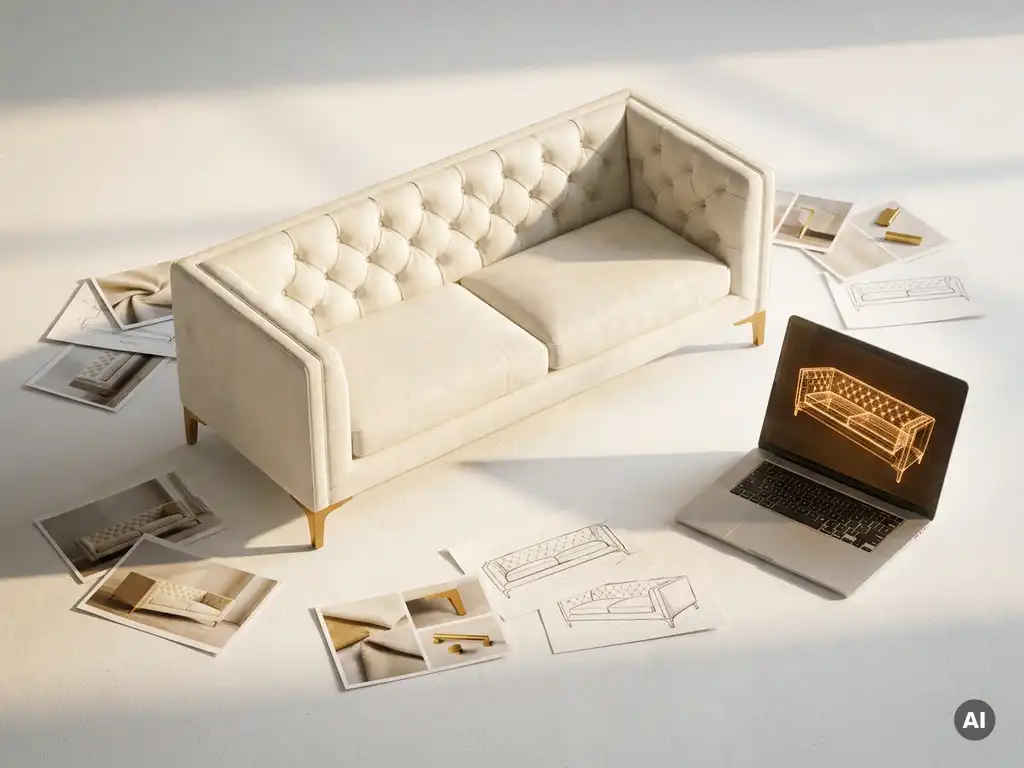
Product photography has always been one of the most resource-intensive parts of running a furniture business. Shooting every sofa in every fabric, every dining table in every finish, every bed frame in every size, the logistics alone can bring a catalogue launch to a crawl. That’s why more furniture brands are turning to image-based 3D model generation as a smarter path forward. When combined with a modern visual commerce platform, the ability to transform flat product images into fully interactive 3D assets opens up a new level of speed, flexibility, and consistency across every sales channel.
This article breaks down how that process actually works, what affects the quality of the output, and how brands are putting generated 3D models to work at scale, from their webshops to their dealer networks.
From flat photos to fully interactive 3D assets
The shift from static product images to interactive 3D assets represents one of the most significant changes in how furniture is sold online. A flat photo shows one angle, one configuration, one moment in time. A 3D model lets the customer rotate the product, zoom in on material details, switch fabric options, and even place it virtually in their own room.
The starting point for generating these assets is often a set of existing product photographs, typically taken from multiple angles under controlled lighting conditions. From these images, photogrammetry and AI-assisted reconstruction techniques extract geometry, surface texture, and material properties to build a structured 3D mesh. The result is a digital twin of the physical product that can be rendered, configured, and deployed across platforms without ever needing another photoshoot.
The technology behind image-based 3D model generation
Image-based 3D reconstruction has matured significantly over the past few years, driven by advances in computer vision and machine learning. At its core, the process involves analyzing multiple overlapping photographs to identify common reference points, calculate depth, and reconstruct the object’s geometry in three dimensions. This technique, known as photogrammetry, has been used in architecture and engineering for decades, but its application to consumer products is relatively recent.
More advanced pipelines now layer AI-driven inference on top of photogrammetry. Where traditional methods struggle with reflective surfaces, thin structures, or uniform textures (all common in furniture), machine learning models can fill in gaps, smooth geometry, and infer surface properties from limited visual data. The output is a clean, optimized 3D mesh with UV-mapped textures and, in many cases, physically based rendering (PBR) materials that respond realistically to different lighting environments.
For furniture specifically, this matters because materials like velvet, leather, and wood grain each behave differently under light. A well-generated 3D model captures those subtleties, making the digital version visually convincing enough to replace a physical sample in many buying scenarios.
How furniture brands use generated 3D models across channels
Once a 3D model exists, it becomes a versatile asset that can serve multiple purposes simultaneously. This is where the real return on investment becomes clear: the same model powers the webshop configurator, the dealer portal, the AR experience, and even automated packshot generation for print and digital marketing.
On the e-commerce side, a 3D product configurator built on generated models lets customers interact with the product directly in the browser, selecting dimensions, materials, and finishes while seeing the result update in real time. This kind of experience directly reduces purchase hesitation and return rates because customers arrive at checkout with a clear, accurate picture of what they’re buying.
In the dealer network, the same 3D assets can be deployed in-store on tablets or kiosks, allowing sales staff to walk customers through the full product range without needing physical samples for every variant. Brands using our platform at iONE360 benefit from this kind of omnichannel reach from a single content source: one model, deployed everywhere, always consistent.
What determines the quality of the output model
Not all generated 3D models are created equal, and the quality of the output depends on several controllable factors. Understanding these helps brands set realistic expectations and invest in the right input conditions from the start.
Input image quality
The most direct influence on model quality is the quality of the source photographs. Images taken under consistent, diffuse lighting with minimal shadows produce cleaner geometry. Higher resolution captures more surface detail, which translates into sharper textures in the final model. The number of angles covered also matters: more perspectives give the reconstruction algorithm more data to work with.
Product complexity and material type
Highly reflective materials, transparent elements, and very thin structures are notoriously difficult for image-based reconstruction. A glass-topped coffee table or a chrome-framed chair introduces challenges that require either specialized capture techniques or manual artist intervention post-generation. Upholstered furniture with matte fabrics, on the other hand, tends to reconstruct cleanly and accurately.
Post-processing and optimization
Raw generated meshes often require cleanup before they’re ready for real-time use. Polygon reduction, UV unwrapping, and material refinement are all part of bringing a model to production quality. The pipeline a brand uses, whether fully automated, semi-automated, or artist-assisted, determines how much of this happens without manual effort.
Scaling 3D content production across large product catalogues
For furniture brands with hundreds or thousands of SKUs, the real challenge isn’t generating a single 3D model, it’s doing it at scale without ballooning costs or timelines. This is where a structured, platform-driven approach makes all the difference.
An AI product configurator approach to content production treats 3D generation as a repeatable, systematized process rather than a one-off creative project. By establishing consistent input standards (camera setup, lighting, number of angles), brands can batch-process large portions of their catalogue through automated pipelines. Variants, different fabric colors, leg finishes, or size configurations, can often be derived from a single base model rather than generated independently, multiplying the output without multiplying the effort.
At iONE360, we’ve built our platform specifically to handle this kind of complexity. The configurator logic handles millions of possible product combinations, driven by ERP-integrated business rules that ensure pricing and availability stay accurate across every variant. The 3D content layer sits on top of that logic, delivering the right visual for every configuration without requiring a separate asset for each one.
As 3D generation technology continues to improve in 2026, with faster processing, better material inference, and tighter integration with product data systems, the barrier to building a fully visual product catalogue is lower than it has ever been. For furniture brands looking to compete on digital experience, the question is no longer whether to invest in 3D content, but how to do it efficiently enough to cover the entire range.
Related Articles
- Why AI features in 3D product configurators reduce returns and boost conversion
- How do 3D product configurators support B2B and B2C sales at the same time?
- What software is best for room design?
- What makes a product configurator user-friendly?
- What's the difference between room planners and product configurators?