

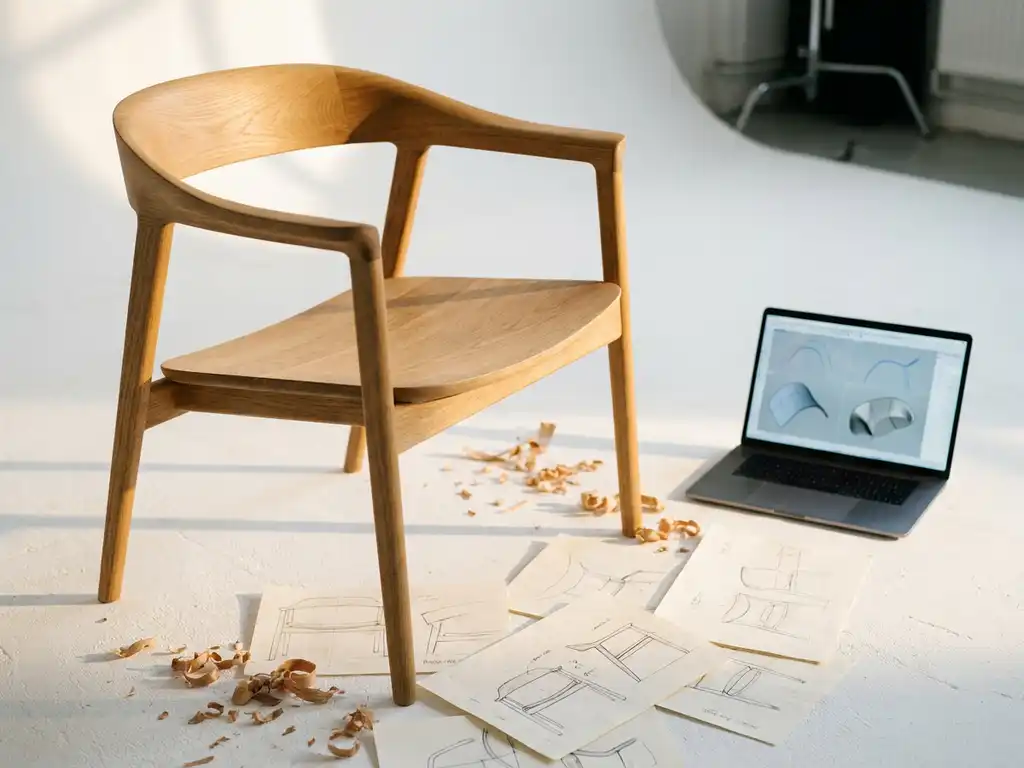
Yes, you can use AI to help design furniture. In 2026, AI tools can generate design concepts, suggest colour combinations, create mood boards, and even produce photorealistic images of furniture that does not yet physically exist. For furniture brands and retailers, AI is increasingly useful across the product development and sales journey, though it works best when combined with purpose-built visual tools.
The distinction between AI design tools and structured configurator platforms matters more than most people realise. This article walks through the most common questions furniture professionals are asking about AI right now.
What can AI actually do in furniture design today?
AI can support furniture design in several practical ways: generating initial concept visuals, suggesting material and colour pairings, automating repetitive design tasks, and producing lifestyle imagery from text prompts. These capabilities are genuinely useful in the early stages of product development and marketing content creation.
Generative AI tools like Midjourney, Adobe Firefly, and similar platforms allow designers to rapidly prototype visual ideas without committing to physical samples. A designer can describe a sofa in a specific fabric, finish, and room setting and receive a photorealistic concept image within seconds.
Where AI currently excels in furniture design:
- Rapid concept generation and ideation for new product lines
- Mood board creation and visual storytelling for marketing
- Automated background removal and image enhancement
- Colour and material matching suggestions based on trend data
- Generating lifestyle context images for products
What AI does not yet do reliably is handle the structural, commercial, and configurational complexity of real furniture products. Generating a beautiful sofa image is not the same as building a system that lets a customer choose their exact fabric, leg finish, and module combination and see the precise result.
What’s the difference between AI design tools and 3D product configurators?
AI design tools generate creative visuals from prompts, while 3D product configurators are structured systems that let customers interact with real, commercially accurate product variants. The key difference is precision and business logic: a configurator is connected to your actual product catalogue, pricing rules, and stock data, whereas an AI tool produces creative approximations.
Think of it this way. An AI image generator can produce a stunning visual of a modular bookcase in walnut with brass fittings. A 3D product configurator lets your customer select that exact bookcase, choose from your real available finishes, add or remove modules, see the updated price in real time, and place an order that flows directly into your production system.
For furniture brands selling configurable or custom products, this distinction is commercially critical. AI visuals are compelling for inspiration and marketing. A configurator is a sales tool that converts browsers into buyers and reduces costly ordering errors.
The two approaches are not mutually exclusive. AI-generated content can feed into a visual commerce strategy, but it cannot replace the structured product logic that a proper configurator platform delivers.
How does AI improve the furniture buying experience online?
AI improves the online furniture buying experience primarily by reducing uncertainty. It helps shoppers visualise products in their own space, suggests complementary items, and personalises the browsing experience based on behaviour and preferences. The result is a more confident customer who is more likely to complete a purchase.
Recommendation engines powered by AI analyse browsing patterns and purchase history to surface relevant products at the right moment. Virtual styling tools use AI to suggest how pieces work together in a room. Chatbots and AI assistants help customers navigate large catalogues and answer product questions without requiring a sales representative.
Paired with a 3D room planning tool, the buying experience becomes genuinely powerful. Customers can arrange multiple furniture pieces in a virtual version of their own room, experiment with different layouts, and see how their choices work together before committing. Research in the furniture sector consistently shows that showing products in a room context significantly increases buying intent compared to isolated product shots.
Can AI generate product images for furniture variants?
AI can generate product images for furniture variants, but with important limitations. Current AI image generators struggle to maintain precise consistency across a full range of variants, particularly when colour accuracy, texture detail, and proportional accuracy are commercially critical. For marketing mood boards, AI-generated images can be highly effective. For a complete, consistent product catalogue across hundreds of configurations, they fall short.
The core challenge is that furniture products often have dozens or hundreds of valid combinations: fabrics, frames, legs, sizes, configurations. AI generation requires a prompt and human review for each output, which does not scale efficiently across a large product range. There is also the risk of visual inconsistency between variants, which undermines brand trust.
Automated packshot generation through a structured 3D visualisation platform is a more reliable approach for catalogue-scale image production. When your product data is built into a 3D system, every variant can generate a photorealistic image automatically, with no manual effort per image and guaranteed visual consistency across the full range.
What are the limitations of using AI to design furniture?
The main limitations of using AI in furniture design are a lack of structural accuracy, inability to enforce business rules, inconsistency at scale, and no native connection to commercial systems. AI tools are creative assistants, not production-ready design or sales infrastructure.
Specific limitations to be aware of:
- Structural inaccuracy: AI-generated furniture images often contain physically impossible details, incorrect proportions, or construction errors that a trained eye will spot immediately.
- No business logic: AI cannot enforce which fabric is available on which frame, apply tiered pricing, or prevent invalid configurations.
- Inconsistency across variants: Generating the same product in 40 different fabrics via AI will produce 40 slightly different-looking products, creating catalogue inconsistency.
- No system integration: AI image tools do not connect to your ERP, PIM, or webshop, meaning outputs require manual processing before they can be used commercially.
- Intellectual property uncertainty: The legal landscape around AI-generated commercial imagery is still evolving in 2026, which introduces risk for brands using AI visuals in customer-facing contexts.
None of these limitations mean AI is without value in furniture. They simply define where it fits and where a more structured platform approach is needed.
Should furniture brands invest in AI tools or a visual configurator platform?
Furniture brands should treat AI tools and a visual configurator platform as complementary investments rather than alternatives. AI supports creative workflows and marketing content production. A visual configurator platform handles the commercial layer: interactive product presentation, accurate variant visualisation, room planning, and conversion-driving sales tools. For brands serious about e-commerce and omnichannel growth, the configurator platform delivers the more direct commercial return.
The clearest way to think about this is by commercial impact. AI tools improve efficiency in design and content teams. A configurator platform directly influences conversion rates, average order value, and return rates at the point of sale. For manufacturers and retailers with configurable product ranges, the latter has a measurable impact on revenue that AI creative tools alone cannot replicate.
Brands that rely on traditional photography are already at a structural disadvantage. A photoshoot cannot scale across every variant, every channel, and every retail partner. A visual commerce platform can.
How iONE360 helps with AI-powered furniture visualisation
We built iONE360 specifically for the complexity that furniture and home furnishings brands face every day. Our platform does not ask you to choose between beautiful visuals and commercial accuracy. You get both, at scale, integrated with your existing systems.
Here is what iONE360 brings to the table:
- Automated packshot generation across your full product range, covering every variant without a single additional photoshoot
- Interactive 3D product configurator with full business rule and pricing logic built in, handling millions of valid combinations
- Augmented reality so customers can place products in their own space directly from a browser, no app required
- 3D room planning software that lets customers combine, configure, and visualise multiple pieces together in a realistic room setting, increasing buying intent significantly
- Seamless integration with your PIM, ERP, CMS, and webshop so every output flows directly into your commercial infrastructure
- White-label flexibility for consistent brand presentation across every retail partner and sales channel
Whether you are looking to scale your visual content, modernise your online buying experience, or give your retail network a consistent, conversion-ready tool, iONE360 delivers a proven solution built on over 45 years of furniture industry expertise. Ready to see what it looks like for your product range? Get in touch with our team and we will show you exactly what is possible.
Frequently Asked Questions
How long does it typically take to set up a 3D product configurator for a furniture brand?
Implementation timelines vary depending on the size of your product range and the complexity of your configuration rules, but most furniture brands can expect an onboarding period of several weeks to a few months. The bulk of the work involves digitising your product data, 3D modelling your assets, and mapping your business logic such as valid fabric-frame combinations and pricing tiers. Working with a purpose-built platform like iONE360, which already understands furniture industry complexity, significantly reduces this setup time compared to building a custom solution from scratch.
Can AI tools like Midjourney or Adobe Firefly be used alongside a configurator platform, or do they conflict?
They work well together when used for the right purposes at the right stages. AI generative tools are best deployed upstream, during concept development, trend exploration, and marketing content creation, while your configurator platform handles the downstream commercial layer of accurate product presentation and sales. For example, AI-generated lifestyle imagery can be used in brand campaigns and social media, while your configurator delivers the precise, interactive product experience on your website and in-store. The two do not conflict as long as you are clear about which job each tool is doing.
What happens to our existing product photography investment if we move to 3D visualisation?
Your existing photography does not become worthless overnight, and most brands run both in parallel during a transition period. High-quality hero shots and lifestyle images produced through traditional photography can still serve brand and editorial purposes. However, 3D visualisation takes over the heavy lifting of catalogue-scale variant coverage, which is where traditional photography simply cannot scale. Over time, as your 3D asset library grows, the reliance on photoshoots for new variants and channel-specific assets typically decreases significantly, reducing ongoing production costs.
How do we ensure the 3D visuals accurately represent the real physical product to avoid customer disappointment?
Accuracy starts with the quality of your 3D assets and material textures, which need to be built or validated against real physical samples. A well-implemented platform uses photorealistic rendering with calibrated lighting and material properties to match what a customer will actually receive. It is also worth establishing a review process where your product and quality teams sign off on 3D representations before they go live, just as you would approve a product photoshoot. Platforms like iONE360 are built specifically for the furniture industry, meaning material rendering, scale, and proportion accuracy are central to how the system is designed.
Is augmented reality actually used by furniture shoppers, or is it more of a gimmick?
Adoption of AR in furniture retail has grown substantially, particularly since browser-based AR removed the barrier of requiring a dedicated app. Shoppers use it most at the consideration and decision stage, when they want to confirm that a piece will fit their space and work with their existing décor before committing to a significant purchase. Studies across the furniture and home sector consistently show that AR-enabled product pages drive higher engagement and lower return rates, both of which have a direct commercial impact. The key is making AR frictionless and accessible directly from the product page, which is how iONE360 delivers it.
What should we prioritise first if we are just starting to modernise our furniture brand's online visual experience?
The highest-impact starting point for most furniture brands is solving variant coverage: ensuring that every configuration of every product can be shown accurately online, not just the hero version photographed in one fabric. This single gap is responsible for a significant amount of lost online revenue, as customers who cannot visualise their chosen configuration are far less likely to convert. From there, adding an interactive configurator and room planning capability builds progressively on that foundation. Starting with a platform that can grow with you, rather than individual point solutions, avoids costly re-platforming further down the line.
How do we make the business case internally for investing in a visual configurator platform?
The strongest internal business case combines three measurable outcomes: increased conversion rate on configurable products, reduced return rates due to better pre-purchase visualisation, and lower content production costs by replacing photoshoots with automated 3D image generation. Many furniture brands also find a fourth argument compelling: the ability to onboard new retail partners and sales channels quickly with a consistent, ready-to-deploy visual toolkit, without additional production spend per partner. Requesting a platform demo with your actual product range, as iONE360 offers, is often the most effective way to make the case concrete for stakeholders who need to see the outcome before approving the investment.