

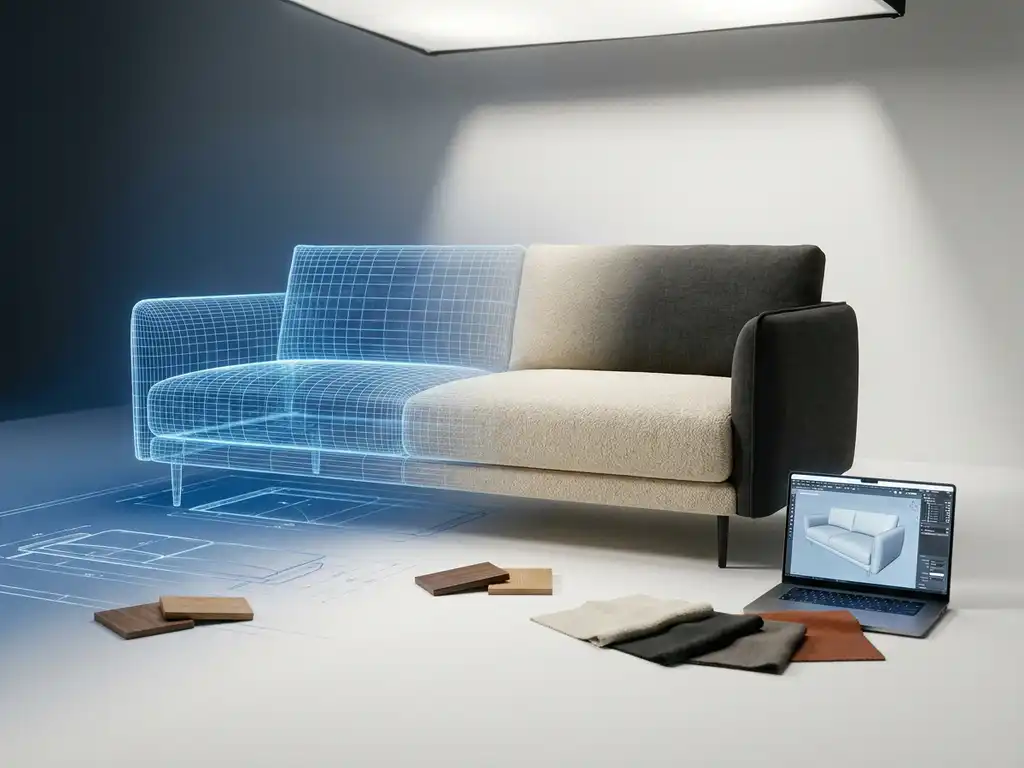
Yes, AI can design furniture, but not in the way most people imagine. Today’s AI tools can generate visual concepts, suggest proportions, explore material combinations, and accelerate the early stages of the design process. What they cannot do is replace the structural knowledge, ergonomic judgment, and cultural sensitivity that experienced furniture designers bring to the table. For furniture manufacturers, understanding exactly where AI adds value and where it falls short is what makes the difference between a smart investment and an expensive distraction.
What can AI actually do in the furniture design process?
AI can assist with concept generation, pattern exploration, material matching, and design iteration at a speed no human team can match. In practical terms, AI tools can produce dozens of visual design directions from a short text prompt, analyze existing product catalogues to identify gaps, and suggest configurations that align with current interior trends. This makes AI genuinely useful in the early ideation phase of furniture design.
Beyond concept work, AI is also being applied to more technical tasks. Generative design algorithms can optimize structural geometry for material efficiency, helping manufacturers reduce waste without compromising strength. AI-powered rendering tools can produce photorealistic visuals of furniture concepts before a single physical prototype is built, cutting down the time and cost involved in early-stage product development.
Where AI delivers the most consistent value in 2026 is in tasks that are repetitive, data-heavy, or visually iterative. These include:
- Generating multiple colorway and material variations of a single design
- Producing mood board concepts based on trend data
- Automating the creation of product visuals across an entire catalogue
- Flagging design inconsistencies across a product range
- Predicting which design attributes resonate with specific customer segments
How does generative AI create furniture designs?
Generative AI creates furniture designs by learning patterns from large datasets of existing furniture imagery, design specifications, and material libraries, then producing new outputs based on text or image prompts. The model does not “think” about furniture the way a designer does. Instead, it recombines learned visual and structural patterns to generate novel-looking results that statistically resemble the training data.
In practice, a designer might prompt a generative AI tool with something like “Scandinavian dining chair, solid oak, upholstered seat, low back” and receive several rendered concept images within seconds. More advanced tools allow designers to constrain outputs by dimensions, material properties, or brand style guides, giving manufacturers tighter control over what the AI produces.
The quality of the output depends heavily on the quality of the input. Vague prompts produce generic results. Well-structured prompts that reference specific aesthetics, functional requirements, and brand parameters produce far more useful starting points. This is why generative AI works best as a tool in the hands of an experienced designer rather than as a standalone design engine.
What can’t AI do that human furniture designers still handle?
AI cannot replace the structural engineering knowledge, tactile material judgment, ergonomic expertise, and cultural awareness that skilled furniture designers apply to every project. A generative AI tool can produce a visually compelling chair concept in seconds, but it cannot verify that the joinery will hold under load, that the seat depth suits a range of body types, or that the aesthetic resonates meaningfully with a specific regional market.
Human designers also navigate the practical constraints of manufacturing. They understand which finishes behave differently across wood species, how a design needs to be adjusted for flat-pack assembly, and how production tolerances affect the final product. AI has no awareness of a factory’s capabilities, a supplier’s lead times, or the cost implications of a particular construction detail.
There is also the question of intent. Great furniture design communicates something. It reflects a philosophy, a heritage, or a response to how people actually live. That kind of meaning does not emerge from pattern recombination. It comes from designers who understand their audience, their brand, and the cultural moment they are designing for.
Are there real furniture brands already using AI in design?
Yes, several furniture and home furnishings brands are already integrating AI into their design and product development workflows in 2026. The applications range from AI-assisted trend forecasting and material selection to automated visual content generation for entire product catalogues. Larger brands with substantial digital infrastructure have moved furthest, but mid-sized manufacturers are catching up quickly as the tools become more accessible.
The most common real-world applications seen across the industry include:
- Catalogue visual generation: Using AI rendering to produce product images across all variants without a photoshoot
- Trend-driven concept exploration: Feeding market and social data into AI tools to identify emerging aesthetic directions
- Personalized product recommendations: Applying machine learning to match customers with configurations that suit their stated preferences
- Structural optimization: Using generative design algorithms to reduce material use in upholstered frames and cabinet construction
- Automated quality checking: AI-powered visual inspection tools flagging production defects before products leave the factory
What is notable is that brands using AI most effectively are not replacing their design teams. They are using AI to handle volume, speed, and variation, freeing designers to focus on the work that genuinely requires human judgment.
How does AI-generated design connect to product configuration and visualization?
AI-generated design connects directly to product configuration and visualization by accelerating the creation of the 3D assets and visual content that power interactive configurators and room planning software. When a manufacturer uses AI to generate and validate design variants early in the process, those assets can be fed directly into a configuration platform, making the entire pipeline from design concept to customer-facing visual faster and more cost-efficient.
This connection matters because the value of a product configurator depends entirely on the quality and completeness of its visual content. A configurator that only shows three fabric options out of thirty available is not serving the customer or the manufacturer well. AI tools that automate the generation of material and colorway variations make it practical to populate a configurator with the full product range, not just a curated subset.
For furniture manufacturers selling configurable products, the combination of AI-assisted design and a robust 3D configuration platform creates a compounding advantage. Customers can explore every variant of a product in realistic detail, in a room context, before making a purchase decision. That level of visual confidence directly reduces returns and increases order values.
Should furniture manufacturers embrace AI design tools now or wait?
Furniture manufacturers should begin engaging with AI design tools now, but with a focused and practical approach rather than wholesale adoption. The tools that deliver the clearest near-term value, particularly AI-assisted visual content generation and catalogue automation, are mature enough to deploy in 2026. Waiting risks falling behind competitors who are already compressing their content production timelines and reducing photoshoot costs.
The case for acting now is strongest for manufacturers who face one or more of these situations:
- A large catalogue with many configurable variants that are expensive to photograph
- Pressure to launch new collections faster without increasing production costs
- Inconsistent product presentation across retail partners and digital channels
- A strategic push toward e-commerce growth or omnichannel consistency
The case for a measured approach, rather than rushing, is equally valid. AI tools require good data, clean product information, and clear integration with existing systems to deliver on their promise. Manufacturers who invest in their data infrastructure first will get significantly more out of AI tools than those who adopt them on top of fragmented or incomplete product data.
How iONE360 helps furniture manufacturers turn AI-ready design into confident customer experiences
We built iONE360 specifically for the furniture and home furnishings industry, which means we understand exactly where visual content challenges slow manufacturers down and where the right technology creates a measurable commercial advantage. Whether you are exploring AI-assisted design workflows or already generating product variants at scale, we provide the visual commerce infrastructure that turns those assets into sales.
Here is what we bring to the table:
- A complete 3D product configurator that handles complex business rules, pricing logic, and millions of product variants without manual effort per configuration
- Automated high-quality packshot generation so every variant in your catalogue has a professional visual, without a photoshoot
- An integrated room planning tool that lets customers place, configure, and combine your products in a realistic room context, increasing buying intent significantly
- Augmented reality viewing so customers can see exactly how a product fits in their own space before they buy
- Seamless integration with your existing PIM, ERP, CMS, and webshop so the platform fits into your workflow rather than disrupting it
The result is a consistent, high-quality brand experience across every channel, from your own webshop to your retail partners, without the cost and fragmentation of managing separate tools for each. If you are ready to see what this looks like in practice for your product range, get in touch with us and we will walk you through it.
Frequently Asked Questions
How do I know which AI design tool is the right fit for my furniture manufacturing business?
Start by identifying your most pressing bottleneck — whether that is slow concept iteration, high photoshoot costs, or inconsistent catalogue visuals — and look for tools that solve that specific problem first. Avoid platforms that promise end-to-end design automation without a clear integration path into your existing product data systems. Piloting one focused use case, such as automated material variant rendering, will give you a realistic picture of ROI before you commit to a broader rollout.
What kind of data or assets do we need to have in place before adopting AI design tools?
AI tools perform significantly better when they have clean, structured product data to work with — this means accurate material specifications, consistent naming conventions, up-to-date dimension data, and ideally existing 3D models or high-quality reference imagery. Manufacturers with fragmented or incomplete product information often find that AI outputs are inconsistent or require heavy manual correction. Investing in a solid PIM (Product Information Management) setup before deploying AI tools is one of the highest-leverage steps you can take.
Can AI-generated furniture designs be used directly for manufacturing, or do they always need to be reworked by a human designer?
AI-generated concepts almost always require human review and rework before they are production-ready. The outputs are best treated as informed starting points — they can dramatically compress the early ideation phase, but a qualified designer still needs to validate structural integrity, manufacturing feasibility, ergonomic suitability, and brand alignment before any design moves toward prototyping. Treating AI outputs as finished designs without that review step is one of the most common and costly mistakes manufacturers make when first adopting these tools.
Will using AI in our design process affect how we work with external designers or design studios?
It can change the collaboration dynamic, but it does not have to diminish it. Many manufacturers are finding that sharing AI-generated concept directions with external designers actually speeds up briefing and alignment, since there is a visual reference to react to rather than a purely verbal brief. The key is being transparent about how AI is being used in the process and ensuring that external designers are brought in at the stage where their judgment genuinely adds value — structural refinement, cultural nuance, and final aesthetic decisions — rather than being handed fully formed AI outputs with little room to contribute.
How does AI-assisted design affect the intellectual property ownership of furniture designs?
This is an evolving legal area, and the answer varies by jurisdiction, but the general principle in most markets is that purely AI-generated outputs with no meaningful human creative input have limited or no copyright protection. For manufacturers, this means that designs where a human designer has made substantive creative decisions — even with AI assistance — are in a stronger IP position than those generated wholesale by an AI with minimal human direction. It is worth consulting with an IP specialist familiar with your market, particularly if you intend to register designs or defend them against copying.
What is a realistic timeline for seeing ROI from AI design tools in a mid-sized furniture manufacturing business?
For focused, well-scoped applications like automated catalogue visual generation or colorway variant rendering, many mid-sized manufacturers report seeing measurable cost savings within three to six months of deployment — primarily through reduced photoshoot frequency and faster time-to-market for new collections. Broader workflow integrations, such as connecting AI design outputs to a product configurator or room planning tool, typically take six to twelve months to fully optimize but deliver compounding returns as the asset library grows. Setting clear KPIs before you start — cost per visual, time from design brief to published product page, number of variants covered — makes it much easier to evaluate progress honestly.
How do we ensure AI-generated designs stay consistent with our brand identity and don't produce generic-looking results?
The most effective way to maintain brand consistency is to build a structured prompt framework and a curated reference library that reflects your brand’s visual language — including specific materials, proportions, finish treatments, and aesthetic references that define your product identity. More advanced AI platforms allow you to fine-tune or constrain outputs using brand style guides or even custom-trained models built on your own product catalogue. Without this kind of intentional guardrailing, AI tools default to statistically average outputs that tend to look like everyone else’s furniture, which is the opposite of what a differentiated brand needs.