

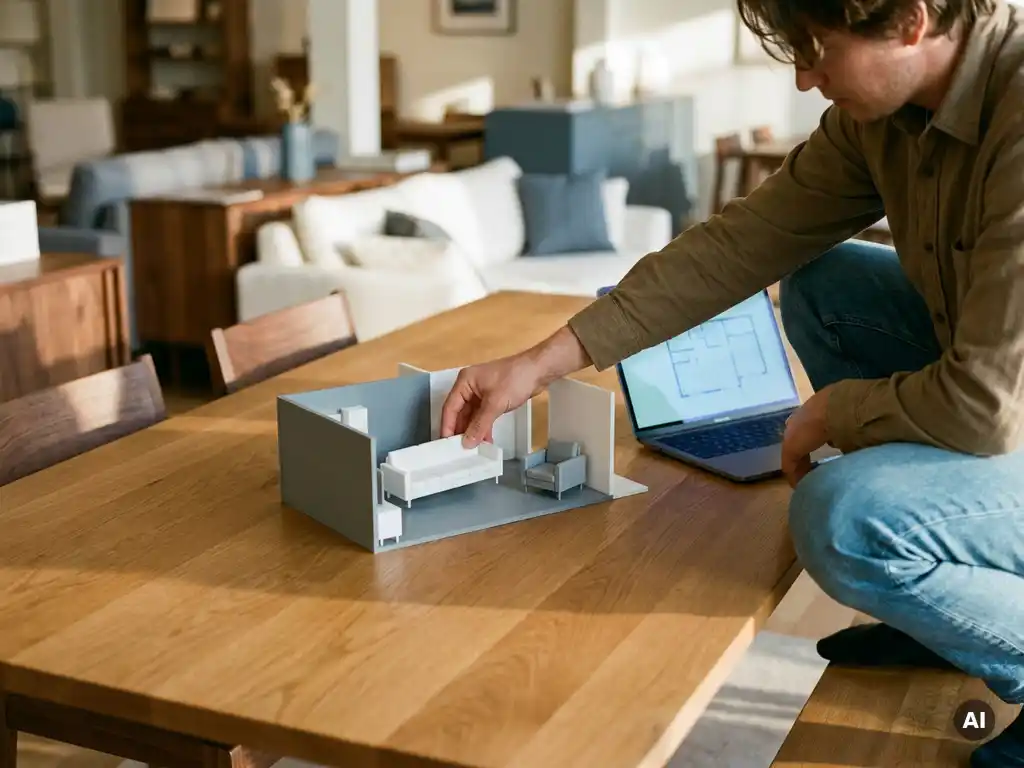
Yes, furniture manufacturers should offer a room planner on their own website. A room planner gives potential buyers the confidence to make purchasing decisions directly at the source, before they ever visit a retailer. For manufacturers with their own brand presence and direct consumer touchpoints, it is one of the most effective tools available to drive engagement, increase order value, and reduce costly returns.
The shift toward online research in furniture buying means that more customers form their preferences and shortlist products long before they walk into a store or click “add to cart.” Manufacturers who meet that moment with an interactive, visual experience hold a significant advantage over those who rely solely on static product pages. The sections below walk through the most common questions manufacturers ask when evaluating whether to add a room planning tool to their site.
What does a room planner actually do on a furniture website?
A room planner is an interactive tool that lets website visitors design a floor plan, place furniture items inside it, and visualize how those products look together in a realistic 3D environment. Users can adjust layouts, swap configurations, change materials and colours, and rotate the view to see the space from any angle. The result is a fully visual, self-directed shopping experience built around the customer’s own home.
Beyond the basic drag-and-drop layout, more advanced room planning tools go further. They allow visitors to configure individual products on the spot, meaning a sofa can be resized, reupholstered, or reconfigured without leaving the room view. Customers can add flooring, curtains, and wallpaper to complete the scene, and they can see live pricing alongside their design. This transforms a passive browsing session into an active planning exercise with real purchase intent behind it.
For manufacturers, this means the website stops functioning as a digital brochure and starts working as a sales environment.
How does a room planner influence the furniture buying decision?
A room planner directly reduces the uncertainty that prevents customers from committing to a furniture purchase. Furniture is a high-consideration, high-cost category where buyers worry about scale, style fit, and whether pieces will work together. Seeing products placed realistically in a space that resembles their own home answers those questions visually, which is far more persuasive than written descriptions or even individual product photography.
Several mechanisms explain this influence:
- Spatial confidence: Customers can verify that a sofa actually fits their living room before ordering, eliminating one of the most common reasons for returns.
- Style coordination: Seeing multiple pieces together encourages customers to add complementary items, which increases basket size.
- Emotional connection: A realistic 3D scene creates a feeling of ownership. When someone has designed a room around a product, they are far more invested in completing that purchase.
- Reduced need for physical validation: Customers who have already visualised a product in their own context are less likely to require a showroom visit before buying.
Showing products in the right environment has a measurable effect on buying intent. Industry experience consistently points to significant lifts in conversion when customers can interact with a product in context rather than viewing it in isolation.
Should a furniture manufacturer offer a room planner or leave it to retailers?
Furniture manufacturers should offer their own room planner rather than relying on retailers to provide that experience. When the room planning journey happens on a retailer’s platform, the manufacturer loses control over how their products are presented, configured, and contextualised. Brand consistency suffers, and the manufacturer receives little to no data about how customers interact with their collection.
Owning the room planning experience on your own website gives manufacturers three distinct advantages. First, it establishes the manufacturer as the authoritative source for product knowledge, which strengthens brand positioning and consumer trust. Second, it captures first-party data about customer preferences, popular configurations, and common room types, which feeds directly into product development and marketing decisions. Third, it creates a referral asset: a manufacturer can offer the same room planning tool to retail partners as a white-labeled or co-branded experience, extending reach without losing brand control.
Retailers benefit from having room planning tools too, but that does not diminish the case for manufacturers to run their own. Both can coexist, and manufacturers who build the capability first are in a stronger position to support their retail network from a place of expertise.
What are the biggest challenges of adding a room planner to a manufacturer site?
The most common challenges furniture manufacturers face when adding a room planner to their website fall into three categories: content preparation, technical integration, and ongoing maintenance.
- 3D content at scale: A room planner requires 3D models of every product in every configuration. For manufacturers with large, configurable catalogues, producing that content can feel like a significant upfront investment. The key is choosing a platform that can generate visual assets efficiently and connect to existing product data rather than requiring manual work per variant.
- Integration with existing systems: The room planner needs to connect with the product catalogue, pricing engine, and ideally the order management or ERP system. Without those connections, the tool becomes a visual toy rather than a commercial asset. Integration with PIM, CMS, and webshop platforms is therefore a critical evaluation criterion.
- Keeping content current: Collections change seasonally. A room planner that cannot be updated efficiently becomes outdated quickly, which damages credibility rather than building it. Manufacturers need a back-end environment where product managers can update configurations, pricing, and availability without relying on external developers for every change.
- User experience design: A room planner that is difficult to use will be abandoned. The tool needs to be intuitive enough for a non-technical consumer to use without instructions, which places demands on interface design and loading performance.
None of these challenges are insurmountable, but they underscore why choosing the right platform partner matters as much as the decision to add a room planner in the first place.
What should furniture manufacturers look for in a room planning solution?
Furniture manufacturers should evaluate room planning solutions against five core criteria: visual quality, configurability, integration depth, scalability, and industry fit. A solution that scores well on all five is far more likely to deliver lasting commercial value than one that excels on only one or two dimensions.
- Visual quality: The 3D output must be photorealistic enough to build purchase confidence. Low-quality renders undermine the entire purpose of the tool.
- Configurability within the planner: The ability to configure products directly inside the room view, rather than switching between separate tools, is a significant differentiator. It keeps the customer in one seamless experience.
- Integration with business systems: The solution should connect natively or via API to PIM, ERP, CMS, and webshop platforms. Isolated tools create data silos and manual overhead.
- Scalability across the catalogue: The platform should handle large, complex product ranges with multiple variants without requiring individual manual effort per product or configuration.
- Furniture industry expertise: Generic room planning tools built for broad markets often lack the depth needed for complex furniture configurations, business rules, and pricing logic. A solution built specifically for the furniture and home furnishings sector will handle edge cases that generalist tools cannot.
It is also worth evaluating whether the solution can serve retail partners through a white-label or co-branded version, and whether it includes a marketplace component that extends reach beyond the manufacturer’s own website.
How can a room planner reduce returns and increase conversion for furniture brands?
A room planner reduces returns by giving customers the information they need to make the right decision the first time. Most furniture returns happen because a product did not fit the space as expected, did not match other items in the room, or looked different in person than it did in a product photo. A 3D online room planner addresses all three causes directly by letting customers verify dimensions, test combinations, and see realistic material renderings before they order.
On the conversion side, the mechanism is equally straightforward. Customers who have invested time in designing a room around specific products have a much stronger purchase intent than those who are passively browsing. The act of planning creates commitment. It also surfaces upsell opportunities naturally, because a customer building a living room will encounter and consider complementary pieces they might not have searched for individually.
The combination of fewer returns and higher basket values produces a compounding commercial effect. Fewer returns mean lower logistics costs and less stock damage. Higher basket values mean more revenue per customer acquisition. Together, they improve the unit economics of every sale the manufacturer makes online.
How iONE360 helps furniture manufacturers with room planning
We built our room planning solution specifically for the furniture and home furnishings industry, which means it handles the complexity that generic tools cannot. Here is what manufacturers get when they work with us:
- A fully integrated 3D room planner where customers can design floor plans, place and configure furniture, add flooring, curtains, and wallpaper, and see live pricing, all in one seamless web-based experience.
- Direct product configuration inside the room view, so customers never have to leave the planning environment to customise a sofa, bed, or storage unit.
- Two flexible deployment paths: a bespoke, white-labeled room planner built for your platform, or onboarding to HomeDecoHub, our ready-to-use room planning marketplace powered by the same proven software.
- Seamless integration with PIM, ERP, CMS, and webshop systems, so the room planner works as part of your commercial infrastructure rather than alongside it.
- A back-end environment that lets your team update products, configurations, and pricing without developer dependency.
- Over 45 years of furniture industry expertise behind every feature, from complex business rules and pricing logic to photorealistic 3D output at catalogue scale.
If you are ready to explore what a room planner could do for your brand, get in touch with our team and we will show you exactly how it works for manufacturers like you.
Frequently Asked Questions
How long does it typically take to get a room planner live on a furniture manufacturer's website?
The timeline depends largely on the size of your product catalogue and how much 3D content already exists. For manufacturers with existing digital assets and clean product data, a room planner can go live in a matter of weeks. For those starting from scratch with a large, configurable range, a phased launch — starting with hero products and expanding from there — is a practical approach that gets the tool in front of customers faster without waiting for the entire catalogue to be ready.
Do customers actually use room planners, or do most visitors skip them?
Engagement rates are consistently higher than most manufacturers expect, particularly when the tool is well-placed within the browsing journey and easy to launch without a sign-up barrier. Customers who are actively researching a furniture purchase — the high-intent visitors who matter most — are exactly the audience most likely to invest time in a planning tool. The key is reducing friction at entry: a room planner that loads quickly, works on mobile, and requires no tutorial will see far greater adoption than one that feels like a separate application.
Can a room planner work for manufacturers who sell through retailers rather than direct-to-consumer?
Absolutely. Even if the manufacturer does not sell directly, a room planner on the brand’s own website builds product familiarity and purchase intent that flows downstream to retail partners. Customers who have already planned a room around specific products arrive at a retailer ready to buy, not still deciding. Beyond that, manufacturers can offer the same room planning tool to their retail network as a white-labeled or co-branded experience, making the capability a genuine trade benefit rather than a consumer-only asset.
What if our product catalogue is very large or changes frequently — is a room planner still manageable?
A frequently updated catalogue is actually one of the strongest arguments for choosing a purpose-built platform rather than a custom-built solution. The right room planning platform connects directly to your existing product data — PIM, ERP, or webshop feeds — so that pricing, availability, and configuration updates flow through automatically rather than requiring manual work per product. Manufacturers with seasonal collections should prioritise back-end flexibility as a non-negotiable evaluation criterion when selecting a solution.
How do we measure whether our room planner is actually driving commercial results?
The most meaningful metrics to track are conversion rate among room planner users versus non-users, average order value for sessions that included the planner, and return rates segmented by whether the purchase involved the planning tool. Most room planning platforms provide built-in analytics, and the data can also be passed to your existing web analytics or CRM setup. Establishing a baseline before launch and measuring at 30, 60, and 90 days gives a clear picture of commercial impact without waiting for a full trading cycle.
What is the biggest mistake furniture manufacturers make when launching a room planner?
The most common mistake is treating the room planner as a standalone feature rather than an integrated part of the commercial journey. A tool that is buried in a menu, disconnected from live pricing, or unable to push a configured basket to checkout will generate engagement but not revenue. The room planner needs to sit within the natural browsing flow — accessible from product pages, category pages, and campaign landing pages — and it needs a clear path from design to purchase to convert planning intent into completed orders.
Can a room planner be used as part of an in-store or showroom experience, or is it purely for online use?
A web-based room planner is equally effective in a physical environment. Many furniture brands deploy the same tool on showroom tablets or large touchscreens, allowing sales consultants to plan alongside customers in real time using the actual products on display. This creates a consistent brand experience across channels and gives in-store teams a powerful consultative tool. Saved room designs can also be shared with customers via email or link, so a plan started in the showroom can be revisited and completed at home.