

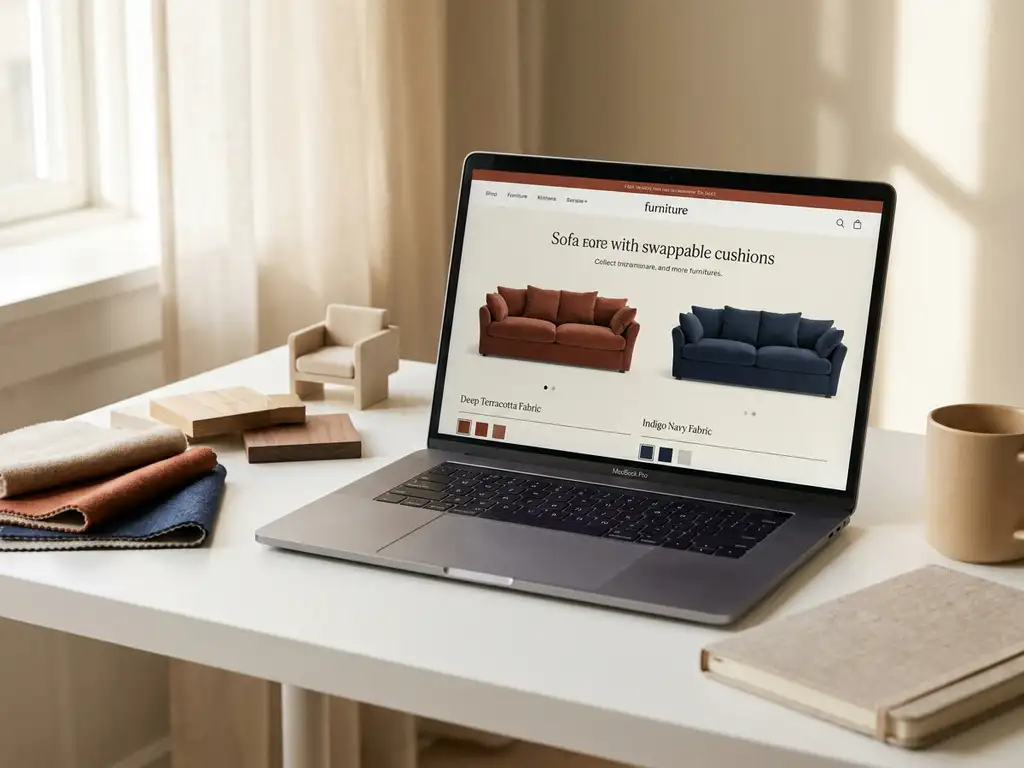
Companies can sell customizable furniture online by combining interactive 3D product configurators, augmented reality tools, and room planning software into a seamless digital buying experience. These technologies allow customers to visualize exactly what they are ordering before they commit, which removes the hesitation that typically holds back online furniture purchases. The sections below unpack the most common questions furniture brands face when taking customizable products online.
What makes selling customizable furniture online so difficult?
Selling customizable furniture online is difficult because the number of possible product variations makes it impossible to photograph or display every option. A single sofa with multiple fabric choices, frame colors, leg finishes, and size configurations can produce thousands of unique combinations, each of which a customer needs to see before buying with confidence.
Traditional product photography simply cannot scale to cover every variant. A photoshoot for one configuration is already expensive and time-consuming. Multiply that across an entire catalogue and the cost becomes prohibitive. The result is that most furniture brands online only show a handful of options, leaving customers to imagine the rest and often choosing not to buy at all.
Beyond visuals, there is the challenge of communicating complex pricing and availability rules. Custom products often have conditional logic built in: certain fabrics only come in certain sizes, certain finishes add lead time, certain combinations change the price. Communicating all of that clearly in a standard webshop interface is genuinely hard.
The combination of incomplete visuals and unclear configuration logic creates uncertainty, and uncertainty kills conversion in e-commerce.
What is a 3D product configurator and how does it work for furniture?
A 3D product configurator is an interactive digital tool that lets customers build and visualize a product in real time by selecting options such as size, material, color, and finish. For furniture, it renders each configuration as a photorealistic 3D model, so customers see exactly what they are ordering before they buy.
Here is how the process typically works for a furniture brand:
- Product data is structured: Materials, dimensions, finishes, and business rules are mapped out and loaded into the configurator platform.
- 3D models are created or converted: Existing CAD files or design assets are transformed into interactive 3D assets.
- The configurator is embedded: The tool is integrated into the brand’s webshop, dealer portal, or in-store sales system.
- The customer configures in real time: Every choice the customer makes updates the 3D visual instantly, including price and lead time.
- The order is placed with precision: The exact configuration is passed directly to the backend, eliminating manual errors.
For furniture manufacturers dealing with complex product rules, a well-built configurator handles the conditional logic automatically. It prevents impossible combinations, guides the customer through valid choices, and ensures that what is ordered can actually be produced.
How does augmented reality help customers buy furniture online?
Augmented reality helps customers buy furniture online by letting them place a virtual version of the product into their own living space using a smartphone or tablet camera. This removes the single biggest source of doubt in online furniture buying: whether the piece will actually fit and look right in the room.
The practical benefit is significant. Customers who can see a sofa or dining table in their actual home, at true scale, feel far more confident in their decision. That confidence translates directly into higher conversion rates and fewer returns after delivery.
AR works best when it is connected to a product configurator. A customer who has just customized a sofa in a specific fabric and leg finish should be able to place that exact configured version into their room, not a generic model. This connection between configuration and AR visualization is what makes the experience genuinely useful rather than just a novelty.
For furniture brands, AR also reduces the dependency on physical showrooms. Customers no longer need to visit a store to get a sense of scale and fit. They can do it from their phone, at home, on their own timeline.
What’s the difference between a product configurator and a room planner?
A product configurator focuses on a single item, letting customers customize its attributes such as size, material, and color. A room planner is a broader tool that lets customers arrange multiple furniture pieces together within a floor plan, giving them a complete view of how an entire space will look and function.
The two tools serve different but complementary purposes:
- Product configurator: Best for customizing one product in depth, handling complex rules, pricing, and generating a precise order.
- Room planner: Best for helping customers furnish a full room, experiment with layouts, and see how pieces work together before committing.
The most powerful setups combine both. A customer opens a 3D room planning tool, designs their living room, and can configure each individual piece on the spot, adjusting fabric, finish, and size while seeing the result in the full room context. Prices and lead times update in real time, and the entire room can be ordered in one go.
This combined approach is particularly effective for customers furnishing a new home or redesigning a space, because it mirrors how people actually think about buying furniture: not as isolated products, but as a coordinated environment. Research in the industry suggests that showing products in a room context can increase buying intent by as much as 64%.
How can furniture brands keep visuals consistent across all sales channels?
Furniture brands can keep visuals consistent across all sales channels by using a single centralized platform that generates product imagery and configuration experiences from the same underlying 3D assets. When every channel, including the brand’s own webshop, dealer portals, and in-store screens, draws from one source, consistency is built in rather than managed manually.
The traditional alternative is to produce separate photography and marketing assets for each channel, which is expensive, slow, and almost impossible to keep synchronized when products change or new variants are introduced. A single sofa update can require reshoots, new files sent to dozens of retailers, and manual updates across multiple systems.
A centralized visual commerce platform solves this by generating packshot images and configurator experiences automatically from the 3D product data. When a new fabric is added, it appears everywhere simultaneously. Retailers and dealers always present the current, correct version of the product without requiring any effort from the brand’s marketing team.
This also protects brand integrity. Inconsistent product presentation across retailers is one of the most common sources of brand dilution in the furniture industry. When every touchpoint uses the same high-quality visuals and the same configuration logic, the brand looks and feels the same whether a customer encounters it online, in a dealer showroom, or on a branded app.
What results can furniture companies expect from a visual configurator?
Furniture companies that implement a visual configurator typically see higher conversion rates, larger average order values, and fewer product returns. These outcomes are driven by one underlying shift: customers who can see exactly what they are ordering before they buy make more confident, more considered decisions.
The specific improvements vary by brand and context, but the mechanisms behind them are consistent:
- Higher conversion: Removing visual uncertainty means fewer customers abandon the process out of doubt.
- Larger orders: Customers who can see combinations together, especially in a room planner context, are more likely to add coordinating pieces.
- Fewer returns: When customers have seen their exact configuration in 3D and in their own space via AR, delivery surprises are rare.
- Lower content costs: Automatically generated packshots replace expensive photoshoots across all variants and channels.
- Fewer sales errors: Configuration logic built into the tool prevents impossible or incorrect orders from reaching production.
For manufacturers specifically, a configurator also reduces the burden on the sales team. Complex custom orders that previously required back-and-forth between sales, customer, and production can be handled directly by the customer through a guided step-by-step process, freeing sales staff for higher-value conversations.
How iONE360 helps furniture brands sell customizable products online
We built iONE360 specifically to solve the challenges described throughout this article. Our platform brings together a 3D product configurator, AR visualization, automatic packshot generation, and room planning software in one integrated, web-based solution, purpose-built for the furniture, home, and décor industry.
Here is what working with us looks like in practice:
- One platform, every channel: Your entire product catalogue, in every configuration, available consistently across your webshop, dealer network, and in-store systems.
- Advanced room planning: Our room planning software lets customers design full rooms, configure individual pieces on the spot, and order directly from the 3D environment.
- Complex product logic handled: Our configurator manages conditional rules, pricing, and lead times across products with millions of possible variants.
- Seamless integration: iONE360 connects with your existing PIM, ERP, CMS, and webshop infrastructure without disrupting your current setup.
- Proven industry expertise: Backed by over 45 years of furniture industry software experience from the Dutch Colijn Group, and recognized by Gartner as a vendor in the product configurator domain.
If you are ready to take your customizable furniture catalogue online with the visual quality and scalability your brand deserves, get in touch with our team and we will show you exactly what iONE360 can do for your business.
Frequently Asked Questions
How long does it typically take to implement a 3D product configurator for a furniture brand?
Implementation timelines vary depending on the complexity of your product catalogue and existing digital assets, but most furniture brands can expect the process to take anywhere from a few weeks to a few months. The main factors that affect timeline are the number of SKUs, the availability of CAD or 3D design files, and the complexity of your product configuration rules. Working with a platform like iONE360 that is purpose-built for furniture can significantly shorten the process, since the infrastructure for handling conditional logic, pricing rules, and multi-channel publishing is already in place.
Do customers need to download an app to use AR furniture visualization?
In most modern implementations, no download is required. Web-based AR runs directly in a smartphone or tablet browser using technologies like WebAR, meaning customers can place a virtual piece of furniture in their room simply by tapping a link on a product page. This removes a major barrier to engagement, since requiring an app download causes a significant drop-off in usage. For the best experience, customers should be using a relatively recent iOS or Android device with a capable camera.
What if my product catalogue has millions of possible variants — can a configurator really handle that?
Yes, and this is actually where a well-built configurator delivers the most value. Unlike photography-based approaches that break down at scale, a 3D configurator generates visuals dynamically from the underlying product data and 3D assets, so the number of variants has no practical upper limit. The key is that the configuration logic — which combinations are valid, how pricing adjusts, which options affect lead time — is encoded into the system once and applied automatically across every possible combination. This means a sofa with thousands of fabric, size, and finish combinations is just as manageable as one with ten.
How does a configurator integrate with my existing webshop, ERP, or PIM system?
Most modern configurator platforms are designed to connect with the tools furniture brands already use, including common e-commerce platforms, ERP systems, and PIM solutions, via APIs and standard data integrations. The configurator pulls product data from your existing sources and pushes confirmed order configurations directly into your backend, eliminating manual re-entry and reducing the risk of production errors. Before committing to any platform, it is worth confirming which specific integrations are supported out of the box and what custom development, if any, would be required for your particular tech stack.
Will switching to 3D visuals mean I have to give up my existing product photography?
Not necessarily, and the transition does not have to be all-or-nothing. Many furniture brands phase in 3D visuals starting with new product launches or their most complex configurable lines, while continuing to use existing photography for simpler products. Over time, as the 3D asset library grows, automatically generated packshots can replace traditional photography for an increasing share of the catalogue. The long-term cost savings are substantial, since adding a new fabric or finish to a 3D asset requires no photoshoot at all.
What is the biggest mistake furniture brands make when going online with customizable products?
The most common mistake is trying to replicate a physical showroom experience online using static content — a limited set of product photos, a dropdown menu of options, and a written description of what is available. This approach forces customers to imagine too much, and imagination is not enough to overcome purchase hesitation for high-value items like furniture. The brands that succeed online invest in tools that let customers see and interact with their exact configuration, because confidence in what is being ordered is the single most important driver of conversion for customizable products.
Is a room planner worth the investment for smaller furniture brands, or is it mainly for large retailers?
Room planning tools have become increasingly accessible and are no longer exclusively the domain of large retail chains. For smaller brands with a focused, curated catalogue, a room planner can actually be a powerful differentiator, giving customers a premium, immersive experience that larger generalist retailers struggle to offer for a specific product range. The key question is not company size but catalogue fit: if your products are designed to work together as part of a coordinated interior — sofas, chairs, tables, shelving — a room planner helps customers see and buy that vision, which typically increases both order value and satisfaction.