

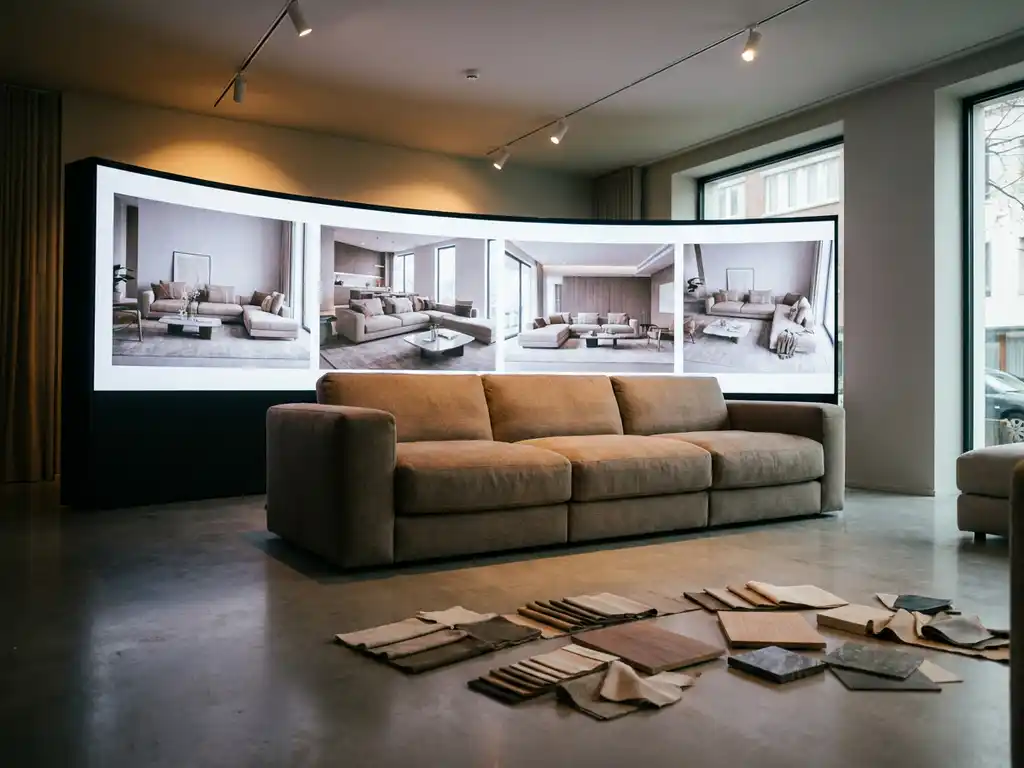
The best alternatives to Cylindo for furniture brands in 2026 are platforms that combine high-quality 3D visualisation platform for furniture with integrated 3D room planning software, AR capabilities, and deep configurability. Strong contenders include iONE360, Threekit, Zakeke, and Expivi, each with different strengths depending on your product complexity and channel strategy. This article walks through the key comparison points so you can make the right choice for your business.
How does Cylindo compare to other 3D furniture visualisation platforms?
Cylindo is a 3D furniture visualisation platform that offers product spin views and basic variant switching. It tends to perform well on visual output for standard upholstered furniture, but shows limitations when it comes to complex product configuration logic, integrated 3D room planning software, and omnichannel flexibility — areas where newer and more specialised alternatives have a clear advantage.
Where Cylindo focuses primarily on 360-degree product viewers and packshot generation, platforms like iONE360 go further by combining the product configurator, AR viewer, and room planner into a single integrated environment. For brands selling highly configurable products with thousands of variants, the difference in back-end capability becomes significant quickly.
Key dimensions to compare across 3D furniture visualisation platforms include:
- Visual quality and realism of rendered outputs
- Configuration depth, including support for complex business rules and pricing logic
- Room planning integration within the same platform
- AR capabilities and whether they require app downloads
- System integration with PIM, ERP, and webshop environments
- Scalability across large product catalogues and multiple sales channels
What features should you look for in a Cylindo alternative?
When evaluating Cylindo alternatives, prioritise platforms that handle your full product complexity without requiring separate tools for configuration, visualisation, and room planning. The strongest alternatives offer all of these capabilities within a single, web-based environment that integrates cleanly with your existing tech stack — eliminating the cost and friction of maintaining disconnected point solutions.
Beyond the basics of 3D rendering, the features that genuinely separate strong Cylindo alternatives from weaker ones are:
- Complex configuration logic: Can the platform handle intricate product rules, conditional options, and dynamic pricing across millions of variants? This is the foundation of a true furniture product configurator, not just a visualisation layer.
- Automated packshot generation: Does it produce high-quality product images automatically without manual effort per variant?
- Integrated 3D room planning software: Can customers arrange and configure multiple products together in a realistic room environment?
- Web-based AR for furniture: Does augmented reality work directly in the browser without requiring a separate app download?
- White-label flexibility: Can the platform be branded and deployed consistently across your retailer network?
- Back-end self-service: Can your own team create and manage configurations without relying entirely on the vendor?
- Proven furniture industry experience: Does the vendor understand the specific commercial and technical requirements of furniture and home furnishings?
Platform longevity and future-readiness
When choosing a Cylindo alternative, consider not just current capabilities but the vendor’s track record of platform evolution. Technologies like AI-assisted 3D asset generation and photorealistic real-time rendering are advancing rapidly, and your platform partner should be actively investing in these areas. We continuously develop iONE360 in direct response to the evolving needs of the furniture industry — backed by over 45 years of sector expertise and a dedicated product team focused exclusively on furniture and home décor commerce.
What are the best alternatives to Cylindo for furniture brands?
The strongest Cylindo alternatives for furniture brands in 2026 are iONE360, Threekit, Zakeke, and Expivi. Each platform has a distinct profile, and the right choice depends on your product complexity, channel strategy, and integration requirements. Of these, iONE360 is the only platform built exclusively for the furniture and interior industry, making it the most complete fit for brands with complex, configurable catalogues.
| Evaluation Criteria | Cylindo | iONE360 | Threekit | Zakeke | Expivi |
|---|---|---|---|---|---|
| Configuration Depth | Basic | Advanced / Complex | Moderate | Moderate | Moderate |
| Integrated Room Planner | No | Yes | Partial | No | Partial |
| Web-Based AR | Partial | Yes | Yes | Yes | Yes |
| Furniture Industry Focus | General | Specialist | General | General | General |
| White-Label Support | Partial | Yes | Partial | Partial | Partial |
| PIM/ERP Integration | API | Native / API | API | Limited | API |
The table above gives a quick overview of where each platform stands on the criteria that matter most for furniture brands. Read the detailed platform profiles below to understand how each fits different business profiles and catalogue types.
iONE360
iONE360 is a specialist visual commerce platform built exclusively for the furniture, home, and décor industry by the Dutch Colijn Group, which brings over 45 years of sector-specific software expertise. It combines a 3D product configurator, automated packshot generation, web-based AR, and an advanced 3D room planning tool within a single integrated platform. iONE360 handles highly complex products with sophisticated business rules and pricing, making it particularly well-suited for manufacturers and brands with large, configurable catalogues. Among the platforms evaluated here, iONE360 offers the deepest furniture-specific capability and the most cost-effective path to scaling visual configuration across multiple sales channels.
Furniture brands working with us consistently report meaningful improvements in online conversion rates, significant reductions in product photography spend through automated packshot generation, and larger average basket sizes when room planning is part of the customer journey. Our platform is trusted by manufacturers and retailers across Europe with catalogues ranging from hundreds to tens of thousands of configurable SKUs.
Threekit
Threekit is a US-based platform with strong visual quality and broad industry coverage beyond furniture. It performs well for brands that need photorealistic 3D and AR outputs, and its rendering engine is one of the more capable options available for general commercial use. However, its room planning capabilities are less native and less furniture-specific than dedicated platforms, and its configuration depth for complex furniture business rules is shallower than specialist solutions. Threekit is best suited to brands with strong visual quality requirements and relatively straightforward configuration needs, or those operating across multiple product categories beyond furniture. For manufacturers with highly intricate product logic, modular structures, or large configurable catalogues, it is likely to reach its limits earlier than a furniture-specialist platform. Compared to iONE360, it lacks the deep furniture-specific configuration layer and integrated room planning that complex catalogue brands require.
Zakeke and Expivi
Zakeke is a mid-market platform with good ease of use and accessible pricing, making it a practical entry point for smaller furniture brands or retailers with moderate variant counts and straightforward customisation options. Its configurator covers the basics well, but it is not designed for very large catalogues or the kind of intricate conditional logic that complex furniture manufacturers depend on. For brands at an early stage of 3D visualisation adoption with limited SKU counts, Zakeke offers a manageable starting point — though it will require augmenting with separate tools as complexity grows. Compared to iONE360, it does not offer the same depth of furniture-specific configuration or an integrated room planning environment.
Expivi offers configurator functionality and reasonable AR support, making it a viable option for brands in an earlier stage of 3D adoption. It handles standard configuration scenarios competently, but reaches its limits when intricate business rules, multi-channel deployment, or large variant trees are involved. It is best positioned for brands that need an accessible configurator without immediately requiring deep integration or enterprise-scale catalogue management. For furniture brands with complex products or a need for integrated room planning, iONE360 provides a significantly more complete and scalable solution.
Which Cylindo alternative is right for your business size and catalogue?
The right platform depends as much on your business profile as on feature checklists. Here is a quick guide to which alternative fits which type of furniture operation.
- iONE360 — best for mid-to-large furniture manufacturers and brands with complex, configurable catalogues, multi-channel distribution including retailer networks, and a need for integrated configuration, AR, and room planning in one platform. The most complete fit for brands that cannot afford gaps in configuration logic or channel consistency.
- Threekit — suited to brands with strong visual quality requirements and simpler configuration needs, or those operating across multiple product categories beyond furniture. A reasonable choice when photorealistic output is the priority and product logic is relatively straightforward.
- Zakeke — a practical starting point for smaller furniture retailers or brands with limited SKU counts and straightforward customisation options. Works well when budget is a primary constraint and catalogue complexity is low.
- Expivi — fits brands in an early stage of 3D adoption looking for an accessible configurator with reasonable AR support. A stepping stone platform for businesses not yet ready for enterprise-scale visual commerce.
If you are unsure which profile matches your situation, contact our team for a direct conversation about your catalogue and channel requirements.
Which Cylindo alternative is best for configurable or custom furniture?
For configurable or custom furniture, the best Cylindo alternative is a platform that can handle complex product logic natively — not just visual rendering. If your products involve conditional options, fabric and finish combinations, modular structures, or custom dimensions, you need a furniture product configurator built for that level of complexity, not just a 3D viewer with variant switching. iONE360 is purpose-built for exactly this use case.
This is where the distinction between a visualisation tool and a true product configurator matters most:
- A 3D visualisation tool: renders product images from given inputs — no logic layer, no validation of combinations, no dynamic pricing.
- A true product configurator: manages valid combinations, calculates pricing dynamically, and guides the customer through a structured selection process — essential for complex furniture manufacturing.
Platforms with deep configuration logic also reduce sales errors, since the system enforces valid combinations rather than relying on sales staff to catch incompatible selections manually. For brands selling through a dealer network, this consistency in the guided sales process is a meaningful commercial advantage.
How do Cylindo alternatives handle AR and room planning?
AR and room planning capabilities vary significantly across Cylindo alternatives. The key distinction is whether these features are native to the platform or added through third-party integrations — and whether the room planning software allows customers to configure products directly within the room environment, rather than simply placing pre-set variants.
Basic AR implementations let customers place a single product in their space using their phone camera. More advanced solutions — including the best 3D room planning software options available in 2026 — go further by allowing customers to furnish an entire room, switch between product configurations on the spot, see realistic lighting and material rendering, and view the full scene in AR using web-based AR for furniture, all without leaving the browser. Industry experience consistently shows that presenting products in context significantly increases buying intent.
When evaluating AR and room planning across Cylindo alternatives, ask these practical questions:
- Does AR require an app download, or does it work directly in the browser?
- Can customers configure products within the room planner, or only place pre-set variants?
- Does the room planner support flooring, wallpaper, curtains, and full room decoration?
- Can multiple products be configured and ordered directly from within the room planning environment?
- Is the room planner white-labeled and embeddable in your own webshop or retailer sites?
What is 3D room planning software and why does it matter for furniture brands?
3D room planning software is a browser-based tool that lets customers furnish and decorate a full room using realistic 3D models — selecting, configuring, and arranging products in a virtual space before making a purchase decision. Unlike a standard product viewer, 3D room planning software places buying decisions in context, allowing shoppers to see how a sofa works with a coffee table, how a fabric reads under different lighting, and how an entire interior comes together before a single item is ordered.
For furniture brands, the commercial case for integrated 3D room planning software is well-established. Presenting products within a complete room environment increases basket size by encouraging multi-product purchases, reduces returns by giving customers a more accurate sense of scale and fit, and improves buying confidence at the moment of decision — particularly for high-value or complex purchases where uncertainty is the primary barrier to conversion.
When evaluating 3D room planning software as part of a Cylindo alternative, look for these core capabilities:
- Real-time product configuration within the room — customers should be able to change fabrics, finishes, and dimensions on the spot, not just place pre-set variants
- Photorealistic material and lighting rendering that reflects how products actually look in a home environment
- Web-based AR view of the full room scene, without requiring an app download
- Multi-product ordering directly from within the planner, without requiring customers to leave and rebuild their basket
- White-label embeddability for deployment across your own webshop and retailer networks
We built iONE360 to deliver all of these capabilities within a single integrated environment — making it the most complete 3D room planning software solution available for furniture brands with complex, configurable catalogues.
How much does a Cylindo alternative cost? Pricing models to understand
Most 3D visualisation platforms for furniture brands operate on one of two dominant pricing structures. The first is a subscription or SaaS model, where brands pay a monthly or annual fee — typically tiered by catalogue size, number of active channels, or platform usage volume. The second is a project-based or licence model, where an upfront implementation fee covers initial platform setup and asset configuration, with ongoing support and maintenance billed separately. Understanding which model a vendor uses — and what triggers tier upgrades — is essential before comparing headline costs.
The more significant cost variable is total cost of ownership, which often looks very different from the initial licence fee. Hidden cost factors that inflate TCO include per-SKU fees for 3D asset creation or migration, per-channel deployment charges when expanding to retailer networks, ongoing content management fees for catalogue updates, and integration development costs when connecting to existing PIM or ERP systems. Brands that choose a general-purpose platform and then layer on separate tools for configuration, AR, and room planning frequently find that their combined spend significantly exceeds the cost of a single integrated solution from the outset.
We designed iONE360 as a cost-effective, pragmatically scalable platform that consolidates configuration, visualisation, AR, and 3D room planning software into one environment — avoiding the cumulative cost and operational friction of maintaining multiple specialist tools. For brands evaluating Cylindo pricing against alternatives, the relevant comparison is not platform fee versus platform fee, but total workflow cost versus total workflow cost.
Questions to ask any vendor about total cost:
- What are the asset migration or creation fees per SKU, and who bears that cost?
- Is pricing per SKU, per channel, or per usage volume — and what triggers a tier increase?
- Can your own team manage content updates through a self-service back end, or is ongoing vendor involvement required?
- What are the integration support costs for connecting to your PIM, ERP, and webshop?
How do you migrate from Cylindo to a new visualisation platform?
Switching from Cylindo to a new 3D visualisation platform involves four main phases: asset audit and transfer, platform configuration, system integration, and staged rollout. The complexity depends on the size of your product catalogue, the depth of your existing integrations, and whether you are moving to a platform with significantly different capabilities.
A practical migration from Cylindo typically follows this sequence:
- Asset audit: Review your existing 3D assets and determine which can be reused or need to be rebuilt to meet the new platform’s quality or format standards.
- Platform configuration: Work with your new vendor to configure your product logic, business rules, and pricing within their system.
- System integration: Connect the new platform to your PIM, ERP, CMS, and webshop through available APIs or connectors.
- Staged rollout: Run a parallel period where both platforms operate simultaneously before fully cutting over.
The most important factor in a smooth migration is choosing a vendor with genuine onboarding expertise in the furniture industry. A vendor that understands your product structure from day one will significantly reduce the risk of delays or data quality issues during the transition.
Integration capabilities: how Cylindo alternatives connect to your tech stack
For IT managers and digital directors evaluating Cylindo alternatives, integration capability is as important as front-end visualisation quality. The three main integration points for any 3D visualisation platform are your PIM (product data and variant management), your ERP (pricing, stock, and order data), and your customer-facing webshop or CMS. Platforms vary significantly in whether these connections are delivered through native connectors, documented API integrations, or require custom development work — a distinction that has a direct impact on implementation timelines and ongoing maintenance costs.
A well-integrated platform enables automatic synchronisation of product data changes across all visual outputs, so a fabric update in your PIM propagates immediately to the configurator, the room planner, and all retailer-facing deployments without manual intervention. It also enables real-time pricing updates within the configurator, consistent product presentation across your own webshop and retailer channels without duplication of effort, and clean order data flowing back into your ERP from every touchpoint. Without this level of integration, brands typically end up managing product data in multiple places simultaneously — creating version control problems and increasing the operational cost of catalogue management.
We offer iONE360 with a well-documented API and proven integration experience with the major e-commerce and PIM environments used across the furniture industry. Our integration approach is designed to reduce implementation complexity and support your internal team through the connection process. Before committing to any platform, ask vendors the following:
- Are PIM and ERP connectors native to the platform, or do they require custom development?
- Which e-commerce platforms does the integration layer support out of the box?
- How is PIM compatibility documented, and what data standards does the platform require?
- How complete and maintained is the API documentation?
- What is the typical integration timeline from kickoff to live connection?
How iONE360 helps with 3D room planning and furniture visualisation
We built iONE360 specifically to solve the challenges that furniture manufacturers and retailers face when trying to present complex, configurable products consistently across every sales channel. Rather than patching together separate tools for visualisation, configuration, AR, and room planning, we offer everything within one integrated platform — designed from the ground up for the furniture and interior industry.
Here is what that means in practice:
- Advanced 3D room planning software that lets customers furnish and decorate entire rooms, configure products on the spot, and view the result in photorealistic 3D or AR, all without leaving the browser
- A fully integrated product configurator that handles millions of variants, complex business rules, and dynamic pricing without manual effort per product
- Automated packshot generation that eliminates the cost and time of traditional product photography at scale
- White-label flexibility that ensures consistent brand presentation across your own webshop, retail partners, and in-store touchpoints
- Seamless integration with PIM, ERP, CMS, and e-commerce platforms through a well-documented API
- Over 45 years of furniture industry expertise behind every product decision we make
Brands that have made the switch from Cylindo tell us that the combination of deep configuration logic and integrated room planning transforms both their internal workflows and their customer-facing sales experience. If you are evaluating Cylindo alternatives and want to see how iONE360 fits your specific catalogue and channel strategy, get in touch with our team for a personalised demonstration.
Frequently Asked Questions
How long does it typically take to switch from Cylindo to an alternative platform?
The timeline varies depending on catalogue size and integration complexity, but most furniture brands should plan for 8–16 weeks from kickoff to full go-live. Smaller catalogues with straightforward integrations can move faster, while large manufacturers with complex product trees, multiple sales channels, and deep ERP or PIM connections should allow more time. Choosing a vendor with dedicated furniture industry onboarding experience is the single biggest factor in keeping the project on schedule.
Can I reuse my existing 3D assets when switching to a new visualisation platform?
In many cases, yes — but not always without rework. Whether your existing assets are compatible depends on the file formats, polygon counts, and material standards the new platform requires. Some platforms accept industry-standard formats like OBJ, FBX, or glTF directly, while others may need assets rebuilt or optimised to meet their rendering pipeline’s quality requirements. During your migration audit, ask potential vendors to assess a sample of your existing assets before committing, so you have a realistic picture of rework costs and timelines upfront.
What's the difference between a 3D product configurator and a 3D room planner, and do I need both?
A 3D product configurator lets customers customise an individual product — selecting fabrics, finishes, dimensions, and modules — while a 3D room planner lets them place and arrange multiple products together in a full room environment. Whether you need both depends on your sales process: if customers typically buy individual pieces, a configurator alone may be sufficient. However, for furniture brands selling room sets, sofas with matching pieces, or full interior collections, combining both tools in an integrated platform significantly increases basket size and buying confidence.
How do I know if a platform can actually handle my product complexity before I commit?
The most reliable way is to run a structured proof-of-concept (POC) using a representative sample of your most complex products — ideally ones with conditional rules, large variant trees, or custom pricing logic. Ask the vendor to configure these products within their system and demonstrate them live, rather than relying on generic demos. Pay close attention to how the platform handles edge cases, invalid combinations, and pricing calculations, since these are the areas where less capable platforms tend to break down in practice.
Do web-based AR tools deliver good enough quality for high-end furniture brands?
Yes — web-based AR has advanced significantly and is now a credible option even for premium furniture brands. Modern browser-based AR solutions support realistic material rendering, accurate product scaling, and stable room placement without requiring an app download, which dramatically increases the number of customers who actually use the feature. The quality gap between native app AR and web AR has narrowed considerably, and the conversion benefit of removing the app download barrier typically outweighs any marginal rendering difference for most brands.
What are the most common mistakes furniture brands make when choosing a Cylindo alternative?
The most common mistake is evaluating platforms primarily on visual output quality while underestimating back-end configuration capability. A platform may produce beautiful renders but struggle with the business logic your products actually require. Other frequent missteps include choosing a general-purpose tool that lacks furniture-specific features, underestimating integration complexity with existing PIM or ERP systems, and failing to account for the total cost of ongoing asset management and content updates. Always evaluate the full workflow — from product data input to customer-facing output — not just the front-end experience.
Can a 3D room planner be deployed across a retailer network, not just on my own webshop?
Yes, and for furniture manufacturers selling through a dealer or retailer network, this is one of the most commercially valuable deployment scenarios. Platforms with white-label room planning capabilities allow you to embed the same branded experience across multiple retailer websites and in-store kiosks, ensuring consistent product presentation and configuration accuracy regardless of where the customer engages. This also gives manufacturers visibility into how their products are being presented at the retail level, which is difficult to achieve with disconnected, retailer-managed tools.