

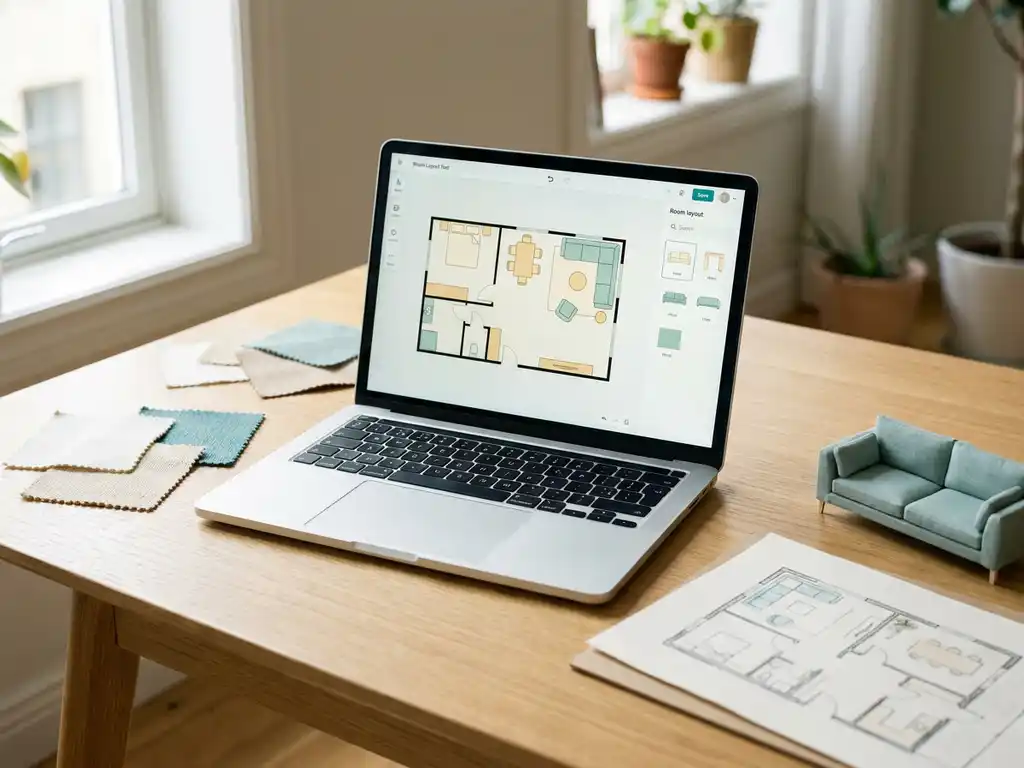
A white-label room planner is a ready-built, web-based room planning tool that a furniture brand or retailer can deploy under their own branding, without building the software from scratch. It gives customers an interactive 3D environment to arrange and visualise furniture before they buy. This article walks through how these tools work, what they include, and why they are increasingly central to modern furniture retail.
What features does a white-label room planner typically include?
A white-label room planner typically includes 3D floor plan creation, drag-and-drop furniture placement, real-time product configuration, photorealistic visualisation, and camera controls such as zoom and rotation. More advanced platforms also support room decoration features like flooring, wallpaper, and curtains, alongside pricing display and direct ordering.
The feature set varies between entry-level and more sophisticated room planning software, but the most capable platforms offer a comprehensive toolkit that covers the full customer journey from inspiration to purchase. Key features to look for include:
- Interactive floor plan builder that lets users define room dimensions and wall layouts
- Drag-and-drop furniture placement with real-time 3D rendering
- Integrated product configurator so users can change fabrics, colours, and dimensions on the spot
- 360-degree camera controls for viewing the room from any angle
- Room decoration tools including flooring, wallpaper, lighting, and accessories
- Live pricing and lead times tied to the configured product specifications
- Direct add-to-cart or quote request functionality built into the planning experience
The combination of configuration and spatial planning in one interface is what separates advanced room planning software from basic layout tools. When customers can configure a sofa and immediately see it at scale in their planned room, the buying decision becomes significantly easier.
How does a white-label room planner work technically?
A white-label room planner works as a web-based application built on a 3D rendering engine, delivered via an embeddable widget or iframe that sits inside the retailer’s existing website or app. The software connects to a product catalogue database, pulls 3D models and configuration rules, and renders them in real time inside the customer’s browser with no download required.
Under the hood, the platform typically relies on a combination of WebGL-based 3D rendering, a rules engine that governs valid product configurations, and API connections to backend systems such as PIM, ERP, or e-commerce platforms. When a customer places a product in the room and changes its configuration, the rules engine validates the selection, the renderer updates the 3D scene, and the pricing engine recalculates the cost simultaneously.
The white-label layer sits on top of this technical infrastructure. Branding elements such as fonts, colours, logos, and UI language are applied through a configuration layer, meaning the same core software serves multiple brands with entirely different visual identities. This is what makes the model both scalable and cost-effective compared to building a proprietary solution.
What is the difference between a white-label and a custom-built room planner?
A white-label room planner is a pre-built platform that is branded and configured for a specific company, while a custom-built room planner is developed from the ground up to that company’s exact specifications. The key difference is time, cost, and risk: white-label solutions can be deployed in weeks and carry proven functionality, whereas custom builds take months or years and carry significant development risk.
The distinction matters most when evaluating total cost of ownership. A custom-built solution may offer theoretical flexibility, but it also requires ongoing development resources, internal maintenance, and continuous updates to keep pace with browser and device changes. A white-label platform distributes those costs across all its clients, meaning each individual user benefits from continuous improvements without bearing the full development burden.
That said, white-label does not mean generic. A well-architected white-label room planning platform can be deeply configured to match a brand’s catalogue, business rules, pricing logic, and visual identity. The practical output for the end customer is indistinguishable from a bespoke build, at a fraction of the cost and deployment time.
Who should use a white-label room planner?
White-label room planners are best suited to furniture manufacturers, home furnishings brands, and larger retailers who sell configurable or multi-piece products and need to scale visual content across a wide product range without the cost of custom software development. They are particularly valuable for businesses selling online, through dealer networks, or across multiple retail locations.
More specifically, the strongest use cases include:
- Furniture manufacturers with dealer networks who need a consistent, branded planning experience they can roll out to retail partners without rebuilding it per location
- E-commerce furniture brands where customers cannot physically experience products before buying and need high-confidence digital tools to reduce purchase hesitation
- National furniture retail chains managing showroom limitations and looking to extend the in-store experience into a digital channel
- Digital agencies and resellers serving multiple furniture clients who want a white-label platform they can implement and brand for each client under a structured partner programme
The common thread across all these profiles is a need to show products in context, at scale, without the cost and time constraints of traditional photography or bespoke software development.
How does a white-label room planner integrate with existing systems?
A white-label room planner integrates with existing systems through APIs and webhooks that connect the planning tool to a company’s PIM, ERP, CMS, or e-commerce platform. Product data, pricing, stock availability, and configuration rules flow from backend systems into the room planner in real time, keeping the customer-facing experience accurate and up to date.
Integration depth varies by platform, but a well-built 3D room planning solution should support at minimum:
- Two-way product data sync with a PIM or ERP so catalogue changes are reflected automatically
- Cart and checkout integration with the existing webshop so configured room products can be ordered directly
- CMS embedding via iframe or JavaScript widget with no impact on page performance
- Single sign-on or session management so returning customers can save and retrieve their room plans
For businesses operating across multiple retail partners, the platform should also support multi-tenant deployment, meaning each retailer or dealer can access a branded version of the tool without requiring separate technical integrations for each one.
What impact does a white-label room planner have on sales and returns?
A white-label room planner increases sales conversion and reduces product returns by giving customers a clear, accurate picture of how products will look and fit in their space before they commit to a purchase. When uncertainty is removed from the buying decision, customers are more likely to buy, more likely to buy more, and less likely to return what they ordered.
The mechanism behind this is straightforward. Traditional furniture buying involves significant imagination work on the customer’s part: will this sofa fit? Does this colour work with my flooring? Will these pieces look right together? Room planning software eliminates that guesswork by providing a spatially accurate, photorealistic answer to each of those questions in real time.
The downstream effects on business performance are meaningful. Fewer returns reduce logistics costs and protect margin. Higher order values result from customers confidently adding complementary pieces they can see working together in their planned room. Faster purchase decisions reduce drop-off in the buying journey. Industry experience consistently shows that showing products in a realistic environment significantly increases buying intent, with some estimates suggesting increases of up to 64%.
How iONE360 helps with room planning
We built our room planning software specifically for the furniture and home furnishings industry, combining over 45 years of sector expertise with a platform designed to handle the complexity that furniture businesses actually face. Here is what that means in practice:
- Two flexible deployment paths: integrate a bespoke, white-labelled room planner built specifically for your platform, or onboard HomeDecoHub, our ready-to-use room planning marketplace powered by the same proven configurator engine
- Integrated product configuration: customers can configure products directly inside the room planner, seeing live prices, lead times, and ordering without leaving the planning experience
- No downloads required: the entire experience runs in the browser, removing friction for every customer regardless of device
- Seamless system integration: our platform connects to your PIM, ERP, CMS, and webshop through well-documented APIs, keeping product data and pricing accurate across every touchpoint
- Scalable across your full catalogue: from a single configurable sofa to thousands of SKUs across multiple collections, our platform handles complexity without requiring manual effort per product
- Consistent brand presentation: your dealers and retail partners can use the same tool under your branding, ensuring a consistent customer experience across every channel
If you are ready to explore what a white-label room planner can do for your brand, get in touch with us and we will walk you through the options that fit your catalogue, your channels, and your goals.
Frequently Asked Questions
How long does it typically take to get a white-label room planner up and running?
Deployment timelines vary depending on catalogue size and integration complexity, but most white-label room planners can go live within a few weeks rather than the months required for a custom build. The main variables are how quickly 3D product models can be prepared or converted, and how deeply the platform needs to connect with existing backend systems such as a PIM or ERP. Working with a provider that has a structured onboarding process and pre-built integration connectors will significantly shorten that timeline.
Do my products need to have 3D models already, or can the provider create them?
Most white-label room planning providers offer 3D model creation as part of their onboarding service, so you do not need existing assets to get started. Models are typically built from product specifications, technical drawings, or reference photography, and are configured to support all available variants such as fabrics, colours, and dimensions. It is worth asking any prospective provider about their modelling pipeline, turnaround times, and how updates are handled when products change.
Can the room planner handle configurable or made-to-order products, not just fixed SKUs?
Yes, and this is one of the most important capabilities to evaluate when choosing a platform. A well-built room planner should support a rules-based product configurator that governs valid combinations of options such as size, fabric, leg finish, and modular components, updating the 3D render and live pricing simultaneously. This is especially critical for furniture businesses where a single sofa might have hundreds of valid configurations, and where showing the wrong combination to a customer could lead to an invalid order.
What happens if a customer starts a room plan but does not complete a purchase?
Most advanced room planning platforms allow customers to save their room plans and return to them later, either through an account login or a shareable link, which significantly reduces abandonment. From a business perspective, saved plans also represent a valuable retargeting signal: a customer who has invested time planning a room is a high-intent lead, and that data can feed into email follow-up workflows or sales team outreach. Make sure any platform you evaluate supports plan saving and can pass that intent data into your CRM or marketing automation stack.
Will adding a room planner slow down my website?
A well-architected room planner should have no meaningful impact on your website’s page load performance because it loads as an embedded widget or iframe that is only initialised when a customer actively engages with it. The 3D rendering runs inside the browser using WebGL and does not require any downloads or plugins. That said, it is worth confirming with any provider that their embed method is asynchronous and does not block your page’s critical rendering path, particularly if site speed is a priority for SEO.
Can I roll out the room planner to my dealer network without each dealer needing a separate technical setup?
Yes, provided the platform supports multi-tenant deployment, which is a key feature to look for if you sell through retail partners or a dealer network. Multi-tenancy means a single instance of the platform can serve multiple branded versions of the tool, each with its own visual identity and potentially its own product selection, without requiring separate integrations for every partner. This makes it practical to offer a consistent, branded planning experience across dozens or hundreds of retail touchpoints without proportionally scaling your technical overhead.
How do I measure whether the room planner is actually improving business performance?
The most direct metrics to track are conversion rate among users who engage with the room planner versus those who do not, average order value for room planner sessions, and return rates on products that were placed and configured in a room plan before purchase. Most platforms provide built-in analytics or can pass event data to Google Analytics or your existing analytics stack. Establishing a baseline before launch and running the room planner as a measurable channel from day one will give you clean data to evaluate ROI and justify further investment.