

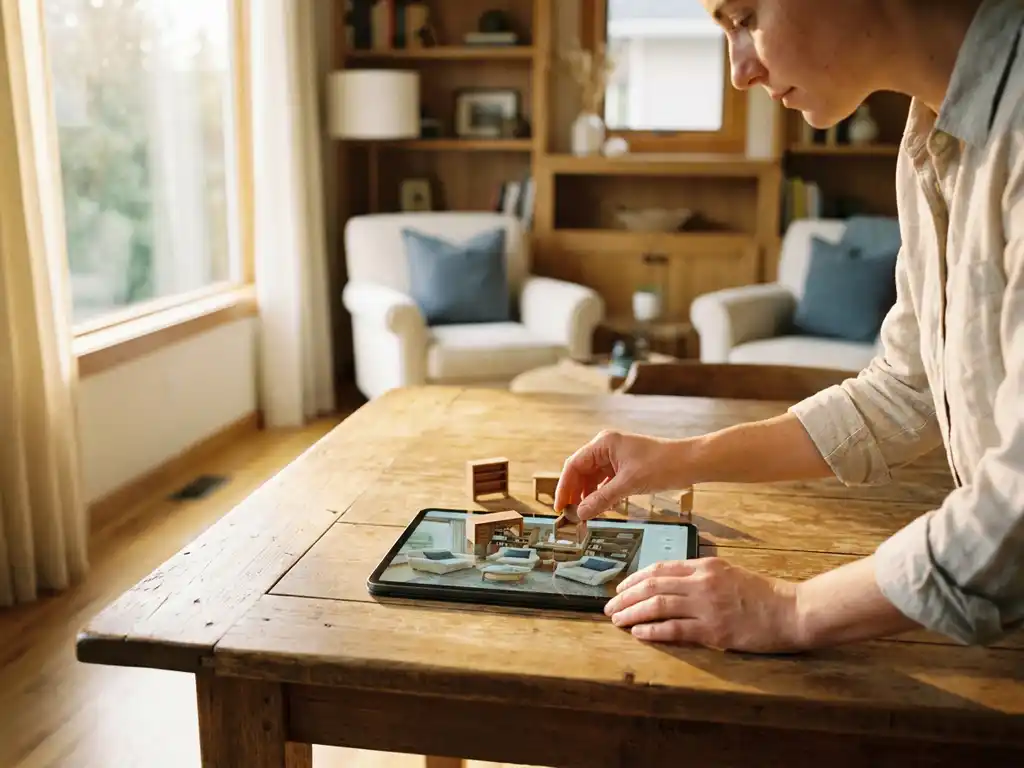
Room planning software increases furniture sales by helping customers visualise complete room setups before they buy, which builds confidence and reduces the hesitation that typically stalls purchase decisions. When shoppers can see how a sofa fits their living room or how a dining table works with their existing decor, they commit faster and spend more. The sections below unpack exactly how that works across features, buyer psychology, order value, returns, and more.
What features does room planning software typically include?
Room planning software typically includes a 2D or 3D floor plan builder, drag-and-drop furniture placement, real-time camera controls for zooming and rotating the scene, and the ability to decorate with flooring, wallpaper, and soft furnishings. More advanced platforms also integrate a product configurator so customers can customise individual pieces directly within the room layout.
The core feature set across most modern 3D room planning tools looks something like this:
- Floor plan creation: Customers draw or import room dimensions to build an accurate spatial canvas
- Furniture placement and arrangement: Products are dropped into the scene and repositioned freely
- 360-degree camera control: Users zoom, pan, and rotate to inspect the room from any angle
- Decoration and finishing: Curtains, flooring, paint colours, and wallpaper can be applied to complete the scene
- Integrated product configuration: Individual furniture pieces can be customised for fabric, colour, and size without leaving the room planner
- Live pricing and lead times: Configured items display up-to-date pricing so customers can make informed decisions on the spot
- Direct add-to-cart: Products configured inside the room planner can be ordered immediately
The most capable platforms also connect seamlessly with a retailer’s existing PIM, ERP, or webshop, meaning product data, stock levels, and pricing stay consistent across every channel without manual updates.
How does visualising furniture in a room reduce purchase hesitation?
Visualising furniture in a realistic room setting reduces purchase hesitation because it eliminates the two biggest uncertainties buyers face: whether the piece will fit the space and whether it will look right with their existing decor. When those doubts are resolved visually, the psychological barrier to committing drops significantly.
Furniture is a high-involvement purchase. Customers are spending meaningful money on something they will live with for years, often without being able to see the exact configuration they want in a physical showroom. That uncertainty creates friction. Room planning tools dissolve it by letting customers answer their own questions in real time.
When a shopper places a sofa in a virtual version of their own living room, adjusts the fabric, and confirms it fits between the window and the TV unit, the decision feels low-risk. They are no longer imagining the result; they are seeing it. Industry experience consistently shows that showing products in a realistic environment can increase buying intent by a substantial margin, and that effect is strongest when the visualisation is photorealistic and interactive rather than static.
The reduction in hesitation also shortens the sales cycle. Customers who have already configured and visualised their purchase arrive at checkout with far fewer unresolved questions, which means fewer abandoned carts and fewer calls to customer service before a decision is made.
Does room planning software actually increase average order value?
Yes, room planning software consistently increases average order value because it encourages customers to think in complete rooms rather than individual products. When a buyer can see how a coffee table, rug, and floor lamp work together in a single scene, they are far more likely to add complementary pieces to their order than if they were browsing products in isolation.
This is one of the most commercially significant benefits of room planning tools for furniture retailers. The mechanism is straightforward: a room planner naturally surfaces product combinations. A customer who came in to buy a dining table sees the chairs, the sideboard, and the pendant light all styled together in a coherent scene. The question shifts from “should I buy this table?” to “how do I want this room to look?” and that framing reliably produces larger baskets.
There are three specific drivers behind the order value increase:
- Cross-category discovery: Customers encounter products they would not have searched for independently because the room context makes their relevance obvious
- Confidence in combinations: Seeing items together removes the risk of buying pieces that clash, so shoppers are more willing to commit to multiple purchases at once
- Emotional investment: The more time a customer spends designing their room, the more attached they become to the result and the more motivated they are to complete the vision
How does a room planner reduce furniture returns?
A room planner reduces furniture returns by ensuring customers make informed decisions before they buy. The most common reasons for returning furniture are that it does not fit the space as expected, the colour or finish looks different in person, or it does not match other pieces in the room. A good room planning tool addresses all three directly.
When customers build a scaled floor plan and place furniture with accurate dimensions, they can confirm fit before ordering. When they configure the exact fabric or finish and see it rendered in a photorealistic environment, colour surprises are minimised. When they style the whole room together, clashes become visible before they become costly.
Returns are expensive for furniture retailers and manufacturers alike. Logistics, restocking, and potential damage all eat into margin. Beyond the financial cost, a return damages customer trust in a way that is difficult to recover from. Room planning software shifts the discovery of problems from after delivery to before purchase, which is the most cost-effective place to catch them.
What’s the difference between a room planner and a product configurator?
A product configurator focuses on a single item, letting customers customise its attributes such as size, material, colour, and finish. A room planner operates at the scene level, allowing customers to arrange multiple products together in a spatial layout. The key distinction is scope: one is about building the perfect product, the other is about designing the perfect room.
In practice, the most powerful furniture retail tools combine both. A customer starts by placing furniture in their room layout, then drills into an individual piece to configure it exactly how they want it, then steps back out to see how the configured piece looks in the full scene. That loop between room-level planning and product-level configuration is where the real commercial value sits.
A standalone configurator without room planning context can still be highly effective for complex products like modular sofas or custom wardrobes. But for retailers selling across multiple categories or wanting to drive multi-product purchases, integrating both tools into a single platform produces significantly stronger results than using either in isolation.
Which types of furniture retailers benefit most from room planning software?
Furniture retailers who sell across multiple categories, offer configurable products, or operate both online and in-store channels benefit most from room planning software. The tool is particularly valuable for brands where customers are furnishing entire rooms rather than buying single replacement items.
The strongest fit tends to be with:
- Full-range furniture brands and manufacturers who want to show how their catalogue works as a cohesive collection rather than isolated products
- Retailers with configurable product lines such as modular sofas, custom storage, or made-to-order dining sets, where visualising the configured result in context is essential
- Omnichannel retailers who need a consistent product experience across their webshop, in-store kiosks, and dealer network
- E-commerce-first furniture brands that cannot rely on a physical showroom to do the selling and need digital tools to replicate that experience online
- Manufacturers selling through retail partners who want to provide dealers with a branded, scalable sales tool without investing in a separate solution for each location
Smaller retailers selling a narrow, non-configurable range will see less return on the investment. But for any business where the customer journey involves imagining how multiple products will work together in their home, room planning software addresses the core challenge directly.
How iONE360 helps increase furniture sales with room planning
We built our room planning software specifically for the furniture and home furnishings industry, drawing on more than 45 years of sector expertise from the Dutch Colijn Group. The result is a tool that does not just look impressive; it is engineered to convert browsers into buyers and single-item orders into full-room purchases.
Here is what sets our approach apart:
- Integrated configurator and room planner: Customers configure individual products and see them rendered in their room layout in real time, without switching between tools
- Live pricing, lead times, and direct ordering: Everything a customer needs to complete a purchase is available inside the room planning environment
- Two flexible deployment paths: A bespoke, white-labelled room planner built for your platform, or onboarding to HomeDecoHub, our ready-to-use room planning marketplace powered by the same proven software
- Seamless system integration: Our platform connects with your PIM, ERP, CMS, and webshop so product data stays accurate and consistent across every channel
- Scalable across your full catalogue: Every product variant, fabric, finish, and configuration is handled automatically, eliminating the need for manual visual content production per variant
- Omnichannel ready: The same tool works on your website, in-store kiosks, and through your dealer network, ensuring brand consistency everywhere your products are sold
The commercial impact is concrete: higher conversion rates, larger basket sizes, fewer returns, and a buying experience that builds the kind of customer confidence that drives loyalty. If you want to see what this looks like in practice for your product range, get in touch with our team and we will walk you through it.
Frequently Asked Questions
How long does it typically take to implement room planning software on a furniture retailer's website?
Implementation timelines vary depending on the size of your product catalogue and how deeply the tool needs to integrate with your existing systems, but most retailers can expect a fully functional room planner to go live within a few weeks to a few months. The most time-intensive part is usually preparing accurate 3D product data and configuring integrations with your PIM or ERP. Choosing a platform that handles data onboarding as part of the setup process, as iONE360 does, significantly reduces the burden on your internal team.
What kind of 3D product data do I need to get started, and what if I don't have it yet?
Most room planning platforms require 3D models of your products along with accurate dimensions, material textures, and configuration logic for any customisable attributes. If you do not have 3D assets ready, many providers can create them from your existing technical drawings, photographs, or physical samples. It is worth asking any platform vendor upfront what their data onboarding process looks like, as the quality and accuracy of your 3D content directly determines how convincing and useful the room planner will be for customers.
Will customers actually use a room planner, or is it just a feature that looks good but gets ignored?
Engagement depends heavily on how prominently the room planner is surfaced in the shopping journey and how intuitive it is to use. Tools that are buried in a product page footer will underperform, while those integrated directly into the product discovery flow tend to see strong adoption. The key is reducing friction: the faster a customer can get a product into a room scene, the more likely they are to engage, and the longer they engage, the higher their likelihood of purchasing.
Can room planning software work for in-store sales teams, not just online shoppers?
Absolutely, and this is one of the most underused applications of the technology. In-store sales associates can use a room planner on a kiosk or tablet to co-design a room with a customer during a showroom visit, which is particularly powerful for complex or high-value purchases. This approach also bridges the gap between what is physically on the showroom floor and the full breadth of a retailer’s configurable catalogue, allowing customers to visualise options that are not available as floor samples.
How do I measure whether room planning software is actually driving more sales for my business?
The most direct metrics to track are conversion rate among users who engage with the room planner versus those who do not, average order value for sessions that include room planning activity, and return rates for products purchased through the tool compared to standard browsing. Most platforms provide built-in analytics or integrate with your existing tracking setup to make these comparisons straightforward. Setting a clear baseline before launch gives you a clean before-and-after picture of commercial impact.
What's the biggest mistake furniture retailers make when rolling out room planning software?
The most common mistake is treating the room planner as a standalone feature rather than integrating it into the full customer journey. If the tool is not connected to live pricing, real stock levels, and a direct path to checkout, customers who complete a design still face friction when trying to act on it, which erodes much of the conversion benefit. Equally, launching with an incomplete or low-quality product catalogue means customers cannot design realistic rooms, which undermines confidence rather than building it.
Is room planning software suitable for furniture manufacturers who sell through retail partners rather than directly to consumers?
Yes, and it can be a significant competitive advantage in a wholesale or dealer model. Manufacturers can provide their retail partners with a branded, ready-to-use room planning tool that showcases the full catalogue in a consistent, high-quality way across every point of sale. This not only supports sell-through at the dealer level but also ensures the brand experience remains controlled and coherent regardless of where the product is being sold.