

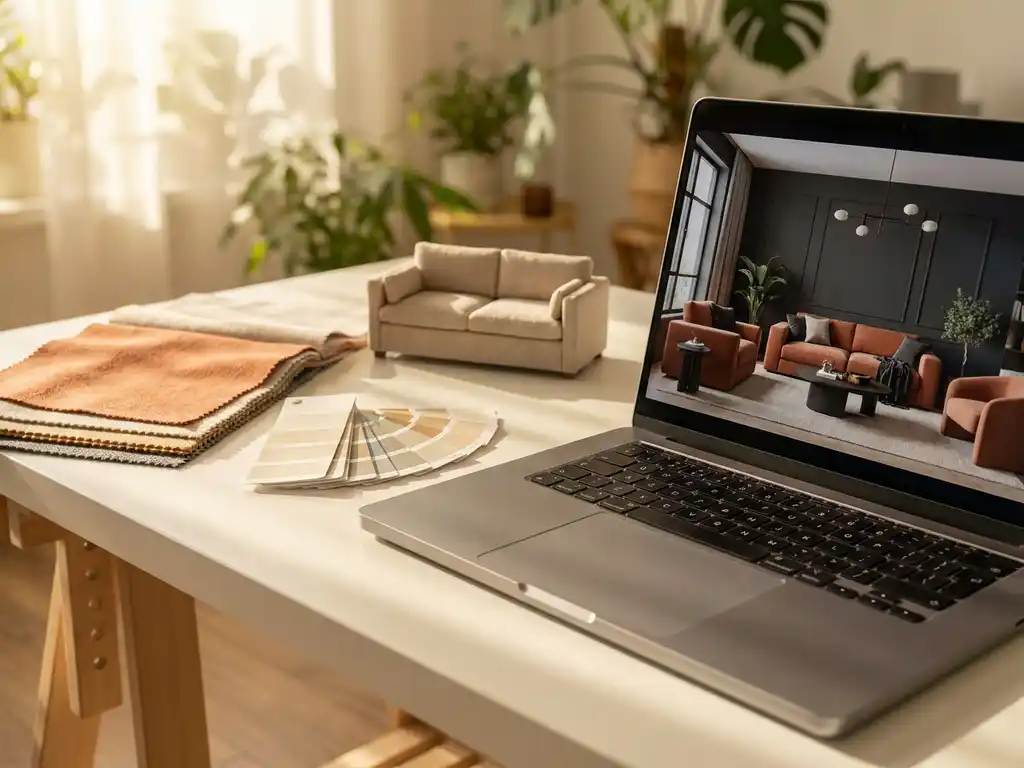
For interior design work that goes beyond inspiration, dedicated 3D room planning software outperforms ChatGPT in almost every practical way. ChatGPT is a powerful language model, but it cannot visualize a room, place real furniture, or let you configure products in three dimensions. For anyone furnishing a home or selling furniture, a purpose-built room planning tool delivers what actually matters: spatial accuracy, real product data, and confident purchasing decisions.
This distinction matters most for furniture brands and retailers who need their customers to move from browsing to buying. The sections below unpack what today’s AI design tools can and cannot do, which alternatives exist, and when a visual configurator is the smarter investment.
What can AI tools actually do for interior design today?
AI tools for interior design can generate mood boards, suggest colour palettes, produce photorealistic room renders from text prompts, and help users explore aesthetic directions quickly. They are genuinely useful for early-stage inspiration and visual ideation, particularly when a designer or homeowner wants to experiment with styles before committing to anything.
The most capable AI design tools in 2026 fall into four clear categories, each solving a different problem at a different stage of the design process:
- Image generators (such as Midjourney or Adobe Firefly): produce styled room visuals from text descriptions, useful for mood and atmosphere
- AI room renderers (such as Decoratly or RoomGPT): apply style filters or redesign uploaded room photos automatically
- AI assistants (such as ChatGPT): answer design questions, explain colour theory, suggest furniture combinations, and help write briefs
- 3D room planning software with AI features: combine spatial planning with real product catalogues and intelligent layout suggestions
The further down that list you go, the closer the tool gets to an actual purchase decision rather than a creative exercise. Only the fourth category — 3D room planning software with integrated product data — supports the full journey from design concept to confirmed order.
Why isn’t ChatGPT enough for serious interior design work?
ChatGPT is not sufficient for serious interior design work because it cannot place furniture in a real room, calculate spatial dimensions, or show what a specific product looks like in a specific space. It operates entirely in language and cannot generate accurate, interactive visual output tied to real product specifications or floor plan dimensions.
This becomes a practical limitation the moment design moves from inspiration to execution. A homeowner asking “will a 240 cm sofa fit along this wall?” needs a spatial answer, not a written one. A furniture retailer whose customer wants to see a corner sofa in fabric option seven, in their actual living room dimensions, needs a tool that handles geometry, product configuration, and visual realism simultaneously — none of which ChatGPT can provide.
ChatGPT also has no access to live product catalogues, pricing, or lead times. It cannot tell a customer what is actually available, what it costs, or how to order it. For furniture brands and retailers, this gap between inspiration and transaction is where sales are won or lost.
What are the best AI-powered alternatives to ChatGPT for interior design?
The best AI-powered alternatives to ChatGPT for interior design are tools that combine visual output with spatial accuracy and real product data. Depending on the use case, the strongest options include dedicated room planning platforms, AI render tools, and 3D configurators built specifically for the furniture and home furnishings industry.
Here is a practical overview of the leading alternatives, matched to their best use case:
- Midjourney or Stable Diffusion: Best for generating photorealistic design concepts and style inspiration. Not suitable for spatial planning or product selection.
- RoomGPT / Decoratly: Best for quickly restyling an existing room photo. Limited to surface-level aesthetics, with no product integration.
- Houzz / Planner 5D: Consumer-facing room planners with basic 3D functionality. Useful for general planning but not built for furniture brand ecosystems or complex product configurations.
- IKEA Place / retailer AR apps: AR-based tools tied to a single brand’s catalogue. Effective within that brand but not configurable across a wider product range.
- Purpose-built 3D room planning software integrated with a product configurator: The most complete solution for furniture brands and retailers. Combines floor plan creation, furniture placement, real-time product configuration, pricing, and ordering in one platform.
For furniture manufacturers and retailers, the fifth category — purpose-built 3D room planning software with an integrated configurator — is where the most measurable commercial impact lies. The tools in the first four categories are useful for consumers browsing independently, but they do not close sales.
How does a 3D product configurator go further than AI image generators?
A 3D product configurator goes further than AI image generators because it works with real, accurate product data rather than generated approximations. Where an AI image generator produces a plausible-looking room, a configurator shows the actual product in the actual dimensions, with the actual fabric or finish selected, at the actual price. That difference is decisive when a customer is ready to buy.
AI image generators are non-deterministic: every render is a creative interpretation. A 3D product configurator is deterministic: it reflects exactly what the customer will receive. This matters for several reasons:
- Customers can select materials, sizes, and configurations and see the result update in real time
- Complex business rules (such as which fabrics are available in which frame sizes) are enforced automatically
- The visual output is tied directly to a SKU, a price, and an order
- Returns drop because customers know precisely what they have ordered before it arrives
When a room planning tool is integrated with a product configurator, the experience becomes even more powerful. Customers can plan an entire room, configure each piece of furniture individually, and add everything to their basket without leaving the planning environment.
When should furniture brands use a visual configurator instead of AI design tools?
Furniture brands should use a visual configurator instead of AI design tools whenever the goal is to convert interest into a sale. AI design tools are excellent for generating inspiration and exploring aesthetics, but they do not support the final steps of a purchase: product selection, configuration, pricing, and ordering. A visual configurator handles all of these within a single, guided experience.
The clearest signals that a brand needs a configurator rather than an AI tool include:
- Products that come in multiple variants (fabrics, sizes, finishes, configurations) that cannot all be photographed cost-effectively
- A need to present the full product range consistently across online and in-store channels
- Customers who abandon the buying process because they cannot visualize what they are ordering
- High return rates driven by products not matching customer expectations
- Dependence on physical showroom space or sample libraries that are expensive to maintain and scale
In these situations, an AI image generator adds inspiration but does not solve the core problem. A purpose-built 3D room planning tool, integrated with a product configurator, addresses the actual friction in the sales process.
How iONE360 solves interior design challenges for furniture brands
iONE360 is a purpose-built visual commerce platform for the furniture and home furnishings industry, designed specifically to close the gap between inspiration and confident purchase. Unlike generic AI design tools, iONE360 combines 3D room planning, real-time product configuration, and photorealistic visualization in a single integrated platform — backed by over 45 years of furniture industry expertise. We built iONE360 to deliver cost-effective, pragmatically scalable visual configuration that connects directly to how furniture brands sell.
Here is what our room planning solution delivers in practice:
- Real-time 3D room planning: customers create accurate floor plans, place furniture, and explore layouts by zooming and rotating the scene from any angle
- Integrated product configurator: every piece of furniture in the room can be configured on the spot, including fabric, size, finish, and options, with prices and lead times updating live
- Photorealistic visualization: automatically generated, high-quality visuals that reflect the exact configuration selected, no manual photoshoot required
- AR viewing: customers can place configured furniture in their actual room using augmented reality before ordering
- Seamless integration: the platform connects with your existing PIM, ERP, CMS, and webshop, and is available as a white-labeled solution or through our ready-to-use HomeDecoHub marketplace
- Proven commercial impact: showing products in a room environment increases buying intent by up to 64%, while reducing returns and increasing average order values
Whether you are a manufacturer looking to scale your visual content without costly photoshoots, or a retailer wanting to give customers a genuinely confident buying experience, our platform is built for exactly that challenge.
Ready to see what a purpose-built room planning tool can do for your brand? Get in touch with our team and we will show you what is possible.
Frequently Asked Questions
Can I use a 3D room planning tool even if I'm not tech-savvy or design-trained?
Yes — purpose-built 3D room planning tools like iONE360 are designed for end consumers, not just trained designers. The interface guides users through the process step by step: drawing a floor plan, placing furniture, and configuring products. No design background is needed, and the tool handles the spatial rules and product logic automatically so that results are always accurate and realistic.
What happens if a customer's room dimensions are unusual or complex — will the room planner still work accurately?
Modern 3D room planning software is built to handle non-standard layouts, including rooms with alcoves, angled walls, bay windows, and irregular floor plans. Customers input their actual measurements, and the tool scales furniture and space accordingly. This is precisely where a room planner outperforms both AI image generators and manual sketches, since the output reflects real geometry rather than an approximation.
How difficult is it for a furniture brand to integrate a 3D configurator with its existing systems?
Integration complexity depends on your existing tech stack, but leading platforms like iONE360 are built with connectivity in mind and support standard integrations with PIM, ERP, CMS, and e-commerce platforms. Most brands can go live without rebuilding their infrastructure. The key step is ensuring your product data — dimensions, variants, pricing, and rules — is structured and available to feed into the configurator.
Will switching to a 3D room planning tool mean I need to replace all my existing product photography?
Not necessarily. A 3D configurator generates photorealistic visuals directly from 3D product models, which means you can reduce or even eliminate the need for traditional photoshoots for new variants, fabrics, or configurations. Existing photography can still be used in marketing and editorial contexts, while the configurator handles the interactive, purchase-stage visuals. Over time, most brands find the cost of maintaining 3D models is significantly lower than ongoing photography for every product variant.
Can a 3D room planner work in-store as well as online, or is it only suited for e-commerce?
A well-built room planning platform works across both channels. In-store, sales associates can use it on tablets or large screens to co-create room plans with customers during consultations, which strengthens the conversation and accelerates decisions. Online, customers use it independently at their own pace. Brands that deploy the tool across both touchpoints typically see the strongest impact on conversion and average order value, since the experience is consistent wherever the customer engages.
How does a visual configurator actually help reduce product returns?
Returns in furniture retail are frequently driven by a mismatch between expectation and reality — a sofa that looks different in person, a colour that reads differently at home, or dimensions that don’t fit as imagined. A visual configurator closes this gap by showing the exact product, in the exact configuration ordered, within a space that matches the customer’s real room dimensions. When customers can see precisely what they are buying before they commit, the likelihood of post-delivery disappointment drops significantly.
Is there a risk that customers spend time using the room planner but still don't convert to a purchase?
Room planning tools are specifically designed to move customers toward a purchase decision, not away from it. Because the tool connects configuration directly to pricing, availability, and the checkout process, the path from planning to buying is intentionally short. Research consistently shows that customers who engage with interactive product visualization show higher buying intent — iONE360 data points to increases of up to 64% — because the planning process itself builds confidence rather than creating more doubt.