

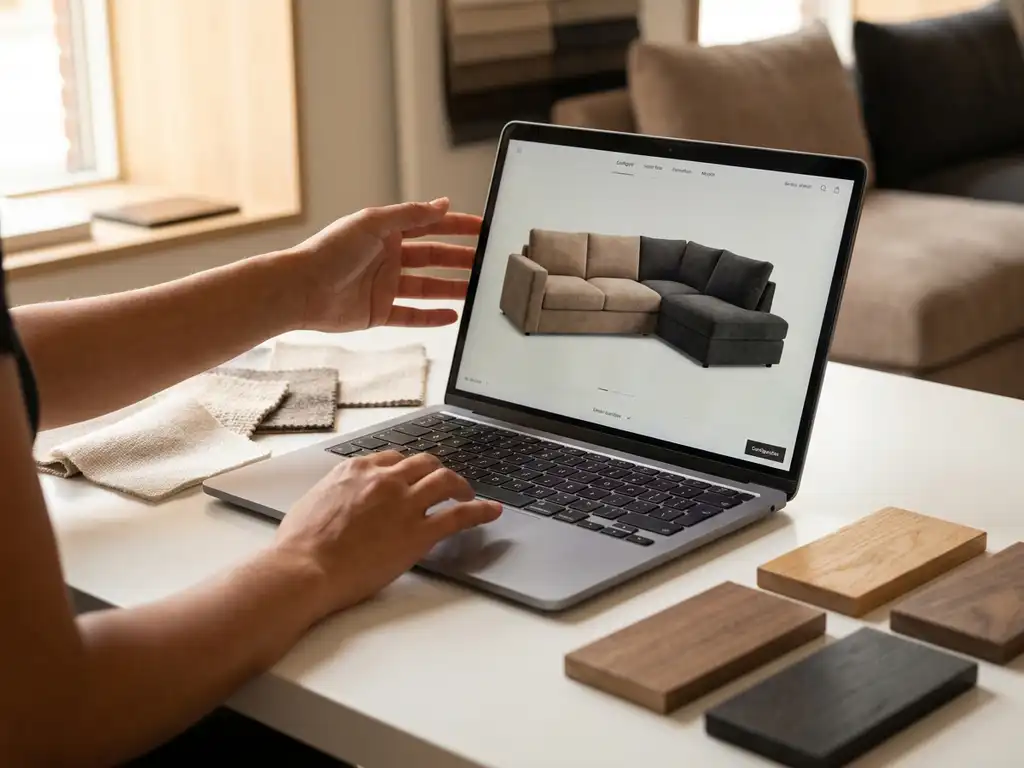
An online configurator is a web-based tool that lets customers build and personalise a product in real time by selecting options such as size, colour, material, and finish, then instantly seeing the result as a visual preview. Rather than browsing static product pages, shoppers interact directly with the product as an online product configurator, making choices that reflect their exact needs. The sections below answer the most common questions about how configurators work, which products benefit most, and what to look for when choosing a platform.
How does an online configurator actually work?
An online configurator works by connecting a product’s configuration rules to a visual rendering engine. When a user selects an option, the configurator applies the underlying business logic, updates the price, and refreshes the visual output in real time. The result is a guided, step-by-step buying experience that replaces guesswork with immediate visual confirmation.
Behind the scenes, five core components work together to make this possible:
- Product specifications and attribute data: Every configurable attribute — dimensions, materials, colours, finishes, and available variants — is stored as structured data that the configurator draws on for every session. Without clean, complete product data, even the most sophisticated rules engine cannot produce accurate results.
- Configuration rules engine: A rules engine defines which combinations are valid, which options depend on others, and how pricing adjusts with each selection. This is where complex business rules live, from minimum dimensions to material compatibility. It prevents customers from selecting impossible combinations and guides them toward valid, producible configurations.
- Visualisation engine: Each valid configuration triggers a corresponding visual, whether a rendered image, an interactive 3D model, or an augmented reality view. The visual updates as the user moves through the options, giving customers immediate, realistic feedback on every choice they make.
- Pricing and CPQ logic: Configure, price, quote (CPQ) functionality calculates an accurate price in real time as options are selected, and can generate a formal quote for complex or high-value orders. For furniture manufacturers with variable material costs, custom dimensions, and tiered pricing structures, this component is essential: it eliminates manual quoting errors and gives customers full pricing transparency before they commit.
- System integration layer: The configurator connects to back-end systems such as ERP (Enterprise Resource Planning), PIM (Product Information Management), and e-commerce platforms, ensuring that the price shown is accurate, stock constraints are respected, and orders flow directly into fulfilment processes. Open APIs and native connectors make this layer the bridge between the customer-facing experience and internal operations.
The user experience is designed to feel simple even when the underlying logic is highly complex. A product with thousands of valid combinations can be presented as a clean, guided journey in just a few steps.
What types of products are best suited for an online configurator?
Products best suited for an online configurator share three characteristics: multiple customisable attributes, visual appearance that changes significantly with each choice, and a number of possible combinations that makes traditional photography impractical. The greater the variety of options, the more value a configurator delivers compared to static product pages.
Configurators are used across a wide range of industries. Automotive brands use product configurators to let buyers select model trims, paint colours, and interior finishes. Custom footwear brands allow shoppers to design every detail of a sneaker before it is manufactured. Consumer electronics retailers use configuration tools for made-to-order laptops, and kitchen appliance manufacturers use them to guide buyers through compatible accessory combinations. However, the category where a visual product configurator delivers the greatest commercial impact is furniture and home furnishings, where visual complexity, customisation depth, and high purchase values combine to make interactive configuration indispensable. This is the sector where we hold deep specialist expertise.
In the furniture and home furnishings industry, this applies directly to categories such as:
- Sofas and seating with variable fabric, colour, leg finish, and module configuration
- Beds and bedroom furniture with size, headboard style, and storage options
- Dining tables and chairs with material, finish, and dimension choices
- Kitchens and storage systems with modular layouts and finish combinations
- Lighting, curtains, and soft furnishings with pattern, size, and material variants
Beyond furniture, configurators work well for any mass-customisable product, including outdoor furniture, office seating, flooring, and decorative accessories. The common thread is that customers need to see their specific combination before committing to a purchase. When a product has ten or more visual variants, a configurator consistently outperforms a gallery of static images.
Online configurator examples: brands that get it right
To understand the practical impact of a product configurator, it helps to look at how leading brands use them across sectors. In automotive, manufacturers allow buyers to build their vehicle online by selecting model, colour, trim level, and optional extras, with a photorealistic visual updating at every step. The result is a buying experience that shortens the time from interest to order and reduces the need for multiple dealership visits.
In footwear, custom sneaker platforms let customers choose upper materials, sole colours, and personalised text, generating a unique visual for each combination. These configurators have become a significant revenue channel, demonstrating that personalisation drives both conversion and brand loyalty in consumer markets.
Within the furniture sector, a leading European modular sofa manufacturer uses an online configurator for furniture that allows customers to select fabric, module arrangement, leg finish, and overall dimensions, then view the result as a photorealistic 3D model from any angle. This replaced a catalogue of thousands of static product images and reduced return rates significantly. A mid-market kitchen retailer implemented a configuration platform that guides buyers through cabinet layouts, door styles, and worktop materials, generating an accurate price quote at the end of the journey. The tool enabled direct-to-consumer sales of a product category that previously required in-store consultation. For furniture product configurator use cases specifically, these examples illustrate how interactive tools transform complex, high-consideration purchases into confident, self-directed buying decisions. Furniture and home furnishings remain the sector where this technology delivers its most measurable commercial return, and it is the market we know best.
What is the difference between a 2D and a 3D product configurator?
The key difference between a 2D and a 3D product configurator is the type of visual output. A 2D configurator shows flat images or swatches that update with each selection, while a 3D configurator renders a fully dimensional model that customers can rotate, zoom, and view from any angle. For complex or highly customisable products, a 3D configurator provides a significantly more accurate and scalable representation of the final product.
| Comparison factor | 2D Configurator | 3D Configurator |
|---|---|---|
| Visual output type | Flat images or swatches | Rotatable, zoomable 3D model |
| Setup complexity | Lower initial setup effort | Higher initial setup, lower ongoing cost |
| Scalability as variants grow | Costly: each view needs a separate asset | Highly scalable: one model covers all combinations |
| Realism and customer confidence | Limited depth and texture representation | Accurate texture, proportion, and finish detail |
| AR support | Not supported | Supported: place product in your own space |
| Best suited for | Simple colour or pattern variants | Complex furniture with shape, texture, and dimension choices |
What a 2D configurator offers
A 2D configurator typically works by swapping pre-photographed or pre-rendered images as options change. It is faster to set up and works well for products where the visual difference between variants is primarily colour or pattern rather than shape or structure. The limitation is that each view requires a separate image asset, which becomes costly and unscalable as the number of variants grows.
What a 3D configurator offers
A 3D configurator uses a three-dimensional model that responds dynamically to every option selected. Because the model itself changes rather than swapping images, the same asset can represent an enormous number of combinations without requiring a separate render for each one. This makes 3D configurators significantly more scalable. Many 3D platforms also support augmented reality (AR), allowing customers to place the configured product in their own space using a smartphone, which further reduces purchase uncertainty.
For furniture and interior products specifically, 3D is the more practical long-term choice. The ability to visualise fabric texture, leg finish, and proportions simultaneously from any angle is something 2D cannot replicate at scale.
How does an online configurator increase conversion rates?
An online product configurator increases conversion rates by reducing the uncertainty that causes customers to abandon a purchase. When shoppers can see exactly what they are buying in their chosen configuration, their confidence in the decision rises. This directly addresses the most common reason customers delay or abandon: they are not sure the product will look right in their space or match their expectations.
The conversion impact works through several mechanisms:
- Visual confidence: Customers who can see a realistic preview of their chosen product are more likely to proceed to checkout without needing to visit a physical store first.
- Reduced decision fatigue: A guided configuration process breaks a complex choice into manageable steps, keeping customers engaged rather than overwhelmed.
- Higher order values: When customers actively build their product, they are more likely to explore and add premium options they might have overlooked on a static product page.
- Fewer returns: When the delivered product matches the visual preview, return rates drop. This is particularly significant for furniture, where returns are costly for both retailer and manufacturer.
Industry experience across furniture and home furnishings consistently shows that interactive visual tools shorten the buying journey and increase both conversion and average order value. The configurator does not just improve the experience; it changes the economics of selling customisable products online.
Why online configurators are a strategic growth tool for e-commerce
Beyond the immediate impact on conversion rates, an online configurator functions as a long-term strategic asset for furniture and home furnishings businesses. Decision-makers evaluating this investment should consider not only what a configurator does for a single transaction, but what it enables across the entire business model.
- Competitive differentiation: Offering genuine, real-time product personalisation sets a brand apart from commodity retailers who can only present fixed product ranges. For a sofa manufacturer with 200 fabric options, a configurator communicates a level of choice and quality that a standard product page simply cannot convey. Customers who experience meaningful personalisation are less likely to compare on price alone.
- Customer loyalty and emotional ownership: When customers design their own product, they develop a stronger sense of ownership before the item even arrives. This emotional investment increases satisfaction, reduces buyer’s remorse, and supports repeat purchasing and word-of-mouth referrals.
- Catalogue scalability without proportional photography costs: Traditional product photography requires a separate shoot for every variant combination. For a furniture manufacturer with 200 fabric options, 10 leg finishes, and 5 sizes, that is a practically unlimited number of images. A 3D configurator replaces this with a single model that generates every visual automatically, allowing the catalogue to grow without a corresponding increase in content production cost.
- Market access and direct-to-consumer capability: Complex, configurable furniture products have historically required a physical showroom to sell effectively. A high-quality configurator removes that barrier, enabling direct-to-consumer sales channels that were previously impossible to scale. This opens new revenue streams and reduces dependence on third-party retail networks.
For businesses building an internal case for configurator investment, these strategic dimensions are as important as the transactional metrics. The right platform selection is therefore not just a technology decision; it is a commercial strategy decision.
What are the latest trends in online product configuration?
The configurator market is evolving rapidly, and the platforms that furniture and home furnishings brands choose today will need to support capabilities that are becoming standard expectations in the near term. Understanding where the market is heading is an important part of making a future-proof platform decision.
- AI-powered guided selling and smart recommendations: Artificial intelligence is increasingly being used to guide customers toward optimal configurations based on popular choices, room dimensions, or stated preferences. Rather than presenting every option simultaneously, an AI-assisted configurator surfaces the most relevant choices first, reducing decision time and improving conversion. This builds directly on the reduced decision fatigue benefit discussed earlier in this article.
- Augmented reality as a mainstream expectation: AR functionality, already available on leading 3D configuration platforms, is moving from a differentiating feature to a baseline expectation in the furniture category. Customers increasingly expect to place a configured sofa or dining table in their own room via smartphone before committing to a purchase. Brands that offer this capability gain a measurable advantage in reducing pre-purchase uncertainty at scale.
- Real-time collaborative configuration: Emerging platforms support multi-user configuration sessions, allowing an interior designer and their client to configure a product together remotely, in real time. For the contract furniture and high-end residential markets, this capability shortens the specification cycle and reduces the number of revision rounds required before an order is placed.
- Omnichannel and in-store kiosk deployment: Configurators are no longer purely a web-based tool. Leading furniture retailers are deploying the same configuration engine across their webshop, dealer portals, and in-store touchscreen kiosks, ensuring a consistent brand experience regardless of where the customer encounters the product. This omnichannel consistency is increasingly a requirement rather than a nice-to-have.
- Sustainability transparency embedded in configuration: As environmental considerations influence purchasing decisions, some configurator platforms are beginning to surface material origin, carbon footprint, or recyclability data alongside each configuration choice. For furniture brands with sustainability commitments, this capability turns the configurator into a tool for communicating values as well as product options.
iONE360 is built to support these evolving capabilities, ensuring that furniture and home furnishings businesses investing in configuration today are not locked out of the innovations that will define the market tomorrow.
What should you look for in an online configurator platform?
When evaluating product configurator software, the most important factors are visual quality, integration capability, scalability, and the complexity of product logic the platform can handle. A platform that looks impressive in a demo but cannot connect to your ERP or handle your pricing rules will create more problems than it solves.
Key criteria to assess when choosing a platform:
- Visual output quality: The rendered images or 3D models must be realistic enough to replace or supplement traditional photography. Poor visual quality undermines customer confidence rather than building it.
- Business rule complexity: The platform must be able to handle your actual product logic, including conditional options, pricing dependencies, and variant restrictions — not just simple colour swaps.
- System integration: Look for native connectors or open APIs that allow the configurator to work with your existing ERP, PIM, CMS, and e-commerce platforms without requiring a full infrastructure rebuild.
- Scalability: The platform should handle your full product catalogue, not just a selection of flagship products. Consider how easily new products and variants can be added without manual effort per item.
- Omnichannel readiness: The configurator should work consistently across your webshop, dealer portals, and in-store kiosk environments so that brand presentation remains uniform across every touchpoint.
- Total cost of ownership: Evaluate the full cost beyond the licence fee. A platform that eliminates costly photoshoots, reduces configuration errors, and lowers return rates can deliver savings that substantially offset the investment.
- Industry experience: A vendor with deep knowledge of your specific sector will understand the nuances of your products and business processes far better than a generic configuration tool provider.
What are the common challenges of implementing an online configurator?
Implementing a product configuration platform is a significant investment, and understanding the risks upfront is essential for building a credible internal business case. The most common challenges are predictable and, with the right platform choice, manageable.
- Complexity of configuration logic and rules management: Furniture products often involve hundreds of interdependent rules governing valid combinations, pricing dependencies, and production constraints. Mapping this logic into a configurator requires careful planning and a platform capable of handling genuine complexity. A well-designed rules engine, such as the one at the core of iONE360, is built to accommodate this depth without requiring custom development for every new product or variant.
- Integration with existing ERP and e-commerce systems: One of the most frequently cited concerns among furniture and home furnishings businesses is connecting a new configurator to existing enterprise infrastructure. A platform with ERP-native logic and open APIs significantly reduces integration complexity, ensuring that pricing, stock, and order data flow accurately between systems without building bespoke connectors from scratch.
- Performance and loading speed for 3D assets: High-quality 3D models can be large files, and slow loading times damage the customer experience and conversion rate. Platforms that optimise asset delivery, use progressive loading, and support compressed 3D formats mitigate this risk. Choosing a vendor with proven performance at catalogue scale is more reliable than attempting to optimise this independently after deployment.
- Content production effort for 3D modelling: Creating 3D models for an entire product catalogue can appear daunting, particularly for businesses accustomed to traditional photography workflows. The key advantage of a platform like iONE360 is that high-quality 3D visuals are generated automatically across the full catalogue and all variants, dramatically reducing the per-product content production effort compared to commissioning individual models or photoshoots.
- Change management and internal adoption: Introducing a configurator affects sales teams, customer service, product management, and IT. Without a structured rollout and clear internal ownership, adoption can stall. Starting with a pilot on a single product family, measuring results, and expanding based on evidence is a proven way to build internal confidence and secure ongoing support from stakeholders.
Each of these challenges is addressable with the right platform partner. iONE360 is specifically designed to resolve them: ERP-native integration reduces system complexity, automatic visual generation removes the content bottleneck, and furniture-specific expertise means the implementation process is guided by teams who have solved these exact problems before.
How do you get started with an online configurator?
For furniture and home furnishings businesses adopting a configurator for the first time, a structured approach reduces risk and accelerates time to value. The following roadmap reflects the steps that consistently lead to a successful implementation.
- Define your product scope: Identify which product lines have the most to gain from configurability. Prioritise categories with high variant counts, significant visual differentiation between options, and strong commercial importance. Starting with your highest-margin or highest-volume configurable range gives the project immediate business relevance and makes the case for wider rollout easier to build.
- Audit your data: Assess the current state of your product data, 3D assets, and pricing logic. Configurators depend on clean, structured data. Gaps in attribute data, inconsistent pricing rules, or missing material specifications will slow implementation. A data audit at this stage prevents delays later and identifies where preparation effort is needed before the platform is configured.
- Evaluate platforms against your integration requirements: Match candidate platforms against your specific ERP, PIM, and e-commerce stack. Assess not only whether integration is technically possible, but how much custom development it requires and what ongoing maintenance looks like. Platforms with native connectors and open APIs offer lower integration risk and faster deployment timelines.
- Run a pilot: Launch the configurator with one product family before scaling to the full catalogue. A focused pilot allows you to validate the customer experience, test integration accuracy, and gather real conversion and return rate data without committing the entire product range. Use the pilot results to refine the configuration logic and build internal confidence before expanding.
- Measure and optimise: Track conversion rate, return rate, and average order value as your primary KPIs post-launch. These three metrics together give a complete picture of commercial impact. Set a baseline before launch and review performance at 30, 60, and 90 days. Use the data to identify which product families benefit most and where configuration logic or visual quality can be improved.
iONE360 makes each of these steps faster and lower-risk. Our furniture-specific expertise means we understand your product data structures, your ERP environment, and your sales channel requirements from day one. The result is an implementation process guided by teams who have delivered exactly this kind of project before, for businesses with exactly your challenges.
How iONE360 helps with online product configuration
iONE360 is a visual commerce platform and furniture configurator built specifically for furniture and home furnishings manufacturers and retailers selling configurable products at scale. Unlike general-purpose configuration tools, iONE360 is designed around the complexity of mass-customisable furniture: intricate business rules, ERP-native pricing logic, and product catalogues spanning millions of valid combinations, all presented to customers as a clean, guided experience that builds purchase confidence.
Here is what iONE360 delivers in practice:
- A single platform for all visual commerce needs: 3D product configuration, automatically generated packshot imagery, room planning, and augmented reality, all without switching tools or vendors. As a complete visual product configurator, iONE360 eliminates the cost and complexity of managing multiple point solutions.
- ERP-native logic: iONE360 is built on ERP logic and integrates directly with your existing enterprise systems, so the rules that govern your production and pricing are reflected accurately in every customer interaction.
- Scalable visual output: High-quality 3D visuals are generated automatically across your entire product range and all variants, eliminating the need for individual photoshoots as your catalogue grows.
- Omnichannel consistency: The same configuration experience works across your webshop, dealer network, and physical stores, ensuring your brand is presented consistently wherever customers encounter it.
- Proven industry expertise: With more than 45 years of software development experience in the furniture and interior sector, we understand the specific demands of your market in a way that general-purpose platforms do not.
iONE360 combines cost-effective implementation, pragmatic scalability, and deep integration capability, making it the platform of choice for furniture and interior businesses that need a configurator built for their industry, not adapted to it. If you are evaluating online configurator platforms for your furniture or home furnishings business, we would welcome the opportunity to show you what iONE360 can do for your specific product range and sales channels. Get in touch with our team to arrange a personalised demonstration.