

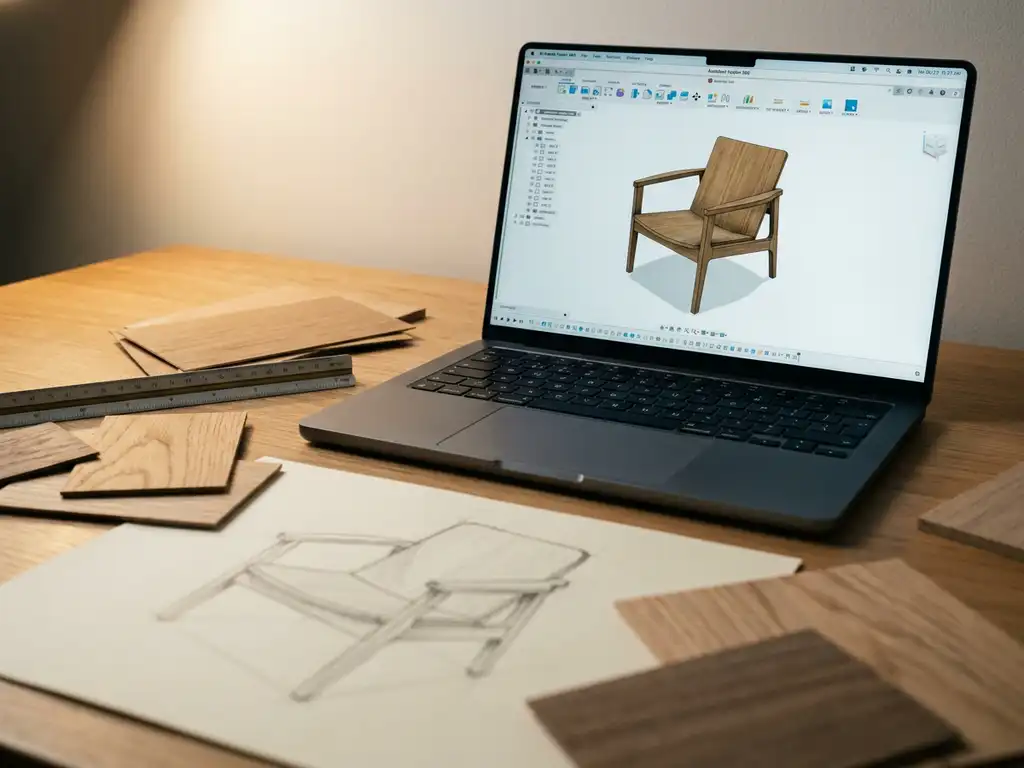
The most widely used Autodesk software for furniture design is Fusion 360, followed by AutoCAD. Fusion 360 combines parametric 3D modeling with manufacturing preparation tools, making it a practical choice for furniture designers who need to move from concept to production. AutoCAD remains popular for technical drafting and 2D floor plans. This article unpacks how each tool is used, where they fall short, and what furniture manufacturers are turning to instead.
Which Autodesk products are actually used for furniture design?
The two Autodesk products most commonly used in furniture design are Fusion 360 and AutoCAD. Fusion 360 handles 3D modeling and manufacturing workflows, while AutoCAD is primarily used for technical 2D drawings, cutting plans, and floor layouts. A smaller number of designers also use Autodesk 3ds Max for high-end rendering, though it is more common in architecture and interior visualization than in furniture manufacturing itself.
Each tool serves a different stage of the design and production process. Fusion 360 is the go-to for product development and CNC preparation. AutoCAD lives at the drafting and documentation end. Neither was built specifically for furniture, which is an important distinction when evaluating them against purpose-built alternatives.
What is Fusion 360 used for in furniture manufacturing?
In furniture manufacturing, Fusion 360 is used primarily for parametric 3D modeling, engineering drawings, and CAM (computer-aided manufacturing) preparation. Designers use it to build accurate 3D models of furniture components, define joinery details, and generate the toolpaths needed to drive CNC cutting machines. It bridges the gap between design intent and factory-floor production.
Fusion 360 is particularly valued in custom and contract furniture manufacturing, where precision tolerances and repeatable production matter. Key use cases include:
- Building component-level 3D models with exact dimensions and material thicknesses
- Creating assembly drawings and exploded views for production documentation
- Generating CNC toolpaths for panel cutting, routing, and drilling
- Running basic stress simulations on structural joints or frame elements
- Exporting files in formats compatible with manufacturing equipment
What Fusion 360 does not do well is consumer-facing visualization. Its rendering output is functional rather than photorealistic, and it offers no tools for interactive product configuration, room planning, or augmented reality. It is an engineering tool first and a design presentation tool a distant second.
How does AutoCAD compare to Fusion 360 for furniture design?
AutoCAD and Fusion 360 serve fundamentally different purposes in furniture design. AutoCAD excels at 2D technical drafting, such as cutting layouts, assembly instructions, and floor plans, while Fusion 360 is built for 3D modeling and manufacturing workflows. For furniture designers who primarily work in 2D documentation, AutoCAD remains the industry standard. For those who need to model in three dimensions and connect to production, Fusion 360 is the stronger choice.
Where AutoCAD fits in the furniture workflow
AutoCAD is widely used for producing shop drawings, technical specifications, and spatial planning documents. In retail and contract furniture contexts, it is often used to draft room layouts and furniture placement plans for clients. Its precision drafting tools and universal file format (.dwg) make it a reliable communication tool between designers, clients, and factories.
Where Fusion 360 has the advantage
Fusion 360 brings the third dimension into the workflow, which matters when designing complex forms, validating fit and clearance between components, or preparing files for CNC production. Its parametric modeling approach means that changing one dimension updates the entire model automatically, saving significant rework time during the design iteration phase.
For manufacturers who need both, the tools are often used in combination: AutoCAD for 2D documentation and client-facing floor plans, Fusion 360 for the 3D development and manufacturing preparation that happens behind the scenes.
What are the limitations of Autodesk software for furniture visualization?
The core limitation of Autodesk software for furniture visualization is that it was not designed for consumer-facing or sales-oriented visual experiences. Fusion 360 and AutoCAD produce technically accurate models, but they cannot generate the photorealistic product imagery, interactive configurators, or augmented reality previews that modern furniture retail demands. The gap between what these tools produce and what an e-commerce or showroom environment requires is significant.
Specific limitations include:
- No product configurator functionality: Autodesk tools cannot present a customer-facing interface where shoppers select fabrics, colors, or dimensions and see the result in real time.
- No automated packshot generation: Creating product images for every variant of a configurable sofa or cabinet requires manual rendering work for each combination, which does not scale.
- No room planning integration: Neither Fusion 360 nor AutoCAD offers a consumer-ready 3D room planning tool that lets shoppers arrange and configure furniture in a virtual space.
- No AR output for retail: Augmented reality features that allow customers to place furniture in their own home are not part of the Autodesk product suite.
- High technical barrier: These tools require trained users. A sales team or end customer cannot operate Fusion 360 or AutoCAD without significant training.
For manufacturers, this means Autodesk software covers the engineering and production side of the workflow well, but a separate layer of visual commerce tooling is needed to serve the sales and marketing function.
What software do furniture manufacturers use instead of Autodesk?
Furniture manufacturers use a range of purpose-built and visual commerce tools alongside or instead of Autodesk products, depending on where in the workflow the need arises. For production planning, industry-specific solutions like Cabinet Vision, Polyboard, and imos iX are common. For consumer-facing visualization, configuration, and room planning, manufacturers increasingly turn to dedicated visual commerce platforms built specifically for the furniture and home furnishings sector.
The shift is driven by a clear need: Autodesk tools solve engineering problems, but they do not help a customer choose a sofa in the right fabric, see it in their living room, or complete a purchase with confidence. That gap is where specialized furniture visualization and configuration platforms step in, offering photorealistic 3D rendering, interactive product configuration, and room planning software that integrates directly with e-commerce systems.
How iONE360 helps furniture manufacturers go beyond design tools
Engineering tools like Fusion 360 and AutoCAD stop at the factory door. What happens between the finished product and the customer’s purchase decision requires a completely different kind of software, and that is exactly where we come in.
iONE360 is a visual commerce platform built specifically for the furniture, home, and decoration industry, with over 45 years of sector expertise behind it. Here is what we offer that Autodesk cannot:
- Interactive 3D product configuration: Customers select fabrics, colors, sizes, and options and see every change rendered in real time, across millions of possible variants.
- Automated packshot generation: High-quality product images are generated automatically for every configuration, eliminating the need for manual photoshoots at scale.
- Room planning software: Our advanced room planning tool lets customers build full room layouts, combine and configure multiple furniture pieces, adjust flooring and wallcoverings, and view the complete result in photorealistic 3D, all in a browser without any download required.
- Augmented reality: Shoppers can place configured products directly into their own space using AR, removing the last barrier to confident purchasing.
- Seamless integration: Our platform connects with PIM, ERP, CMS, and webshop systems, fitting into your existing tech stack rather than replacing it.
The result is measurable: higher conversion rates, larger order values, fewer returns, and a consistent brand experience across every sales channel. If you are ready to take your product visualization beyond what engineering software can deliver, get in touch with us and we will show you what is possible.
Frequently Asked Questions
Can Fusion 360 files be imported directly into furniture visualization platforms like iONE360?
In most cases, yes — Fusion 360 exports to standard formats such as STEP, OBJ, and IGES, which are compatible with most 3D visualization and configuration platforms. However, raw engineering models often require optimization before they are ready for real-time rendering, as CAD files tend to be highly detailed in ways that slow down interactive experiences. A visual commerce platform like iONE360 typically handles this conversion and optimization process as part of onboarding, so you do not need to rebuild your models from scratch.
Is Fusion 360 suitable for small or independent furniture designers, or is it better suited to larger manufacturers?
Fusion 360 is genuinely accessible to independent designers and small studios, partly because Autodesk offers a free version for personal and startup use with annual revenue under a defined threshold. Its parametric modeling and built-in CAM tools make it a strong choice for small-batch custom furniture makers who run their own CNC equipment. That said, the learning curve is real — expect to invest several weeks of practice before working efficiently, and factor in whether the engineering-focused workflow matches how you actually design.
What is the biggest mistake furniture companies make when relying solely on Autodesk tools?
The most common mistake is assuming that a technically accurate 3D model is sufficient for both production and sales. Autodesk tools produce precise engineering files, but those files are not the same as compelling, customer-ready product visuals. Companies that skip the visualization layer often rely on physical samples or static photography, which cannot keep pace with configurable product ranges or omnichannel retail demands. The fix is not to abandon Autodesk software, but to pair it with a dedicated visual commerce solution that handles the customer-facing side of the workflow.
How does purpose-built furniture design software like Cabinet Vision differ from Fusion 360?
Cabinet Vision and similar tools such as Polyboard or imos iX are designed specifically around furniture and cabinetry production logic — they understand concepts like carcass construction, hardware placement, sheet material optimization, and cut-list generation out of the box. Fusion 360 is a general-purpose engineering tool that can be adapted to furniture work but requires more manual setup to achieve the same results. For high-volume cabinet and case goods manufacturers, purpose-built software typically delivers faster workflows and better integration with production management systems.
How long does it typically take to implement a 3D product configurator for a furniture range?
Implementation timelines vary depending on the complexity of the product range, the quality of existing 3D assets, and the number of configuration options involved. For a focused product line with existing models, a configurator can be live in a matter of weeks. Larger catalogues with extensive fabric, finish, and size variants naturally take longer to set up, but platforms like iONE360 are built to handle this scale efficiently. The best starting point is an initial scoping conversation to assess your existing assets and define the rollout sequence.
Can augmented reality features work alongside an existing e-commerce platform, or does it require a complete technology overhaul?
AR features and 3D configurators are designed to integrate with your existing e-commerce stack, not replace it. Modern visual commerce platforms connect via APIs and plugins to common webshop systems, PIM tools, and CMS platforms, meaning your product data and purchase flow remain intact. The AR and configuration layer sits on top as an enhanced product experience, so customers move seamlessly from visualizing a piece to completing a purchase without leaving your existing storefront.
What should furniture manufacturers prioritize first — improving their production software or their customer-facing visualization tools?
If your production workflow is already stable and your main bottleneck is converting browsers into buyers, customer-facing visualization is almost always the higher-impact investment. Research consistently shows that shoppers who interact with a 3D configurator or AR tool convert at significantly higher rates and return products less frequently. If your production process is still manual or error-prone, address that foundation first — but for most established manufacturers, the faster return on investment comes from closing the gap between what customers can see and what they can confidently buy.