

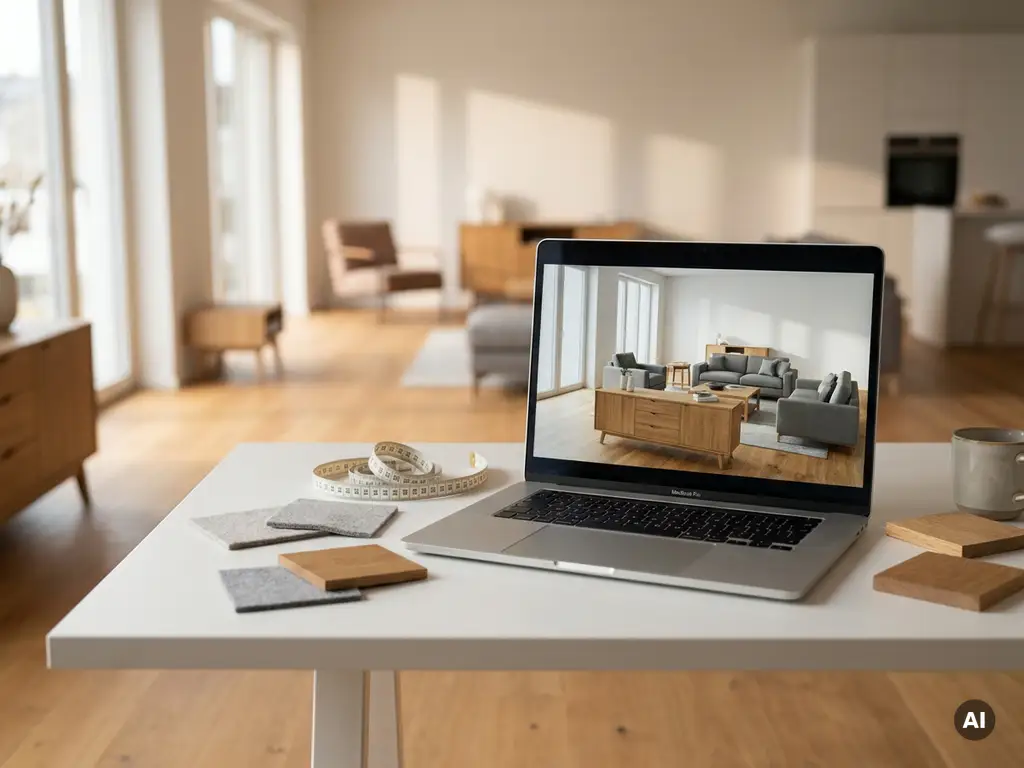
Choosing the right room planning software comes down to finding a tool that matches your product complexity, integrates cleanly with your existing systems, and genuinely improves the buying experience for your customers. For furniture businesses specifically, the right platform must handle configurable products, support multiple sales channels, and deliver photorealistic visualizations without requiring manual effort for every variant. The questions below unpack each dimension of that decision so you can evaluate vendors with confidence.
What features should room planning software include for furniture businesses?
Room planning software for furniture businesses should include 3D visualization, real-time product configuration, floor plan creation, camera controls for zooming and rotating, and the ability to combine multiple products in a single scene. Beyond the basics, look for features like material and finish swapping, room decoration options such as flooring and wallpaper, and direct pricing and ordering from within the planner.
The core value of a room planner is that it eliminates uncertainty for the customer. When someone can arrange a sofa, a coffee table, and a sideboard in a virtual room that reflects their own dimensions and style preferences, they buy with far greater confidence. That confidence translates directly into higher conversion rates and fewer returns.
For furniture businesses dealing with configurable or made-to-order products, the feature set needs to go further. Here are the capabilities that separate a genuinely useful room planning tool from a basic layout editor:
- In-planner product configuration: Customers can select fabrics, finishes, sizes, and options without leaving the room view
- Real-time pricing and lead times: Updated automatically as customers configure products
- Multi-product scene management: Arrange and configure several items simultaneously
- Photorealistic rendering: High-quality visuals that reflect actual product appearance, not generic placeholders
- Mobile and web-based access: No app downloads required, works across devices
- Direct-to-cart or direct-to-order functionality: The configured room becomes a shoppable basket
Room decoration features, including the ability to add curtains, wallpaper, and flooring, are also worth prioritizing. They help customers visualize how your products fit into their actual living space, which increases buying intent significantly.
What’s the difference between a room planner and a product configurator?
A product configurator focuses on a single product, allowing customers to customize its attributes such as size, color, fabric, and finish. A room planner operates at the scene level, letting customers arrange multiple products together in a spatial layout. The most powerful solutions combine both: customers configure individual products and place them in a room plan within the same workflow.
Think of it this way: a configurator answers the question “How do I want this sofa to look?” while a room planner answers “How will this sofa fit and look in my living room alongside everything else?” Both questions matter, but they serve different moments in the buying journey.
Standalone room planners without configuration capability have a significant limitation for furniture brands selling customizable products. If a customer places a sofa in their virtual room but cannot change its fabric or dimensions from within that view, they face a broken experience that requires them to leave, configure elsewhere, and return. That friction costs conversions.
The ideal setup is an integrated room planning tool that embeds full product configuration directly into the room planning experience. This keeps the customer in a single, seamless flow from inspiration to order.
How does room planning software integrate with existing business systems?
Room planning software integrates with existing business systems through APIs that connect to your PIM, ERP, CMS, and webshop. A well-built integration means product data, pricing, stock levels, and configuration rules flow automatically into the room planner without manual duplication. This keeps your visuals accurate and your operational data consistent across channels.
For furniture manufacturers and retailers, integration depth is one of the most important evaluation criteria. A room planner that sits in isolation from your product catalogue creates a maintenance burden: every time a product changes, someone has to update the planner manually. That quickly becomes unsustainable at scale.
Here is how a robust integration architecture typically works:
- PIM or ERP connection: Product attributes, variants, pricing rules, and lead times are pulled directly from your master data source
- CMS or webshop embed: The room planner is embedded via a script or iframe into your existing website or e-commerce platform with no rebuild required
- Configuration rules engine: Business logic governing which combinations are valid is enforced in real time, preventing invalid orders
- Order output: Configured room contents are passed back to your order management or CRM system in a structured format
- Analytics layer: Interaction data from the planner feeds into your reporting tools so you can measure engagement and conversion
When evaluating vendors, ask specifically about their API documentation, existing connectors for your tech stack, and how they handle product data updates. A platform with a well-documented, API-first architecture will give your IT team far fewer headaches during and after implementation.
How do you evaluate room planning software vendors in the furniture industry?
Evaluate room planning software vendors by assessing their industry track record, visual output quality, integration capability, scalability across your full catalogue, and total cost of ownership. Generic software vendors often lack the domain knowledge required to handle furniture-specific complexity such as modular configurations, upholstery rules, and multi-channel distribution requirements.
The furniture industry has unique demands that general-purpose visualization tools are not built for. Vendors with proven references in home furnishings will understand concepts like fabric grading, modular sofa systems, and the need to present products consistently across a dealer network. That expertise shortens implementation time and reduces costly surprises.
Key questions to ask any vendor during evaluation:
- Can you show references from furniture manufacturers or retailers of similar scale?
- How does your platform handle products with thousands or millions of valid configurations?
- What does your 3D content creation process look like, and what do we need to provide?
- How is the platform updated, and does that require downtime or reintegration work on our side?
- What does your partner or reseller program look like if we operate through a dealer network?
- How do you handle brand consistency when the tool is deployed across multiple retail partners?
Visual quality is non-negotiable. Request a live demo using your actual products or close equivalents. Photorealistic output that accurately represents materials and finishes is what drives customer confidence, and no amount of feature richness compensates for poor visuals.
What impact does room planning software have on conversion and returns?
Room planning software has a measurable positive impact on both conversion rates and return rates. Showing products in a realistic room context increases buying intent substantially, because customers can see how items will look and fit in their own space before committing. Fewer surprises at delivery means fewer returns and lower associated costs.
The mechanism behind this is straightforward. Uncertainty is one of the primary reasons customers abandon furniture purchases online. Questions like “Will this fit?”, “Will the color match?”, and “Does it work with what I already have?” are all answered visually when a room planner is part of the buying experience. Removing that uncertainty accelerates the decision and builds confidence in the purchase.
From a business perspective, the impact extends beyond the initial sale. Customers who configure and plan a full room are naturally exposed to more products, which increases average order value. They are also more likely to return to the same platform for future purchases because the experience was helpful rather than stressful.
Returns reduction is equally significant. When a customer has placed a product in a virtual version of their own room, adjusted its configuration, and seen it rendered realistically before ordering, the gap between expectation and reality at delivery narrows dramatically. That directly reduces the operational cost of returns processing, restocking, and customer service handling.
How iONE360 helps you choose and implement the right room planning solution
We built iONE360 specifically for the furniture, home, and decoration industry, and our room planning software reflects more than 45 years of domain expertise. Whether you need a bespoke, white-labeled room planner built around your brand or a faster route to market through our ready-to-use HomeDecoHub marketplace, we offer a path that fits your business model and timeline.
Here is what sets our approach apart:
- Integrated configuration and room planning: Customers configure products and plan full rooms in a single, uninterrupted workflow
- Seamless system integration: API-first architecture connects to your PIM, ERP, CMS, and webshop without rebuilding your tech stack
- Scalable across your full catalogue: Handles complex business rules, pricing logic, and millions of valid product variants
- Consistent brand presentation: Deploy across your own channels and your dealer network with your branding intact
- Proven results: Our platform is recognized by Gartner and has won the Red Dot Award and A’ Design Award for its quality and innovation
If you are ready to see how our room planning software performs with your products and your systems, get in touch with our team and we will walk you through a tailored demonstration.