

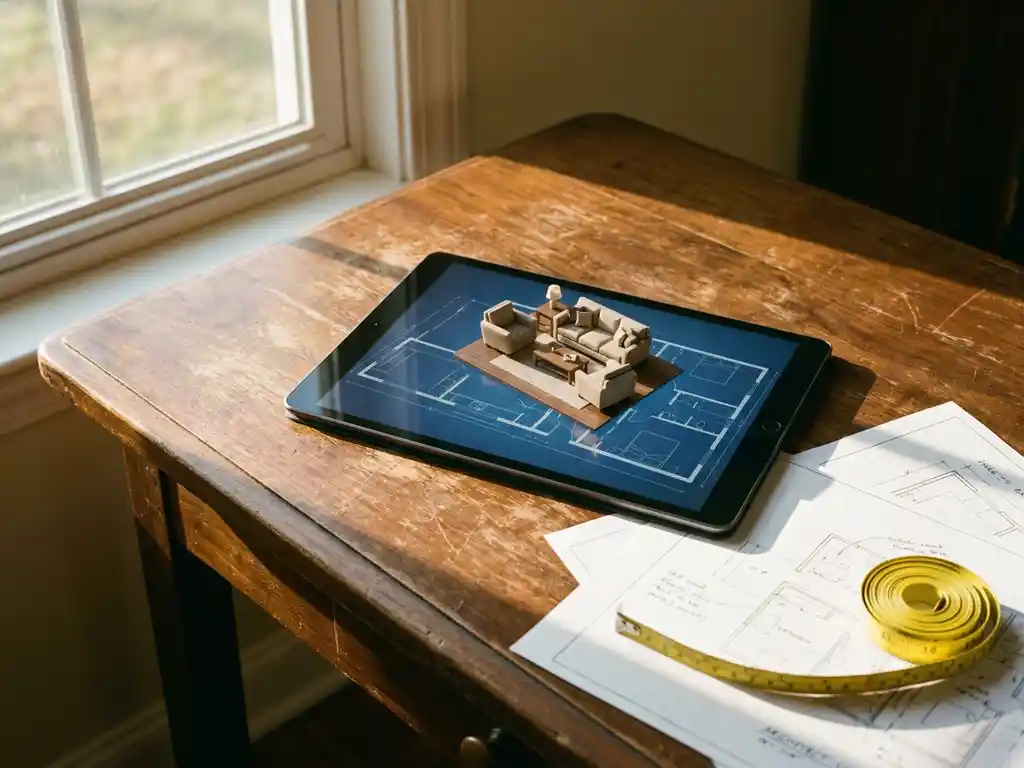
Augmented reality room planners use smartphone cameras and advanced 3D visualization to overlay virtual furniture directly into real spaces, while traditional tools rely on static 2D floor plans or basic 3D software. AR planners provide immersive, real-time visualization that helps customers see exactly how products will look in their actual rooms, leading to more confident purchasing decisions and higher conversion rates.
What is an augmented reality room planner and how does it work?
An augmented reality room planner is a digital tool that uses a device’s camera to capture real room environments and overlays virtual 3D furniture models directly into the live view. Users can place, move, and resize furniture pieces in their actual space through their smartphone or tablet screen to see realistic previews before purchasing.
The technology works by first scanning the room environment to understand spatial dimensions and lighting conditions. Advanced algorithms then anchor virtual furniture models to real surfaces like floors and walls, ensuring proper scale and perspective. Users can walk around their space while viewing the AR overlay, seeing how furniture looks from different angles and positions.
Modern AR room planners integrate with product configurators, allowing customers to customize colors, materials, and dimensions while viewing changes in real-time within their space. This combination creates a comprehensive planning experience that bridges the gap between digital shopping and physical reality.
What’s the difference between AR room planners and traditional planning tools?
AR room planners display furniture directly in customers’ actual rooms using live camera feeds, while traditional tools show products in generic room templates or require customers to interpret 2D floor plans. This fundamental difference makes AR significantly more intuitive and accurate for spatial planning.
Traditional space planning software typically requires technical knowledge to create floor plans, measure spaces, and position furniture using top-down views or basic 3D environments. Users must translate these abstract representations into real-world understanding, often leading to sizing mistakes and layout errors.
AR planners eliminate this translation step by working with real room dimensions and lighting. Customers see immediate visual feedback about scale, proportion, and style compatibility. The technology automatically handles perspective, shadows, and spatial relationships that would require manual calculation in traditional tools.
Integration capabilities also differ significantly. While traditional tools often operate as standalone applications, modern AR planners connect directly with inventory systems, pricing engines, and e-commerce platforms for streamlined purchasing workflows.
Which room planning approach delivers better customer conversion rates?
AR room planners consistently outperform traditional planning tools for conversion rates, with studies showing that displaying products in realistic room environments can increase buying intent by up to 64%. The immersive visualization reduces purchase hesitation and builds customer confidence in their decisions.
Traditional planning tools create friction in the buying process by requiring customers to make mental leaps between abstract representations and real outcomes. This uncertainty often leads to delayed purchases or abandoned shopping sessions as customers seek additional validation through physical store visits or extensive research.
AR planners address this friction by providing immediate visual confirmation that products will work in the intended space. Customers can experiment with different arrangements, colors, and configurations while seeing realistic results, leading to faster decision-making and higher order values.
The technology also reduces return rates significantly, as customers have accurate expectations about how products will look and fit in their homes. This combination of higher conversion rates and lower returns creates substantial improvements in overall revenue per visitor.
What are the limitations of traditional room planning tools?
Traditional room planning tools struggle with accurate scale representation, require technical expertise to use effectively, and fail to show how furniture will actually look in specific lighting and room conditions. These limitations create barriers between customers and confident purchasing decisions.
Generic room templates in traditional software don’t match customers’ actual spaces, making it difficult to assess whether furniture proportions and styles will work in reality. Users must manually input room dimensions and furniture specifications, introducing opportunities for measurement errors that lead to poor purchasing decisions.
The learning curve for traditional 3D room planning software often discourages casual users from engaging deeply with the planning process. Complex interfaces and technical requirements limit adoption to highly motivated customers, reducing the tool’s effectiveness as a broad sales driver.
Static visualization also prevents customers from understanding how furniture will look under their specific lighting conditions or alongside their existing decor. This lack of contextual accuracy maintains uncertainty that AR technology directly addresses through real-environment integration.
When should furniture businesses choose AR room planners over traditional methods?
Furniture businesses should prioritize AR room planners when selling configurable products, targeting mobile-first customers, or competing in markets where visual confidence drives purchasing decisions. AR technology particularly benefits companies with extensive product catalogs or complex customization options.
Companies experiencing high return rates due to size or style mismatches find AR planners especially valuable, as the technology dramatically improves purchase accuracy. The investment typically pays for itself through reduced customer service costs and improved customer satisfaction scores.
AR planners work best for businesses ready to integrate advanced technology with their existing e-commerce and inventory systems. Companies with robust digital infrastructure can leverage AR’s full potential for seamless customer experiences from visualization through purchase completion.
Traditional methods remain viable for businesses serving primarily professional designers or customers who prefer detailed technical planning over visual exploration. However, market trends strongly favor immersive visualization as customer expectations continue evolving toward more interactive shopping experiences.
How iONE360 helps with advanced room planning
We provide comprehensive room planning solutions that combine AR visualization with powerful product configuration capabilities. Our platform enables customers to design complete room layouts while customizing individual furniture pieces in real-time, creating an integrated planning and purchasing experience.
Key features include:
- Real-time AR furniture placement with accurate scaling and lighting
- Integrated product configurator for instant customization
- Seamless connection to pricing and inventory systems
- White-label solutions that maintain your brand identity
- Proven results with furniture industry leaders across Europe
Ready to transform your customers’ planning experience? Explore our showcases to see the technology in action, or contact us for a personalized demonstration of how our room planning software can boost your conversion rates and reduce returns.
Frequently Asked Questions
What technical requirements do customers need to use AR room planners?
Most modern AR room planners work on standard smartphones and tablets with iOS 11+ or Android 7.0+, requiring only a camera and sufficient processing power. No special apps or hardware are needed beyond what most customers already own, making the technology accessible to a broad audience without technical barriers.
How accurate are the measurements and scale in AR room planning?
AR room planners typically achieve accuracy within 2-5% of actual dimensions by using advanced computer vision algorithms to detect room surfaces and anchor virtual objects. The technology continuously calibrates scale based on real-world reference points, providing reliable measurements for furniture placement and sizing decisions.
Can AR room planners work in poorly lit rooms or unusual spaces?
Modern AR systems adapt to various lighting conditions and room layouts, though performance is optimal in well-lit environments with clear floor and wall boundaries. Most platforms include lighting simulation features that show how furniture will appear under different conditions, while unusual room shapes are handled through advanced surface detection algorithms.
What happens if customers experience technical issues while using AR planning tools?
Leading AR room planning platforms include fallback options like traditional 3D viewers and provide customer support through chat or phone assistance. Most technical issues stem from device compatibility or internet connectivity, which can be resolved through browser updates or switching to a supported device.
How long does it typically take to implement AR room planning for a furniture business?
Implementation timelines vary from 2-8 weeks depending on catalog size and integration complexity with existing e-commerce systems. The process involves product digitization, system integration, and staff training, with most businesses seeing initial results within the first month of deployment.
Do AR room planners work with all types of furniture and room configurations?
AR technology works best with standalone furniture pieces like sofas, tables, and cabinets, while built-in elements like kitchen cabinets may require specialized tools. The technology handles most standard room layouts effectively, though very small spaces or rooms with complex architectural features may present visualization challenges.
What ROI can furniture businesses expect from implementing AR room planning?
Businesses typically see 15-40% increases in conversion rates and 25-60% reductions in returns within 6 months of AR implementation. The exact ROI depends on factors like product complexity, target audience, and integration quality, with most companies recovering their investment within 12-18 months through improved sales performance.