

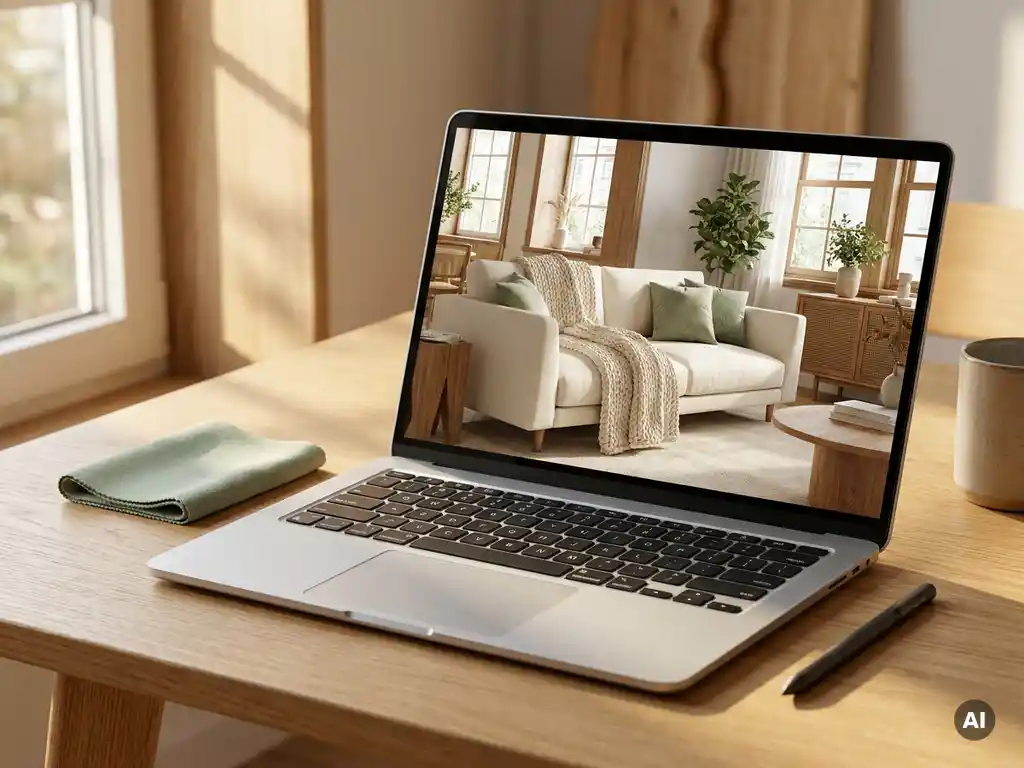
Furniture shoppers have always faced the same fundamental challenge: imagining how a sofa, cabinet, or dining table will actually look inside their own home. Static product images on white backgrounds answer very few of those questions. But placing a photorealistic 3D furniture model directly into a real room photo changes the equation entirely. Thanks to advances in AI-driven visualisation, this capability is no longer reserved for enterprise budgets or specialist CGI studios. It is now a practical, scalable feature built into modern visual commerce platforms like iONE360, and it is reshaping how furniture brands sell online and in-store in 2026.
This post walks through exactly how AI-powered room visualisation works, what we bring to it at iONE360, and why it matters for conversion, returns, and long-term sales confidence across your entire product catalogue.
How AI bridges the gap between product data and room context
AI room visualisation solves a deceptively complex problem: taking structured product data and rendering it convincingly inside an uncontrolled, real-world environment. A photograph of a living room contains irregular lighting, varied surface textures, perspective distortion, and depth cues that a 3D model must respond to in order to look believable. AI handles this by analysing the scene geometry, estimating light sources, and adjusting the model’s shading, shadows, and reflections to match the surrounding environment.
The result is a composite image where the furniture appears to genuinely inhabit the room rather than being pasted on top of it. Modern AI models trained on large datasets of interior scenes can do this with remarkable accuracy and at a speed that makes real-time or near-real-time rendering feasible. For furniture brands managing catalogues with thousands of SKUs across multiple fabric, colour, and finish options, this scalability is the critical differentiator. Instead of commissioning individual lifestyle shoots for every configuration, the AI generates contextualised visuals automatically from the existing 3D product data.
What iONE360 brings to room-based furniture visualisation
We have spent more than 45 years developing software specifically for the furniture, home, and decoration sector, and that depth of industry knowledge is embedded in how iONE360 approaches room visualisation. Rather than offering a standalone rendering tool, we integrate room-based visualisation directly into a unified 3D product configurator platform that connects to your existing ERP, PIM, and e-commerce systems.
A configurator that speaks the language of your business
Our platform is built on ERP logic, which means every configuration option a customer selects, whether it is a fabric grade, a leg finish, or a modular arrangement, is tied directly to the pricing and availability rules your business already operates on. When that configured product is placed into a room scene, the visual output reflects the exact specification the customer has chosen, not a generic approximation. This connection between business rules and visual output is something generic rendering tools simply cannot replicate.
Scalable output without manual effort per variant
One of the most significant advantages we offer is the ability to generate high-quality packshot images and room-context visuals automatically across all product variants. A sofa available in 30 fabrics and three sizes does not require 90 separate photoshoots. The 3D product configurator generates each variant from the same underlying 3D model, ensuring visual consistency while eliminating the cost and time associated with traditional photography. That is a meaningful operational advantage for any brand managing a large or frequently updated catalogue.
From product configuration to realistic room scene in practice
The practical workflow is more straightforward than many brands expect. A customer or sales advisor begins by selecting product options within the configurator, choosing dimensions, materials, colours, and components through a guided, step-by-step process. Once a configuration is complete, the platform can render that exact product into a pre-loaded room template or, in more advanced implementations, into a photograph of the customer’s own space.
The AI layer handles the technical heavy lifting: aligning the model’s perspective to the room, calculating realistic shadow placement, and adjusting surface reflectivity to match the ambient lighting in the photograph. The output is a high-resolution image that shows the configured product as it would genuinely appear in that environment. For in-store sales teams, this means a consultant can walk a customer through configuration options and immediately show them a contextualised result, removing much of the uncertainty that traditionally delays purchase decisions.
Augmented reality extends this further by projecting the configured product into a live camera view of the customer’s actual room, accessible directly through a browser without requiring any app download. The transition from configuration to AR to a shareable room image all happens within the same session, keeping the customer engaged and the sales process moving forward.
Impact on conversion, returns, and sales confidence
The commercial case for AI room visualisation is grounded in a straightforward insight: customers who can see a product in context are more confident in their decision. That confidence translates into measurable outcomes across the sales funnel. Conversion rates improve because hesitation decreases. Order values increase because customers are more willing to explore premium options when they can see exactly what they are getting. And return rates fall because the gap between expectation and reality shrinks significantly.
For furniture specifically, where items are large, expensive, and deeply personal, the stakes of a poor purchase decision are high for both the customer and the brand. Room visualisation directly addresses the primary source of that risk: the inability to judge fit, scale, and aesthetic compatibility before buying. When a customer can see their configured sofa sitting in a room that matches their own interior style, the decision becomes far less abstract. Sales teams also benefit, as they can present configurations with genuine visual authority rather than relying on fabric swatches and imagination.
Key considerations when implementing AI room visualisation at scale
Scaling room visualisation across a full product catalogue requires careful planning, and the quality of the underlying 3D assets is the single most important factor. AI can enhance and contextualise a 3D model, but it cannot compensate for low-resolution geometry or inaccurate material definitions. Investing in accurate, high-fidelity 3D models from the outset pays dividends across every downstream use case, from configurator output to AR to automated packshot generation.
Integration with existing systems
Connecting room visualisation to your existing tech stack is essential for operational efficiency. When the configurator is integrated with your ERP and PIM, product data, pricing, and availability flow automatically into the visual layer. This eliminates manual duplication and ensures that every visual output reflects current, accurate product information. Our platform is designed with this integration as a core requirement rather than an afterthought, which is why it can serve as a genuine extension of an enterprise IT landscape rather than a siloed add-on.
Channel consistency across retail and direct sales
For brands selling through both direct and dealer channels, maintaining consistent visual quality across every touchpoint is a strategic priority. AI-generated room visuals produced from a centralised platform ensure that every retailer, every webshop, and every in-store screen presents the same product with the same level of quality. This consistency strengthens brand perception and removes the fragmentation that often undermines omnichannel strategies. As you plan your implementation, defining which room templates and visual standards will apply across channels is worth addressing early in the process.
The technology is mature, the integration pathways are well established, and the commercial returns are increasingly well documented. For furniture brands ready to move beyond static product imagery, AI-powered room visualisation is not a future capability to evaluate. It is a present-day competitive advantage worth deploying now.