

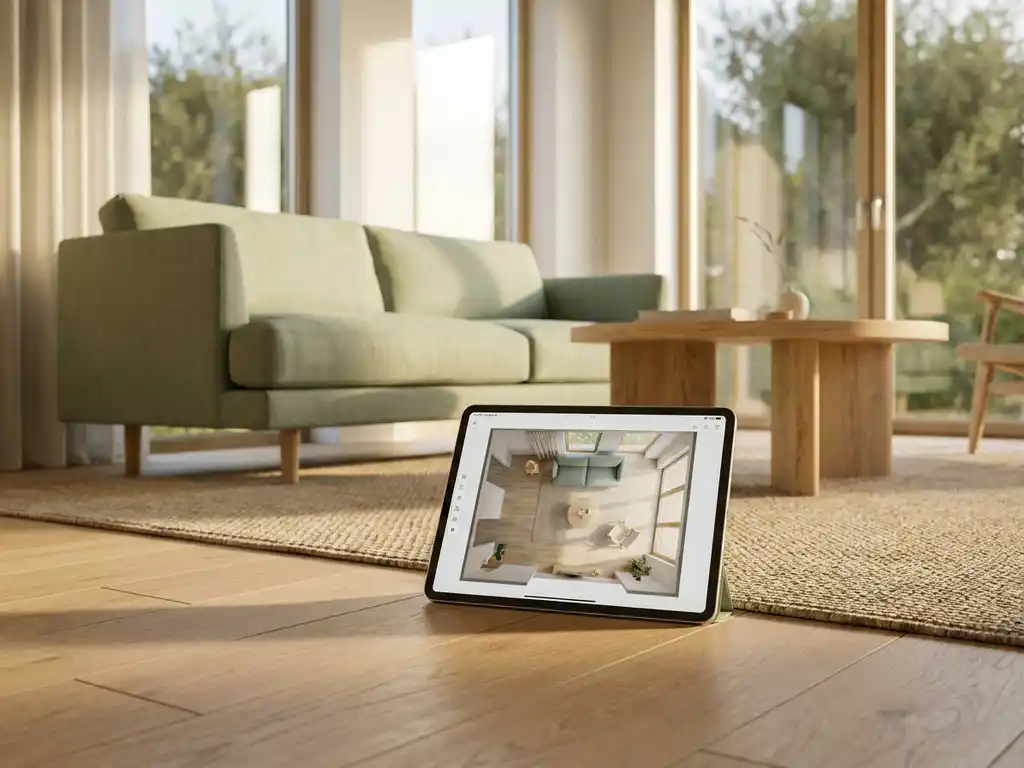
The best app for planning furniture layout depends on what you need it to do. For most people, a web-based 3D room planning tool that works directly in the browser, supports real furniture from actual brands, and lets you visualize configurations in realistic detail will outperform any standalone mobile app. The sections below answer the most common questions about furniture layout planning tools so you can choose the right one for your situation.
What features should a furniture layout app actually have?
A furniture layout app should, at minimum, let you draw or import a floor plan, place and move furniture pieces to scale, and view the result in 3D. Beyond that baseline, the most useful tools also support real-time configuration of product variants, accurate pricing, and the ability to share or save your design. Without these, you are essentially working with a visual toy rather than a practical planning tool.
When evaluating room planning software, look for these core capabilities:
- Accurate floor plan creation with custom room dimensions and wall placement
- 3D visualization with camera rotation and zoom so you can view the layout from any angle
- Product configuration on the spot, including fabric, color, and size options
- Decorative elements such as flooring, wallpaper, curtains, and lighting for a realistic scene
- Pricing and availability displayed alongside the configured products
- Direct ordering from within the planner without leaving the experience
- No download required, so the tool works immediately in any browser
The more of these features a tool combines in a single, seamless experience, the more confident customers feel before making a purchase. That confidence directly reduces returns and increases order values, which matters whether you are a consumer or a furniture brand evaluating tools for your sales channel.
What’s the difference between a room planner and a 3D furniture configurator?
A room planner focuses on spatial layout, letting you arrange multiple pieces of furniture within a room to see how they fit together. A 3D furniture configurator focuses on a single product, letting you customize its materials, dimensions, and components in detail. The key distinction is scope: planners show the full room, configurators show one product in depth. The most powerful platforms combine both.
In practice, these two tools serve different moments in the buying journey. A shopper might start by planning the overall layout of a living room, then dive into configuring a specific sofa in the exact fabric and leg finish they want. If those two steps happen in separate tools, the experience feels fragmented and the data does not carry over.
When a 3D room planning tool integrates directly with a product configurator, users can configure items right inside the room scene. They see how a customized sofa in a specific color looks next to the rug and coffee table they have already placed. That combination is what separates a genuinely useful planning tool from a simple drag-and-drop layout builder.
Which furniture layout apps work without downloading anything?
Web-based furniture layout apps work entirely in the browser without any download, installation, or plugin. The best ones use WebGL technology to render high-quality 3D scenes directly on screen, on both desktop and mobile devices. This matters because download friction is one of the biggest reasons customers abandon planning tools before they ever start.
Browser-based tools also have a significant advantage for furniture brands: every customer who visits a product page or webshop can access the planner instantly, without any extra steps. This removes the barrier that native apps create, particularly for older demographics or customers who are simply browsing rather than committed to installing something.
When comparing browser-based options, check whether the tool performs well on mobile browsers and whether it loads quickly even with complex 3D scenes. A tool that runs smoothly on a mid-range smartphone in a browser is far more accessible than a polished desktop app that requires a download.
How does AR help with furniture layout planning?
Augmented reality (AR) helps with furniture layout planning by letting you place virtual furniture into your actual room using your phone or tablet camera. Instead of imagining how a sofa will look in your living room, you see a scaled, photorealistic version of it positioned in the real space in front of you. This eliminates one of the most common sources of purchase uncertainty: whether a piece will actually fit and feel right in context.
AR is particularly effective at two moments in the planning process:
- Size and fit validation — confirming that a piece fits the available floor space without measuring everything manually
- Style and finish confirmation — seeing how a specific fabric or color looks under your actual room lighting, next to your existing furniture
For furniture brands, offering AR as part of the planning experience significantly increases buyer confidence. Industry experience consistently shows that customers who interact with AR visualizations are more likely to complete a purchase and less likely to return the item. When AR is built into the same platform as the room planner and configurator, rather than offered as a separate app, the experience stays coherent and the configured product carries through correctly into the AR view.
Can furniture brands offer their own built-in layout planner?
Yes, furniture brands can offer a fully branded, built-in room planner integrated directly into their website or webshop. Rather than sending customers to a generic third-party tool, brands can embed a white-labeled planning experience that features only their own products, reflects their visual identity, and connects to their existing systems such as PIM, ERP, and e-commerce platforms. This gives brands full control over the customer journey from planning to purchase.
A branded room planner also solves a common problem for manufacturers who sell through dealer networks: inconsistency. When every retailer uses a different tool or no tool at all, the brand experience fragments. A single, embeddable planner that retailers can deploy on their own sites, powered by the manufacturer’s product data, keeps the presentation consistent across every channel.
Beyond consistency, a built-in planner generates valuable behavioral data. Brands can see which products customers place together, which configurations are most popular, and where in the planning process customers drop off. That insight is not available when customers plan on a third-party platform.
How iONE360 helps with furniture layout planning
We built iONE360 specifically for the furniture and home furnishings industry, combining room planning, product configuration, AR visualization, and automated product imagery in one integrated platform. Our room planning software is web-based, requires no download, and works seamlessly on desktop and mobile. Here is what that means in practice for brands and their customers:
- Floor plan creation and 3D visualization with full camera control, zooming, and rotation
- On-the-spot product configuration inside the room scene, including fabrics, colors, sizes, and finishes
- Live pricing and lead times displayed as products are configured
- Direct ordering from within the room planner, without switching platforms
- AR integration so customers can place configured products in their actual space
- White-label deployment for brands who want the planner embedded in their own website or dealer network
- Ready-to-use marketplace access via HomeDecoHub for brands who want to get started without a bespoke build
- Deep system integration with PIM, ERP, CMS, and webshop platforms
Showing products in a realistic room environment increases buying intent by up to 64%, and our platform is designed to capture that intent at the exact moment it peaks. With over 45 years of furniture industry expertise behind every feature, we understand the complexity of configurable products, the demands of multi-channel distribution, and the need for a solution that scales without requiring manual effort per product variant.
If you are ready to give your customers a planning experience that converts, get in touch with us and we will show you what iONE360 can do for your brand.
Frequently Asked Questions
How long does it take to set up a branded room planner for a furniture brand's website?
The setup timeline depends on the complexity of your product catalog and how deeply you want to integrate with existing systems like your PIM or ERP. With a platform like iONE360, brands can get started quickly through a marketplace option like HomeDecoHub, which requires minimal technical setup. A fully custom, white-labeled integration with deep system connections typically takes longer but delivers a seamless, fully branded experience. The best approach is to discuss your catalog size and channel requirements with the platform provider early so they can give you a realistic timeline.
What's the best way to get accurate room measurements before using a furniture layout planner?
Before entering your room into any planning tool, measure the length and width of the floor, the height of the walls, and the position and dimensions of any fixed features like windows, doors, and radiators. A laser measuring tool makes this faster and more precise than a tape measure, especially in larger rooms. Don’t forget to note the swing radius of doors and any architectural features like alcoves or chimney breasts that will affect furniture placement. Having these numbers ready before you open the planner will save significant time and produce a much more accurate result.
Can a furniture layout planner help reduce product returns?
Yes, and this is one of the most measurable business benefits of offering a quality planning tool. The majority of furniture returns happen because the item didn’t fit the space as expected, the color or finish looked different in person, or the piece didn’t work visually with the rest of the room. A planner that combines accurate 3D visualization, on-the-spot product configuration, and AR placement directly addresses all three of these causes. Brands that integrate these tools consistently report lower return rates because customers arrive at their purchase decision with much greater confidence.
What if my furniture catalog has hundreds of configurable variants — can a room planner handle that?
A well-built room planning platform is specifically designed to handle large, complex product catalogs with many configurable options. The key is whether the planner connects directly to your product data source, such as a PIM system, so that every variant, fabric, finish, and size is automatically reflected in the planning tool without manual updates. Platforms like iONE360 are built around this requirement, given that furniture products often have thousands of possible combinations. The critical question to ask any provider is how product data is maintained and updated, and whether new variants appear in the planner automatically.
Is a 3D room planner useful for B2B or trade customers, or is it mainly a consumer tool?
Room planners are highly valuable for B2B and trade customers, often even more so than for end consumers. Interior designers, architects, and retail buyers use planning tools to present concepts to their clients, validate spatial configurations before ordering, and communicate product selections clearly across teams. A branded planner that supports saving, sharing, and exporting designs is particularly useful in a trade context where multiple stakeholders need to review and approve a layout. If your brand sells through a dealer or trade network, offering a shared planning tool can also strengthen those relationships by making your products easier to specify and sell.
How do I know if a furniture layout app is showing products at accurate, true-to-life scale?
The most reliable way to check is to place a product you already own in the planner and compare its rendered dimensions to your real-world measurements. Reputable platforms use verified product dimensions sourced directly from manufacturer data, so the 3D model should match the physical item precisely. Be cautious of generic furniture libraries where models are approximations rather than exact replicas of real products. If you are evaluating a platform for your brand, always test a sample of your own products to confirm that the dimensions, proportions, and configuration options render accurately before committing to a full deployment.
What common mistakes should people avoid when planning a furniture layout digitally?
The most common mistake is planning furniture placement without accounting for traffic flow — the clear pathways people need to move comfortably through a room. As a general rule, allow at least 60–90 cm of clearance for main walkways and around key pieces like sofas and dining tables. A second frequent error is ignoring the placement of power outlets, light switches, and light sources, which can significantly affect where certain furniture pieces can practically go. Finally, many people plan the large anchor pieces first and forget to leave enough space for smaller functional items like side tables, floor lamps, and storage, which can make a layout that looks great on screen feel cramped in reality.
Related Articles
- What is a 3D product configurator?
- How do augmented reality room planners compare to traditional tools?
- What should I look for when choosing a 3D product configurator for my furniture business?
- What does a 3D product configurator look like for the end customer?
- Can a 3D product configurator show my entire product collection in one place?