

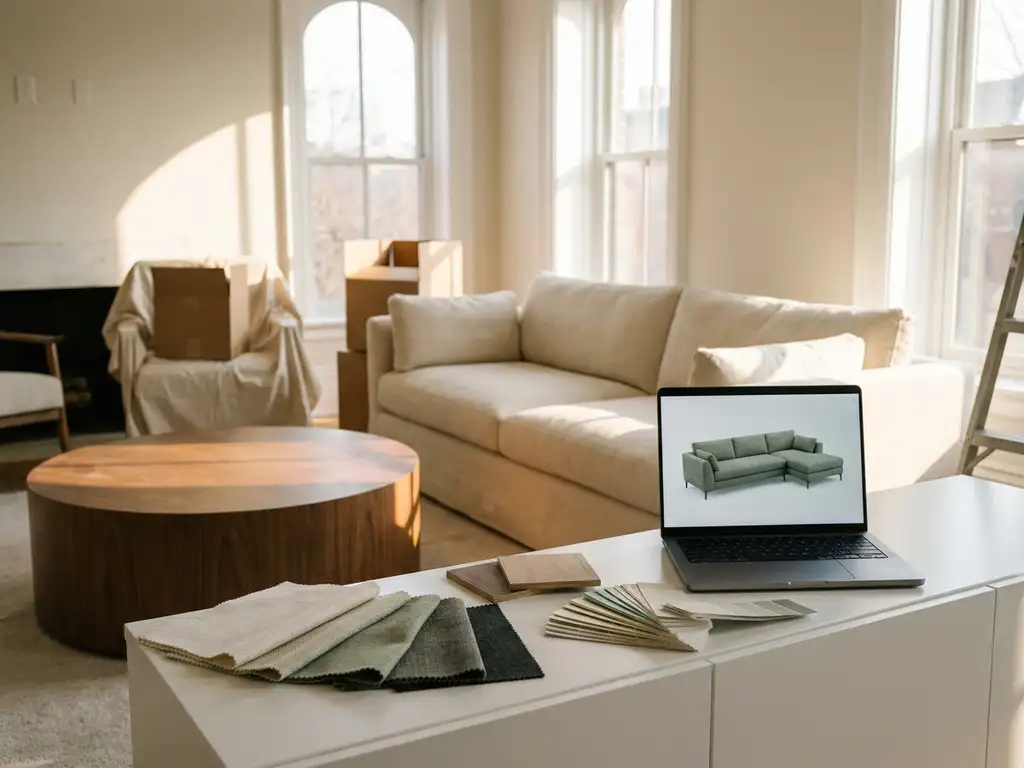
The best AI for interior design depends on what you need it to do. For homeowners exploring visual ideas, AI image generators like Midjourney or Adobe Firefly offer creative inspiration. For furniture brands and retailers who need accurate product visualization, configurable options, and sales integration, a dedicated 3D room planning software platform built for the industry delivers far more practical value.
In 2026, the gap between consumer-facing AI tools and professional-grade visual commerce platforms has widened considerably. Brands that rely on generic AI image tools often find them visually impressive but commercially limited. The questions below unpack exactly what separates these tools and which one belongs in a serious furniture retail or manufacturing operation.
How does AI actually work in interior design?
AI in interior design works by processing visual and spatial data to generate, arrange, or recommend design elements. Depending on the tool, AI can interpret a room’s dimensions, suggest furniture layouts, apply textures and materials in real time, or generate entirely new room visuals from a text prompt. The underlying technology ranges from machine learning models to rule-based configuration engines.
There are two broad mechanisms at work. Generative AI creates new visuals based on patterns learned from millions of images. Configuration AI, by contrast, applies business logic to real product data, rendering accurate representations of actual products in defined spaces. Both are useful, but they solve very different problems.
For furniture retailers and manufacturers, the most commercially relevant AI is the kind that connects product catalogues, pricing rules, and spatial logic into a single interactive experience. That is where room planning tools powered by product configuration engines come into their own.
What are the main types of AI interior design tools available?
There are four main types of AI interior design tools available today: generative image tools, virtual staging platforms, AI-assisted space planners, and integrated 3D product configurators with room planning. Each serves a different audience and use case, from personal inspiration to enterprise-level sales enablement.
- Generative image tools (e.g. Midjourney, DALL-E, Adobe Firefly): Create photorealistic room visuals from text prompts. Great for mood boards and early-stage concept work, but not tied to real products or accurate dimensions.
- Virtual staging platforms: Used primarily in real estate to digitally furnish empty rooms. Fast and cost-effective for listings, but not designed for product sales or customization.
- AI-assisted space planners: Help users create floor plans and test furniture arrangements. Useful for layout planning but often limited in product depth and configurability.
- Integrated 3D room planning software: Combines accurate product data, real-time configuration, pricing, and spatial planning in one platform. Designed specifically for furniture brands and retailers to drive sales and reduce returns.
For consumer-facing applications where commercial outcomes matter, the fourth category is by far the most powerful.
What’s the difference between AI image generators and AI product configurators?
AI image generators create visually plausible rooms based on learned patterns, but the products shown are not real and cannot be ordered. AI product configurators, by contrast, render actual products from a brand’s catalogue in accurate dimensions, configurable materials, and real pricing. One produces inspiration; the other drives transactions.
This distinction matters enormously for furniture brands. An AI-generated image of a sofa in a living room looks compelling, but it cannot tell a customer what the sofa costs in forest green velvet, whether it ships in six weeks, or how it fits alongside a specific dining table. A 3D room planning tool with an integrated configurator answers all of those questions in real time.
Product configurators also operate within business rules. They know which fabric combinations are available, which sizes are compatible with which frames, and how pricing shifts with each selection. Generative AI has no concept of these constraints. For a manufacturer or retailer, that difference between visual inspiration and actionable product data is the difference between a browsing tool and a selling tool.
Which AI interior design tool is best for furniture brands and retailers?
For furniture brands and retailers, the best AI interior design tool is an integrated 3D room planning platform that combines product configuration, spatial visualization, and direct purchasing in a single web-based experience. Generic AI image tools lack the product accuracy, business logic, and system integration that commercial furniture sales require.
The most effective platforms in 2026 allow customers to:
- Build a room layout using accurate floor plan dimensions
- Place and configure real products from the brand’s catalogue
- Adjust materials, colours, and sizes with live pricing updates
- View the result in photorealistic 3D from any angle
- Add to cart or request a quote directly from within the tool
This level of integration transforms a passive browsing experience into an active, confidence-building sales journey. Research consistently shows that showing products in a realistic room context significantly increases buying intent, which directly impacts conversion rates and average order values.
Can AI interior design tools reduce product returns?
Yes, AI interior design tools can meaningfully reduce product returns, particularly when they allow customers to visualize real products in their actual space before purchasing. Returns in furniture retail are most often caused by size mismatches, colour disappointments, and style conflicts with existing furniture. Accurate 3D room planning addresses all three.
When a customer can place a configurable sofa in a scaled version of their own room, select the exact fabric, see how it interacts with their flooring and wall colour, and confirm the dimensions fit before ordering, the guesswork disappears. That reduction in uncertainty is what drives return rates down.
The effect compounds when the tool is connected to live product data. If the configurator only shows available options and reflects accurate lead times, customers make decisions based on reality rather than assumption. This is one of the strongest commercial arguments for investing in room planning software rather than standalone AI image tools.
What should you look for when choosing an AI interior design platform?
When choosing an AI interior design platform for a furniture brand or retail operation, prioritize product accuracy, integration capability, configurability, and scalability. A visually impressive tool that cannot connect to your product catalogue or ERP system will create more operational complexity than it solves.
Key criteria to evaluate include:
- Product data integration: Can it ingest your full catalogue, including all variants, materials, and pricing rules?
- Configuration depth: Does it support complex business logic, such as conditional options, size-dependent pricing, and compatibility rules?
- Visual quality: Are the 3D renders photorealistic enough to replace or supplement traditional product photography?
- System compatibility: Does it integrate with your PIM, ERP, CMS, or webshop without heavy custom development?
- Channel flexibility: Can it be deployed across your own webshop, retailer portals, and in-store kiosks from a single platform?
- Industry experience: Does the vendor have a proven track record specifically in furniture and home furnishings?
Generic platforms built for multiple industries often lack the depth that furniture-specific complexity demands. A platform built by people who understand upholstery options, modular configurations, and lead time logic will always outperform a horizontal tool adapted for the sector.
How iONE360 helps with AI-powered interior design and room planning
We built iONE360 specifically for furniture brands, manufacturers, and retailers who need more than visual inspiration. Our platform combines an advanced 3D room planning software solution with a fully integrated product configurator, giving customers the ability to design, configure, and purchase in a single seamless experience.
Here is what sets our approach apart:
- Two flexible room planning paths: Integrate a bespoke, white-labeled room planner built for your platform, or onboard HomeDecoHub, our ready-to-use room planning marketplace powered by the same proven configurator engine.
- Real-time product configuration: Customers configure products directly within the room planner, with live pricing, lead times, and availability reflected instantly.
- Photorealistic 3D visualization: Every product variant is rendered at the quality level your brand deserves, without a separate photoshoot for each configuration.
- Seamless system integration: Our platform connects with your existing PIM, ERP, CMS, and webshop, so your data stays consistent across every channel.
- Proven commercial impact: Showing products in a room context increases buying intent by up to 64%, reducing returns and lifting average order values.
- 45 years of industry expertise: Built by the Dutch Colijn Group, iONE360 is designed from the ground up for the complexity of furniture and home furnishings.
Whether you are launching a new collection, scaling your visual content, or modernizing your omnichannel experience, iONE360 gives you the tools to do it without compromise. Get in touch with our team to see how we can put it to work for your brand.
Frequently Asked Questions
How long does it typically take to implement a 3D room planning platform for a furniture brand?
Implementation timelines vary depending on the size of your product catalogue, the complexity of your configuration rules, and how deeply the platform needs to integrate with your existing systems. For most furniture brands, a fully integrated 3D room planning solution can be up and running within a few weeks to a few months. Working with a vendor that has furniture-specific experience — and pre-built connectors for common PIM, ERP, and webshop systems — significantly shortens that timeline compared to building from scratch.
Can customers use a 3D room planner without any technical knowledge or design experience?
Yes, and this is a critical design requirement for any consumer-facing room planning tool. The best platforms are built so that any customer — regardless of design experience — can enter room dimensions, place furniture, and configure products intuitively within minutes. Features like drag-and-drop furniture placement, automatic snapping to walls, and guided configuration flows remove the learning curve. If a tool requires training to use, it will not convert casual browsers into buyers.
What if my product catalogue has thousands of SKUs and complex configuration rules — can a room planner handle that?
A purpose-built furniture configurator is specifically designed to handle large, complex catalogues with conditional logic, size-dependent pricing, material compatibility rules, and modular product structures. The key is choosing a platform that ingests your product data in a structured way and applies your business rules programmatically, rather than requiring manual setup for each variant. Vendors with deep furniture industry experience will have already solved the common complexity challenges — such as modular sofas, mixed-material finishes, and frame-and-fabric combinations — before you even ask.
How does a 3D room planning tool integrate with an existing webshop or e-commerce platform?
Most professional 3D room planning platforms are designed to embed directly into your existing webshop via an API or iFrame integration, allowing customers to move seamlessly from room planning to checkout without leaving your site. The configurator passes product selections, chosen variants, and live pricing directly into your cart or quoting system. Before committing to a platform, confirm it has pre-built integrations for your specific CMS or e-commerce stack — custom development to bridge incompatible systems can add significant time and cost to your rollout.
Is a 3D room planner only useful online, or can it also work in physical retail stores?
A well-architected room planning platform can be deployed across multiple channels from a single system — including in-store kiosks, tablet-based sales tools for floor staff, retailer partner portals, and your own webshop. In a physical retail context, store associates can use the room planner to help customers visualize products they see on the floor in the context of their own home, which is a powerful tool for closing higher-value sales. The key advantage of a channel-agnostic platform is that product data, pricing, and configuration rules stay consistent everywhere, eliminating costly discrepancies between online and in-store experiences.
What kind of product data do I need to prepare before onboarding a 3D room planning platform?
At a minimum, you will need accurate product dimensions, 3D models or high-quality visual assets for each product, material and finish options with their corresponding rules, and up-to-date pricing data including any variant-based pricing logic. Many platforms can work with existing 3D assets or help convert traditional photography into 3D-ready formats. The cleaner and more structured your product data is before onboarding, the faster and smoother your go-live will be — so it is worth auditing your catalogue for gaps in dimensions, missing variants, or inconsistent naming conventions ahead of time.
How do I measure the ROI of a 3D room planning tool after implementation?
The most direct metrics to track are conversion rate uplift among users who engage with the room planner versus those who do not, changes in average order value, and shifts in product return rates over time. You should also monitor time-on-site for room planner sessions, quote or add-to-cart rates from within the tool, and any reduction in pre-sale customer service enquiries — since a well-configured room planner answers many sizing and compatibility questions before they reach your support team. Setting a clean baseline before launch and segmenting your analytics by room planner engagement will give you the clearest picture of commercial impact.