

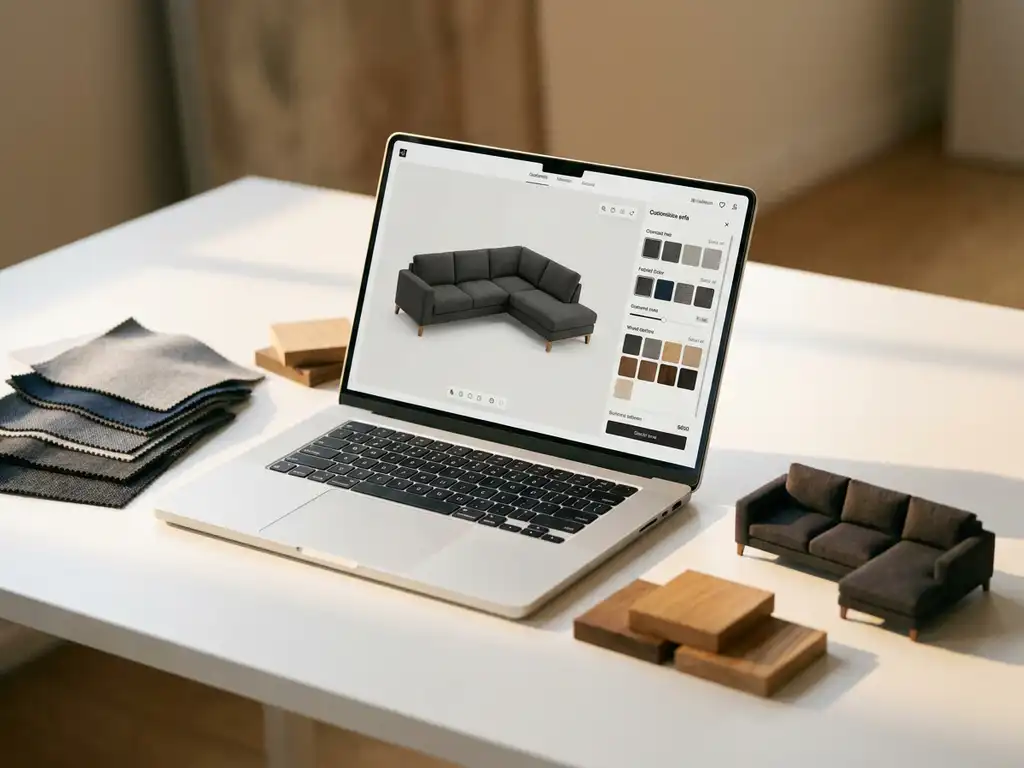
The best furniture design software depends on your role and goal. For manufacturers and retailers selling configurable products, a 3D product configurator combined with room planning software delivers the most commercial value. For industrial design and production engineering, dedicated CAD tools serve a different purpose entirely. This article walks through the key questions you should ask before choosing a solution.
What types of furniture design software exist?
Furniture design software falls into several distinct categories, each built for a different stage of the product lifecycle. The main types are CAD tools for engineering and manufacturing, product configurators for sales and e-commerce, 3D visualization platforms for marketing content, and room planning tools for the customer-facing buying experience.
Here is a quick breakdown of the main categories:
- CAD software (e.g., AutoCAD, SolidWorks): Used by product designers and engineers to create technical drawings and production-ready files
- 3D visualization software: Renders photorealistic images of furniture for marketing, catalogues, and product pages
- Product configurators: Allow customers or sales teams to build and customize products in real time, including pricing and business logic
- Room planning software: Lets customers arrange and configure multiple furniture pieces within a virtual room environment
- Augmented reality (AR) tools: Enable customers to place virtual furniture in their actual living space using a smartphone or tablet
Most manufacturers and retailers need more than one of these capabilities. The most powerful platforms today combine several of these functions in a single, integrated environment.
What’s the difference between furniture CAD software and a product configurator?
Furniture CAD software is an engineering tool used to design and technically specify products before they are manufactured. A product configurator is a sales tool that lets customers or sales staff customize an existing product range within predefined options. They solve fundamentally different problems and are rarely interchangeable.
CAD software produces technical output: precise measurements, material specifications, and production files that factories need to build a product. It requires specialist training and is used internally by designers and engineers.
A product configurator, by contrast, operates at the commercial end of the product lifecycle. It takes a finished product range and makes it interactive. Customers can select fabric, finish, size, and configuration, see the result in real time, and proceed to purchase. The configurator enforces business rules behind the scenes, so only valid and producible combinations are ever presented.
For manufacturers selling customizable products online or through dealer networks, a product configurator has a far more direct impact on revenue than CAD software. CAD is essential for product development; a configurator is essential for product sales.
Which furniture design software is best for manufacturers?
For furniture manufacturers selling configurable or made-to-order products, a web-based 3D product configurator with integrated room planning capabilities is the most commercially impactful software investment. It replaces expensive photoshoots, supports dealer networks, and enables customers to buy with confidence across every channel.
The best solutions for manufacturers share several key characteristics:
- Handles complex product logic: Configurable products often involve thousands or even millions of valid combinations. The software must enforce business rules and pricing automatically without manual input per variant.
- Generates visuals automatically: Every configuration should produce a high-quality 3D render or packshot without a separate photoshoot. This is the only scalable way to cover a full product range.
- Integrates with existing systems: The configurator must connect cleanly with PIM, ERP, CMS, and e-commerce platforms to avoid duplicating data entry and creating inconsistencies.
- Works across channels: Manufacturers sell through their own webshop, dealer networks, and physical showrooms. The software must deliver a consistent experience across all of them.
- Supports room planning: Customers furnishing an entire room convert at significantly higher rates when they can visualize multiple pieces together. A built-in 3D room planning tool adds meaningful commercial value.
How does 3D furniture visualization software work?
3D furniture visualization software works by creating a digital 3D model of a product, applying configurable materials, textures, and dimensions, and then rendering a photorealistic image or interactive view in real time or near real time. The output can be a static packshot, a 360-degree view, an AR experience, or a full room scene.
The process starts with a 3D asset, typically built from technical product data or CAD files. Once the model exists in the system, materials such as fabrics, leather, wood finishes, and paint colors are mapped onto it. When a customer selects a configuration option, the software swaps the relevant material or geometry and updates the visual instantly.
Advanced platforms go further by placing configured products inside room environments, allowing customers to experiment with layouts, lighting, and surrounding decor. This is where room planning software adds its greatest value: customers are no longer evaluating a single product in isolation but seeing how it works in the context of a full interior.
The commercial impact is significant. Showing products in a realistic room setting increases buying intent considerably, because it removes the uncertainty that causes hesitation and returns.
What should you look for in furniture design software?
The most important factors when evaluating furniture design software are visual quality, configurability, integration capability, and scalability. The right platform must handle your full product catalogue, connect to your existing tech stack, and deliver a consistent experience whether a customer is browsing your webshop, visiting a dealer, or using a room planning tool.
Beyond the technical checklist, look for these practical signals of a strong solution:
- Industry-specific experience: Generic configurators often struggle with the complexity of furniture products. Look for a vendor with a proven track record specifically in home furnishings.
- No-download, browser-based access: Customers and sales staff should not need to install anything. Web-based tools have higher adoption rates and lower maintenance overhead.
- White-label flexibility: If you sell through retailers or dealer networks, the software should present your brand, not the software vendor’s.
- Automated content generation: Every new product or variant should generate its own visuals automatically. Manual rendering per SKU is not scalable.
- AR capability: Augmented reality allows customers to place furniture in their own home before buying, which reduces returns and increases purchase confidence.
- Room planning integration: A built-in room planner keeps the customer journey within a single platform, reducing friction and increasing average order value.
How much does furniture design software cost?
The cost of furniture design software varies widely depending on the type of solution, the complexity of your product catalogue, and the level of integration required. Entry-level visualization tools may start at a few hundred euros per month, while enterprise-grade configurator platforms with full room planning and system integration are typically priced as custom projects based on scope.
Rather than focusing on the monthly license fee alone, manufacturers should evaluate the total cost of ownership against the savings the platform generates. A 3D configurator that eliminates traditional photoshoots, for example, can recover its investment quickly when you consider that a single product photoshoot across all variants can cost tens of thousands of euros. Add the reduction in returns, the increase in conversion rates, and the savings on manual sales support, and the business case becomes straightforward.
The most relevant cost comparison for furniture manufacturers is not software versus software. It is software versus the ongoing cost of physical samples, printed catalogues, manual sales processes, and fragmented visual content production.
How iONE360 Helps with Furniture Visualization and Room Planning
We built iONE360 specifically for manufacturers and retailers in the furniture, home, and decor industry. After more than 45 years of experience developing software for this sector, we understand the complexity of configurable products, the demands of dealer networks, and the commercial pressure to produce high-quality visuals at scale.
Here is what iONE360 delivers in practice:
- A 3D product configurator that handles millions of product variations, enforces your business rules, and generates photorealistic visuals automatically for every configuration
- Integrated room planning software that lets customers design entire rooms, configure individual pieces on the spot, and view the result in a realistic 3D environment
- Augmented reality that allows customers to place configured products in their own home before purchasing
- Automatic packshot generation that eliminates the need for traditional product photography across your full catalogue
- Seamless integration with PIM, ERP, CMS, and e-commerce platforms so your data stays consistent across every channel
- White-label flexibility for consistent brand presentation across your own webshop, retail partners, and dealer network
The result is a platform that helps customers buy faster, add more to their order, and return less. Ready to see what this looks like for your product range? Get in touch with our team and we will show you what is possible.
Frequently Asked Questions
How long does it typically take to get a 3D product configurator up and running for a furniture manufacturer?
Implementation timelines vary depending on the size of your product catalogue and the complexity of your configurations, but most furniture manufacturers can expect an onboarding period of several weeks to a few months. The largest variable is usually the preparation and quality of your existing product data and 3D assets — the cleaner your input files, the faster the setup. A vendor with deep furniture industry experience will have established workflows to accelerate this process significantly compared to a generic configurator provider.
Can a product configurator handle furniture with hundreds of fabric and finish options without slowing down?
Yes, a well-architected web-based configurator is specifically designed to handle this level of complexity without performance issues. Rather than pre-rendering every possible combination — which would be technically impossible at scale — modern platforms apply materials and geometry changes dynamically in real time using the customer’s browser. The key is choosing a platform built for furniture-grade complexity, as generic configurator tools often struggle with the sheer number of valid permutations that upholstered or modular furniture products involve.
What 3D file formats do I need to provide, and what if my product data is not yet in 3D?
Most configurator platforms accept common formats such as OBJ, FBX, STEP, or files exported from CAD tools like SolidWorks or AutoCAD. If you don’t yet have 3D assets, many vendors — including specialist furniture software providers — offer 3D modeling services to create assets from technical drawings, physical samples, or even high-quality photography. Starting without a full 3D library is not a blocker; it simply means factoring asset creation into your onboarding timeline and budget.
How does a furniture configurator integrate with our existing e-commerce platform or ERP system?
Most enterprise-grade configurators integrate via APIs, allowing them to exchange data bidirectionally with platforms such as Shopify, Magento, SAP, or custom ERP and PIM systems. This means product data, pricing rules, and inventory information stay synchronized without manual re-entry, and orders placed through the configurator flow directly into your existing fulfillment workflows. Before committing to a platform, it is worth requesting a detailed integration map to confirm compatibility with your specific tech stack and to understand whether any custom development will be required.
Will our dealer network actually adopt a new configurator tool, or is low uptake a common problem?
Low adoption is a real risk with any new sales tool, but it is largely preventable with the right approach. The most important factor is choosing a browser-based solution that requires no installation or specialist training — dealers are far more likely to use a tool they can open instantly in a browser than one that demands a software download and setup. Equally important is white-label flexibility: when the tool presents the manufacturer’s own brand and product range seamlessly, it feels like a natural extension of the sales process rather than an external system being imposed on the dealer.
Does augmented reality actually reduce product returns, and is the technology reliable enough for everyday use?
Evidence from furniture retailers using AR consistently points to measurable reductions in return rates, primarily because customers gain a much more accurate sense of scale, proportion, and how a piece fits within their actual space before purchasing. The technology has matured considerably — modern web-based AR runs directly in a smartphone browser without requiring a dedicated app, which removes the biggest adoption barrier. The greatest impact tends to be on large or statement pieces such as sofas, dining tables, and wardrobes, where size uncertainty is the leading cause of returns.
What is the biggest mistake furniture manufacturers make when choosing visualization or configurator software?
The most common mistake is selecting a generic configurator or visualization tool not built specifically for the furniture industry, then discovering it cannot handle the product logic complexity — modular configurations, per-unit pricing across sizes, fabric repeat matching, or component-level business rules — that furniture products typically require. A related mistake is evaluating software on visual quality alone without stress-testing it against your actual product catalogue and configuration rules. Always run a proof of concept with your real products before committing, and ask the vendor to demonstrate the tool handling your most complex SKU, not just a simple showcase product.