

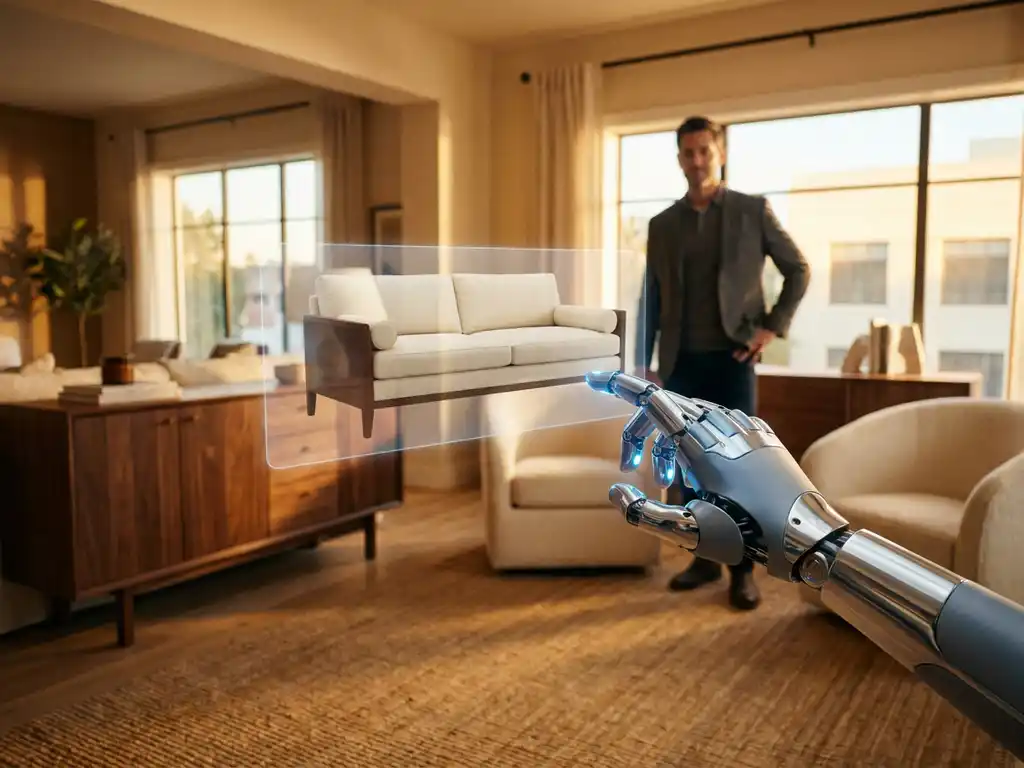
No, AI will not replace e-commerce. Instead, it is fundamentally reshaping how e-commerce works. AI is becoming the engine behind discovery, personalisation, content generation, and customer service, but the strategic decisions, brand relationships, and human judgment that drive successful online retail remain firmly in human hands. The questions below unpack exactly where AI is taking over, where it is not, and what that means for your business in 2026.
How is AI already changing the way people shop online?
AI is changing online shopping by making it faster, more personalised, and more visually immersive. Shoppers in 2026 encounter AI at nearly every touchpoint: product recommendations tailored to browsing behaviour, conversational search that understands natural language, dynamic pricing that adjusts in real time, and visual search tools that let users find products by uploading a photo. The overall effect is a shopping experience that feels less like browsing a catalogue and more like being guided by a knowledgeable assistant.
On the back end, AI is compressing the time between a shopper’s intent and a relevant result. Search algorithms now interpret context and intent rather than just matching keywords. Recommendation engines surface products a customer did not know they wanted but are highly likely to buy. Chatbots handle routine queries around the clock without human intervention. Together, these capabilities raise the baseline expectations shoppers have for every online store they visit.
For furniture and home furnishings retailers specifically, the shift is particularly visible in how products are presented. Static images of a single colourway are no longer sufficient when a customer wants to see how a sofa looks in sage green velvet in their own living room. AI-powered visualisation tools are closing that gap at scale, making it possible to show every product variant without a dedicated photoshoot for each configuration.
What parts of e-commerce can AI actually automate?
AI can reliably automate the repetitive, rules-based, and data-heavy tasks in e-commerce. These include product tagging and categorisation, personalised email campaigns, dynamic pricing adjustments, fraud detection, inventory forecasting, customer service triage, and the generation of product descriptions and marketing copy. These are high-volume tasks where AI consistently outperforms manual processes on speed and cost.
The areas where automation delivers the clearest return are:
- Customer segmentation and targeting: AI analyses purchase history, browsing patterns, and engagement signals to build granular audience segments automatically.
- Search and merchandising: Automated ranking algorithms surface the most relevant products for each visitor without manual curation.
- Visual content production: AI tools can generate product imagery, resize assets for different channels, and remove backgrounds at a fraction of the cost of traditional photography.
- Post-purchase flows: Returns processing, review requests, and loyalty triggers can all run on automated logic without human oversight for each transaction.
- Demand forecasting: Predictive models help buyers and planners make smarter stock decisions based on historical data and external signals.
What AI cannot automate effectively is anything requiring genuine creative direction, a nuanced brand voice, supplier negotiation, or the kind of strategic judgment that comes from deep industry experience. Automation handles the execution; humans still set the direction.
What is the difference between AI-assisted and AI-driven e-commerce?
AI-assisted e-commerce uses artificial intelligence as a tool to support human decision-making. AI-driven e-commerce, by contrast, relies on AI to make and execute decisions autonomously with minimal human input. Most successful online retailers in 2026 operate somewhere between the two, using AI to handle high-frequency decisions automatically while keeping humans in control of strategy, brand, and edge cases.
AI-assisted e-commerce: humans lead, AI accelerates
In an AI-assisted model, a marketing manager uses AI to generate first drafts of product descriptions, then edits them for brand voice. A merchandiser uses AI-generated insights to decide which products to promote, but makes the final call. AI reduces cognitive load and speeds up execution without removing human judgment from the loop. This model suits complex, high-consideration product categories — such as furniture and home furnishings — where context and nuance matter.
AI-driven e-commerce: systems decide and act
In an AI-driven model, algorithms set prices, allocate ad spend, reorder stock, and personalise the homepage for every visitor without a human approving each action. This works well for commodity products with clear performance signals and large data volumes. The risk is that AI-driven systems can optimise aggressively for measurable metrics while missing harder-to-quantify factors like long-term brand equity or customer trust.
For most furniture and home furnishings brands, the right model is AI-assisted: let AI handle the volume and speed, while keeping human expertise in control of the decisions that shape brand perception and customer relationships.
How does AI affect product visualisation and configuration in online retail?
AI is transforming product visualisation and configuration by making it possible to generate high-quality, photorealistic images of every product variant automatically — without a traditional photoshoot for each combination. For retailers selling configurable products, such as sofas in dozens of fabrics, beds in multiple sizes, or modular shelving in various finishes, this is one of the most commercially significant applications of AI in e-commerce today.
Historically, showing every configuration of a customisable product required either an enormous photography budget or a compromise where customers had to imagine what their chosen combination would look like. Neither option is acceptable when a purchase decision involves thousands of euros and something that will sit in a customer’s home for years.
Modern online product configurator platforms now combine 3D rendering with AI-assisted content generation to produce consistent, accurate visuals for every permutation of a product. Customers can interact with a product in real time, changing materials, dimensions, and components while the visual updates instantly. This reduces uncertainty, builds purchase confidence, and directly lowers return rates because customers receive exactly what they saw and chose.
Augmented reality (AR) adds another dimension to this: shoppers can place a configured product in their own space using a smartphone camera before committing to a purchase. The combination of configuration, real-time visualisation, and AR is raising the standard for what online furniture retail looks like in 2026.
Should businesses replace their e-commerce team with AI tools?
No. Businesses should not replace their e-commerce team with AI tools. AI is most effective when it amplifies the capabilities of skilled people, not when it substitutes for them. Teams that integrate AI into their workflows consistently outperform both fully manual teams and fully automated systems, because they combine the pattern recognition and speed of AI with the contextual judgment and creativity that humans bring.
The practical question is not whether to replace people, but how to redistribute effort. When AI handles tagging, reporting, copy drafts, and campaign optimisation, your team can focus on the work that genuinely requires human intelligence: understanding customers, building supplier relationships, defining brand direction, and responding to market shifts that no algorithm anticipated.
There is also a risk management argument for keeping humans in the loop. AI systems can fail silently, optimise for the wrong metric, or produce outputs that are technically correct but brand-damaging. Human oversight catches these failures before they reach customers.
The businesses that will struggle are those that either ignore AI entirely and fall behind on efficiency, or adopt it uncritically and lose the human judgment that differentiates their brand. The competitive advantage in 2026 belongs to teams that know which decisions to delegate to AI and which to own themselves.
What does the future of AI in e-commerce look like?
The future of AI in e-commerce points toward increasingly autonomous, personalised, and visually rich shopping experiences, with AI operating deeper in the purchase journey than it does today. The direction of travel includes agentic AI — systems capable of completing purchases on a shopper’s behalf — hyper-personalised storefronts that reconfigure themselves per visitor, and generative tools that create product content at a scale no human team could match.
Several developments are already taking shape:
- Conversational commerce: AI assistants that understand a shopper’s full context — budget, style preferences, and room dimensions — to make genuinely useful recommendations rather than generic suggestions.
- Predictive personalisation: Systems that anticipate what a customer will want next based on life stage signals, not just past purchases.
- Automated content at catalogue scale: Every product variant, in every market, with localised copy and imagery, generated and maintained without manual input per SKU (stock-keeping unit).
- Seamless omnichannel continuity: AI that connects the in-store, online, and app experience so that a customer’s configuration started on a showroom tablet continues on their phone at home.
For brands in the furniture and home furnishings space, the most important trend is the convergence of configuration, visualisation, and AI-driven personalisation into a single, integrated experience. Customers will expect to configure a product, see it in their space, and receive a personalised recommendation — all within a single session and without friction.
How iONE360 helps with AI-powered product configuration in e-commerce
iONE360 is a specialist visual configuration platform built specifically for furniture and home furnishings brands. We developed iONE360 to solve the visualisation and configuration challenges that hold these brands back online: the inability to show every product variant at scale, the cost of traditional photoshoots, and the complexity of managing millions of valid product combinations across multiple sales channels.
Our platform combines a powerful 3D product configurator with automated packshot generation, augmented reality (AR) visualisation, and a room planning tool — all within a single web-based platform that requires no download and integrates directly with your existing ERP (Enterprise Resource Planning), PIM (Product Information Management), and e-commerce systems.
Here is what that means in practice for your business:
- Eliminate photoshoot dependency: Automatically generate high-quality product images for every variant and configuration without a separate shoot per combination.
- Handle genuine product complexity: Our configurator is built on ERP logic and can manage millions of valid product combinations, complex business rules, and real-time pricing without errors.
- Guide customers confidently: A step-by-step guided selling experience reduces configuration errors, builds purchase confidence, and shortens the decision cycle.
- Deploy across every channel: The same configuration engine powers your webshop, your dealer network, and your in-store sales tools, ensuring consistent brand presentation everywhere.
- Integrate without friction: iONE360 connects directly to your existing ERP and tech stack, so you are extending what you have rather than replacing it.
If you are evaluating how to bring AI-powered visualisation and configuration into your e-commerce strategy, we would be glad to show you what iONE360 can do for your product catalogue. Get in touch with our team to request a demo.
Related Articles
- Should furniture manufacturers invest in room planning software?
- How do room visualizers compare to traditional showrooms?
- What is the difference between a product configurator and a product builder?
- What are the benefits of digital space planning tools?
- Can a 3D product configurator show my entire product collection in one place?