

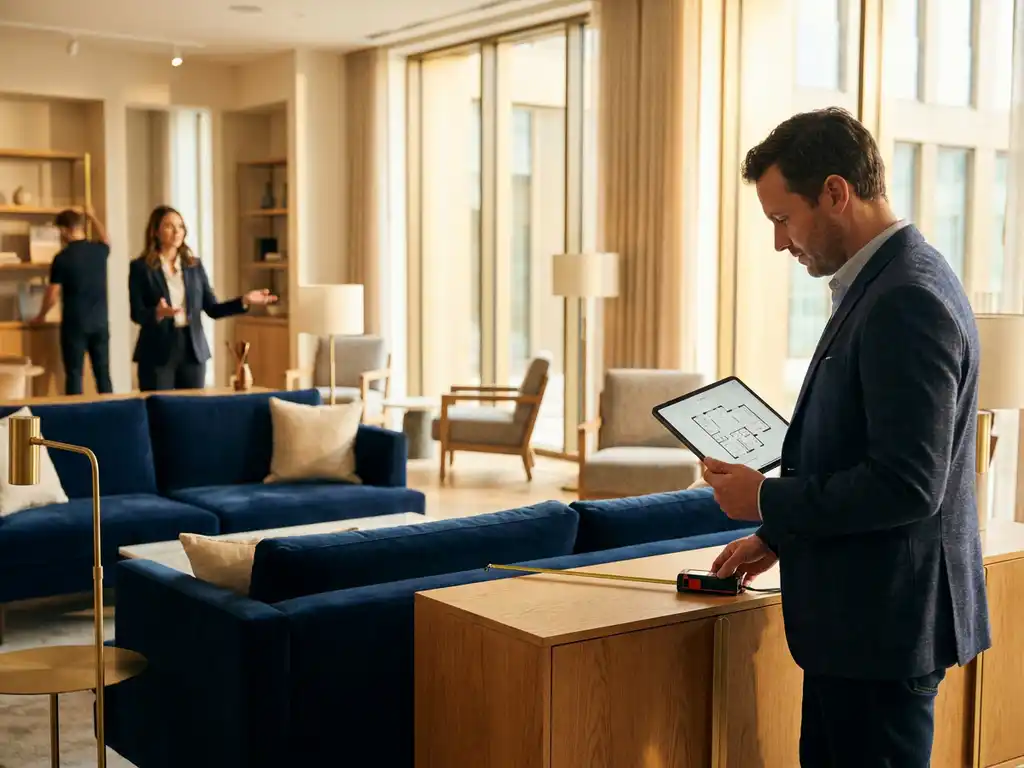
Room planning software benefits industries where spatial visualization directly impacts purchasing decisions and customer satisfaction. Furniture and home decor retailers, interior design firms, real estate companies, and hospitality businesses see the highest returns from 3D room planning tools because they help customers visualize products in context, reduce uncertainty, and increase conversion rates.
What is room planning software and why do businesses need it?
Room planning software is a digital tool that creates interactive 3D environments where users can design, furnish, and visualize spaces before making purchasing decisions. It combines floor planning, furniture placement, and realistic rendering to help customers see exactly how products will look and fit in their rooms.
Businesses need this technology because it bridges the gap between imagination and reality in the buying process. Traditional product photography shows items in isolation, making it difficult for customers to understand scale, proportion, and how pieces work together. Room planning software addresses this by providing contextual visualization that reduces purchase anxiety and increases buyer confidence.
The software transforms abstract product specifications into tangible visual experiences. Customers can experiment with different layouts, test color combinations, and see how furniture fits their actual room dimensions. This hands-on approach leads to more informed decisions, fewer returns, and higher customer satisfaction rates across retail industries.
Which retail industries benefit most from room planning tools?
Furniture retailers, home decor stores, kitchen and bathroom specialists, and flooring companies benefit most from room planning tools because their products require spatial context to drive purchase decisions. These industries sell items that customers must visualize in their actual living spaces to feel confident buying.
Furniture retailers see particularly strong results because customers struggle to imagine how sofas, dining sets, or bedroom furniture will fit and look in their homes. Room planners let shoppers test different arrangements, see scale relationships, and coordinate multiple pieces together. This visualization capability directly addresses the main barrier to furniture purchases online.
Kitchen and bathroom retailers benefit because these spaces involve complex layouts with multiple coordinated elements. Customers need to see how cabinets, countertops, fixtures, and appliances work together before committing to expensive renovations. Room planning software helps them design complete spaces with confidence.
Home decor and flooring companies use these tools to show how their products complement existing furnishings and architectural features. Customers can see how new curtains, rugs, or flooring will transform their current rooms without the guesswork that typically slows purchase decisions.
How do furniture manufacturers use space planning software?
Furniture manufacturers use space planning software to showcase their complete product catalogs in realistic room settings, demonstrate how pieces work together, and provide retailers with powerful sales tools. This technology helps them present products in context rather than as isolated items on white backgrounds.
Manufacturers create virtual showrooms that display their entire collection across different room types and design styles. This approach overcomes the limitations of physical showrooms, which can only feature a small subset of available products. Sales teams can quickly show customers any configuration or color combination without maintaining extensive physical inventory.
The software also helps manufacturers develop and test new product lines by visualizing how items will look in various room settings before production. They can experiment with different sizes, colors, and configurations to optimize their offerings based on how products actually appear in customer environments.
Additionally, manufacturers use room planning tools to support their retail partners. They provide branded room planning software that retailers can integrate into their websites, creating consistent product presentation across all sales channels while maintaining the manufacturer’s visual standards and brand identity.
What’s the difference between room planning software for B2B vs B2C?
B2B room planning software focuses on scalability, integration capabilities, and multi-user collaboration, while B2C versions prioritize ease of use, quick visualization, and simplified purchasing workflows. B2B tools serve professional designers, retailers, and manufacturers who need advanced features and system connectivity.
B2B solutions typically include robust product databases, complex pricing rules, and integration with enterprise systems like ERP, CRM, and inventory management platforms. These tools support professional workflows where multiple stakeholders collaborate on projects, requiring features like user permissions, project sharing, and detailed specifications export.
B2C room planning software emphasizes intuitive interfaces that guide consumers through simple design processes. These tools focus on quick wins like drag-and-drop furniture placement, preset room templates, and streamlined checkout processes. The goal is to help individual customers visualize purchases without requiring design expertise.
B2B platforms also handle more complex product configurations, custom pricing, and bulk ordering scenarios. They support professional use cases where designers specify products for clients or retailers configure showroom displays. B2C tools typically work with standard product catalogs and simplified customization options that don’t overwhelm casual users.
How do interior designers and architects benefit from room planning tools?
Interior designers and architects use room planning tools to communicate design concepts clearly to clients, streamline the specification process, and reduce costly design revisions. These tools help professionals present ideas visually rather than relying on technical drawings that clients may struggle to interpret.
The software allows designers to create photorealistic renderings that show exactly how finished spaces will look, including lighting, materials, and furnishing arrangements. This visual clarity helps clients understand and approve designs faster, reducing the back-and-forth typically required to align on creative vision.
Room planning tools also speed up the specification process by connecting directly to manufacturer product databases. Designers can select items, see real-time pricing and availability, and generate accurate project specifications without manually researching individual products. This automation reduces errors and saves significant time on project documentation.
For client presentations, these tools enable interactive design reviews where clients can explore spaces from different angles and suggest modifications in real time. This collaborative approach leads to better client satisfaction and fewer change orders during project execution.
Should real estate and hospitality industries invest in room planning software?
Real estate and hospitality industries should invest in room planning software when they need to help clients visualize space potential or design custom environments. These tools provide significant value for luxury real estate, vacation rentals, and hotels that want to showcase design possibilities.
Real estate professionals use room planning software to help buyers see how empty properties could look when furnished, making spaces feel more livable and appealing. This visualization capability particularly benefits luxury real estate where buyers want to understand how their existing furniture will work or envision complete interior design schemes.
Hotels and vacation rental properties use these tools to plan room layouts, test different furniture arrangements, and optimize space utilization. The software helps property managers experiment with different design concepts before making expensive furniture purchases or renovation decisions.
The hospitality industry also benefits from room planning tools when designing themed spaces, coordinating group accommodations, or planning event layouts. Properties can show potential clients exactly how spaces will be configured for their specific needs, improving booking confidence and reducing post-event complaints about space arrangements.
How iONE360 helps with room planning software
We provide advanced 3D room planning software that transforms how businesses showcase and sell furniture and home decor products. Our solution combines sophisticated visualization technology with practical business integration to deliver measurable results for manufacturers, retailers, and design professionals.
- Complete visual commerce platform with integrated room planning, product configuration, and AR visualization
- Seamless integration with existing business systems including PIM, ERP, and e-commerce platforms
- White-label solutions that maintain your brand identity across all customer touchpoints
- Automatic generation of high-quality product visuals and room scenes without manual photography
- Proven results including increased conversion rates, higher order values, and reduced return rates
Built on over 45 years of furniture industry expertise, our room planning software handles complex product configurations and business rules while delivering an intuitive customer experience. Ready to see how room planning software can transform your business? Contact us today to schedule a personalized demonstration.
Frequently Asked Questions
How long does it typically take to implement room planning software for my business?
Implementation timeframes vary based on your existing systems and customization needs, but most businesses can launch basic room planning functionality within 4-8 weeks. Complex integrations with ERP systems or extensive product catalog setups may take 3-4 months, while simple e-commerce integrations can be completed in 2-3 weeks.
What's the biggest mistake businesses make when choosing room planning software?
The most common mistake is selecting software based solely on visual features without considering integration capabilities and scalability. Many businesses choose tools that create beautiful room scenes but can’t connect to their existing product databases, pricing systems, or inventory management, leading to manual workarounds and operational inefficiencies.
How do I measure the ROI of room planning software investment?
Track key metrics including conversion rate improvements (typically 20-40% increases), average order value changes, return rate reductions, and time spent on product pages. Most businesses see positive ROI within 6-12 months through increased sales and reduced return processing costs, with some seeing immediate improvements in customer engagement.
Can room planning software work with my existing product catalog and pricing?
Yes, professional room planning solutions integrate with most PIM systems, e-commerce platforms, and ERP systems through APIs or data feeds. The software can automatically sync product information, pricing, availability, and specifications, ensuring your room planner always reflects current inventory and pricing without manual updates.
What technical requirements do my customers need to use room planning tools?
Modern room planning software runs in standard web browsers without requiring downloads or plugins. Customers need a device with internet access and basic graphics capabilities – most smartphones, tablets, and computers from the last 5 years work perfectly. Some advanced AR features may require newer mobile devices with camera capabilities.
How do I train my sales team to effectively use room planning software with customers?
Focus on teaching consultative selling techniques rather than software mechanics. Train staff to ask about customer room dimensions, style preferences, and functional needs first, then use the room planner to address specific concerns. Most effective sales teams use the software to solve problems rather than just showcase features.
What happens if customers create room designs but don't complete purchases?
Room planning software typically captures customer engagement data and design preferences, enabling targeted follow-up campaigns. You can send personalized emails featuring their saved designs, offer design consultations, or provide special pricing on items in their virtual rooms. Many businesses see 15-25% of abandoned designs convert through strategic remarketing.