

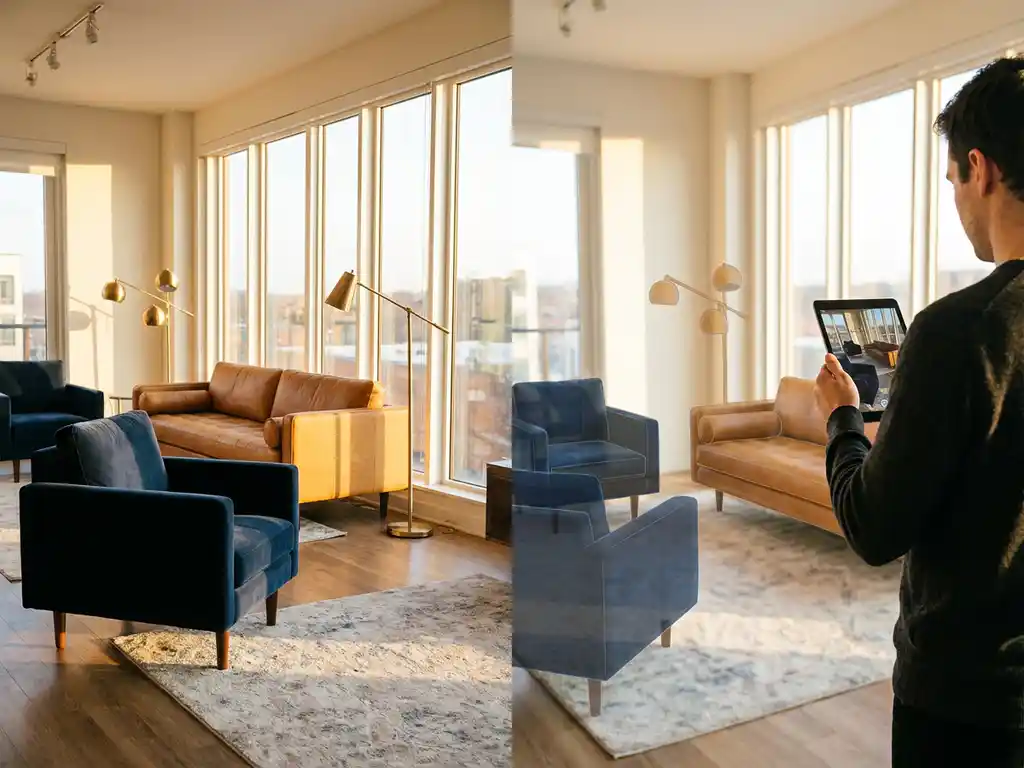
Room visualizers are digital tools that create 3D representations of spaces where customers can place and arrange furniture virtually, while traditional showrooms display physical furniture in set arrangements. Room visualizers offer unlimited configuration possibilities and instant visualization of different layouts, whereas showrooms provide tactile experiences but are limited by physical space and inventory constraints.
What are room visualizers and how do they work?
Room visualizers are digital platforms that create interactive 3D environments where users can design spaces by placing, arranging, and customizing furniture virtually. They work by combining 3D product models with room templates or custom floor plans, allowing real-time manipulation of layouts, colors, and configurations.
These tools typically start with either pre-built room templates or allow users to input their own room dimensions. Users then browse furniture catalogs and drag items into the space, where they can adjust placement, rotation, and often customize colors, materials, and sizes. Advanced room visualizers include features like realistic lighting, shadow effects, and the ability to change wall colors, flooring, and other environmental elements.
Modern room planning software integrates with product configurators, enabling customers to modify furniture specifications directly within the visualization. This means users can change a sofa’s fabric, adjust a table’s dimensions, or select different finishes while seeing the results immediately in their designed space. The technology renders these changes in real time, providing instant feedback on how different choices affect the overall room aesthetic.
What’s the difference between room visualizers and traditional showrooms?
Room visualizers offer unlimited virtual space and instant product variations, while traditional showrooms provide physical interaction with actual furniture but are constrained by floor space and inventory limitations. The key difference lies in the accessibility and scope of what can be displayed.
Traditional showrooms excel at providing tactile experiences where customers can touch fabrics, test comfort levels, and examine build quality firsthand. However, they can only showcase a limited selection of products in predetermined arrangements. Changing a display requires physical effort, time, and often significant cost, making it impractical to show every possible configuration or color option.
Room visualizers eliminate these physical constraints by creating digital environments where any product can be displayed in countless variations. Customers can see how a blue sofa looks compared to gray, experiment with different room layouts, and even test products that aren’t currently in stock. This technology also allows for personalization by letting customers input their actual room dimensions and see how furniture fits their specific space.
What are the main advantages of room visualizers over showrooms?
Room visualizers provide unlimited product variety, instant customization, 24/7 accessibility, and personalized room layouts without the space and inventory constraints of physical showrooms. They also enable customers to visualize products in their actual living spaces rather than generic display settings.
The most significant advantage is scalability. A single room visualizer can showcase thousands of product combinations that would require enormous showroom space to display physically. Customers can experiment with different furniture arrangements, color schemes, and room layouts without any time pressure or sales assistance, leading to more confident purchasing decisions.
Cost efficiency represents another major benefit. Maintaining a comprehensive showroom requires substantial real estate, inventory investment, and regular updates as product lines change. Room visualizers eliminate these ongoing costs while providing superior product coverage. They also integrate seamlessly with e-commerce platforms, allowing customers to configure, visualize, and purchase products in a single session.
Personalization capabilities set room visualizers apart from one-size-fits-all showroom displays. Customers can input their specific room dimensions, architectural features, and existing furniture to create accurate representations of their actual spaces. This level of customization helps eliminate the guesswork that often leads to poor purchasing decisions and returns.
What limitations do room visualizers have compared to physical showrooms?
Room visualizers cannot replicate the tactile experience of touching fabrics, testing furniture comfort, or assessing actual build quality that physical showrooms provide. They also depend on screen quality and may not perfectly represent true colors or textures.
The absence of physical interaction remains the most significant limitation. Customers cannot assess comfort levels by sitting on chairs or sofas, feel the texture of different fabrics, or examine construction details like joint quality or material thickness. These tactile elements often play crucial roles in furniture purchasing decisions, particularly for higher-end pieces where quality assessment is essential.
Technical limitations can also affect the user experience. Room visualizers depend on device capabilities, internet connectivity, and screen quality for optimal performance. Color representation may vary between different monitors, and complex 3D renderings might load slowly on older devices. Additionally, some customers may find digital interfaces intimidating or prefer human assistance when making significant purchases.
Which option works better for furniture shopping decisions?
The most effective approach combines both room visualizers and physical showrooms, using digital tools for initial exploration and layout planning, followed by showroom visits for tactile evaluation of shortlisted items. This hybrid approach maximizes the benefits of both methods.
Room visualizers excel in the early shopping phases when customers are exploring options, comparing layouts, and narrowing down choices. They allow extensive experimentation without time constraints and help customers arrive at showrooms with specific, well-considered preferences. This preparation makes showroom visits more focused and productive.
For final purchase decisions, especially on significant investments, physical evaluation often remains important. Customers typically want to confirm comfort, quality, and aesthetic appeal before committing to expensive furniture pieces. However, having already visualized products in their intended spaces through room planning software, they approach these physical evaluations with greater confidence and clearer criteria.
The integration of both approaches creates a superior customer experience. Digital tools handle the broad exploration and planning phases efficiently, while physical showrooms provide the sensory confirmation needed for final decisions. This combination reduces both the time spent in showrooms and the likelihood of purchase regret.
How iONE360 helps with room visualization and space planning
We provide comprehensive room planning software that combines advanced 3D visualization with integrated product configuration, enabling customers to design complete living spaces while customizing individual furniture pieces in real time. Our solution addresses the limitations of traditional showrooms by offering:
- Unlimited product showcase: Display your entire catalog in countless configurations without physical space constraints
- Real-time customization: Customers can modify colors, materials, and dimensions while seeing instant results in 3D
- Seamless integration: Our platform connects with your existing systems for pricing, inventory, and order processing
- Proven results: Room planning tools increase buying intent by up to 64% by showing products in proper context
- Reduced returns: Customers make more confident decisions when they can visualize products in their actual spaces
Built on over 45 years of furniture industry expertise, our room visualizer transforms the traditional buying experience by eliminating uncertainty and enabling confident purchasing decisions. Ready to see how room planning software can revolutionize your customer experience? Explore our showcases or contact us for a personalized demonstration.
Frequently Asked Questions
How accurate are room visualizers in terms of scale and proportions?
Modern room visualizers are highly accurate when users input correct room dimensions. Most platforms use precise 3D modeling that maintains proper scale relationships between furniture pieces and room space. However, accuracy depends on users providing accurate measurements of their rooms and any existing furniture they want to incorporate into the design.
What technical requirements do I need to run room planning software effectively?
Most room visualizers work on standard computers, tablets, and smartphones with modern web browsers. For optimal performance, you’ll need a stable internet connection, updated browser software, and ideally a device with dedicated graphics capabilities for smoother 3D rendering. Mobile devices may have limited functionality compared to desktop versions.
Can room visualizers help me plan around existing furniture I want to keep?
Yes, most advanced room planning software allows you to input dimensions and add representations of existing furniture pieces to your design. This helps you see how new purchases will work with your current setup and ensures proper spacing and visual harmony between old and new pieces.
How do I get accurate room measurements for the best visualization results?
Measure your room’s length, width, and height using a tape measure, and note the locations of windows, doors, outlets, and any architectural features. Some room visualizers offer mobile apps that use your phone’s camera to help measure spaces, though manual measurements with a tape measure typically provide the most accurate results.
What should I do if the colors in the room visualizer don't match what I see in the showroom?
Color variations between digital displays and real life are common due to screen calibration and lighting differences. Use the room visualizer to narrow down your choices, then always view actual fabric or material samples in your intended room’s lighting conditions before making final color decisions.
Can room visualizers show how furniture will look in different lighting conditions?
Advanced room planning software often includes lighting simulation features that can show how furniture appears under different lighting scenarios, including natural daylight, warm evening lighting, and various artificial lighting options. This helps you understand how your choices will look throughout the day.
How can I share my room design with family members or designers for feedback?
Most room visualizers offer sharing features through email links, social media, or downloadable images. Some platforms also provide collaboration tools where multiple users can access and modify the same design project, making it easy to get input from family members, friends, or professional designers before making purchases.