

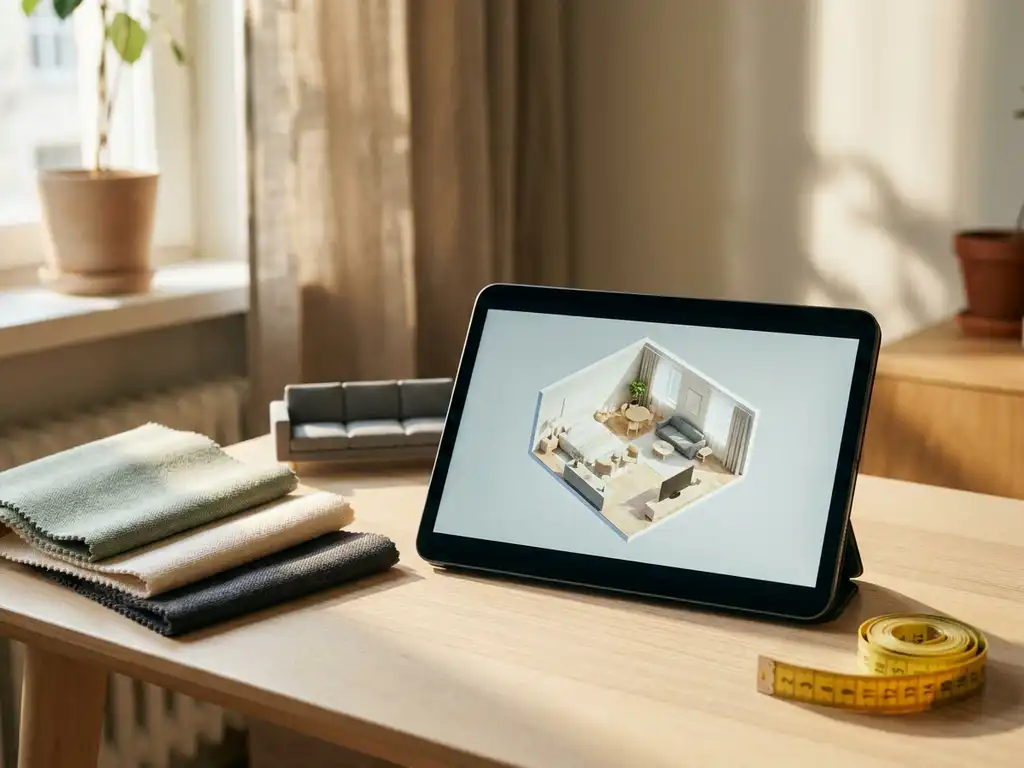
The best app for room layout design depends on what you need it to do. For casual home planning, free tools like Planner 5D or RoomSketcher offer a solid starting point. For furniture retailers and manufacturers, however, a professional room planning tool for furniture that integrates product configuration, real pricing, and ordering directly into the experience delivers far greater value. This article walks through the key questions buyers and businesses ask when evaluating room planning software in 2026.
What features should a room layout design app actually have?
A room layout design app should include an intuitive drag-and-drop floor plan builder, accurate room scaling, a furniture library with real product dimensions, and the ability to switch between 2D and 3D views. The best tools also support material and colour customisation, real-time pricing, and direct ordering, turning a planning session into a complete sales journey.
Beyond the basics, the features that separate a functional tool from a genuinely useful one include:
- 3D visualisation: Flat floor plans tell you where things fit. A 3D view tells you how the room actually feels.
- Product configuration: The ability to change fabric, finish, size, and configuration directly inside the planner, without leaving the interface.
- Augmented reality (AR): Placing furniture in a real space using a smartphone camera removes doubt at the point of decision.
- Curtains, flooring, and wallpaper: Complete room decoration tools help customers visualise the full interior, not just the furniture.
- Pricing and lead times: Showing live prices and delivery windows during planning reduces friction at checkout.
- Integration with existing systems: A room planner that connects to your PIM, ERP, or webshop removes manual steps and keeps product data consistent.
For furniture businesses specifically, a room planner that lacks product configuration is only half a solution. Customers need to see their exact chosen sofa in the exact fabric, at the exact price, in their room, before they commit.
What are the most popular free room layout apps available today?
The most popular free room layout apps in 2026 include Planner 5D, RoomSketcher, Roomle, IKEA Place, and Homestyler. Each offers a browser or mobile interface for creating basic floor plans and experimenting with furniture placement. Most free tiers, however, limit the number of rooms, restrict 3D rendering quality, or lock advanced features behind a subscription.
Here is a quick overview of what these tools typically offer at the free level:
- Planner 5D: User-friendly drag-and-drop interface with a large generic furniture catalogue. Good for personal home planning.
- RoomSketcher: Clean 2D and 3D floor plan tool with professional output options. Free tier limits 3D snapshots.
- Roomle: Strong on configurability and often used by furniture brands as a white-label integration tool.
- IKEA Place: AR-first app tied exclusively to IKEA products. Excellent AR quality but no cross-brand planning.
- Homestyler: Design-focused with a social sharing element. Better suited to interior design inspiration than precise planning.
For individual consumers decorating a single room, these tools are often sufficient. For furniture retailers or manufacturers who need to show their own configurable product range inside a planner, a branded, integrated solution is the more appropriate path.
How does a 3D room planner differ from a basic 2D floor plan tool?
A 3D room planner allows users to view, rotate, and navigate a space as a fully rendered three-dimensional environment, while a basic 2D floor plan tool shows only a top-down schematic. The practical difference is significant: 3D room planning software helps customers understand proportion, light, and visual harmony in ways a flat plan simply cannot communicate.
In a 2D floor plan, you can confirm that a sofa fits against a wall. In a 3D room planner, you can see whether it overwhelms the space, whether the colour works with the floor, and whether the layout feels open or cramped. That emotional layer is what drives purchasing confidence.
Advanced 3D room planning software goes further still. Users can zoom and rotate the camera freely, switch between a bird’s-eye view and a first-person walkthrough, and interact with individual products to change their configuration in real time. This level of immersion is particularly valuable in the furniture sector, where purchases are high-value and returns are costly.
Can room layout apps show furniture in augmented reality?
Yes, many modern room layout apps support augmented reality, allowing users to place virtual furniture into their real physical space using a smartphone or tablet camera. AR-enabled room planning tools overlay 3D product models onto a live camera feed, giving customers a realistic sense of scale, proportion, and fit before purchasing.
The quality of AR experiences varies considerably. Basic AR apps place a generic model in the room. More sophisticated room planning software renders a fully configured product in AR, meaning the customer sees their chosen sofa in the exact fabric and dimensions they selected, positioned in their actual living room.
AR functionality has a measurable impact on purchase confidence. When customers can see a product in their own space, uncertainty drops significantly, and so does the likelihood of a return. For furniture brands, this makes AR not just a feature but a genuine commercial tool. Research in the furniture industry consistently points to AR as one of the highest-impact technologies for reducing hesitation at the point of sale.
When is a standalone app not enough for room layout planning?
A standalone room layout app is not enough when the planning experience needs to connect directly to a real product catalogue, live pricing, business rules, and an ordering system. For furniture manufacturers and retailers, a disconnected app creates a gap between inspiration and purchase that costs conversions and increases errors.
Specifically, a standalone app falls short when:
- Your products have hundreds or thousands of configurable variants that a generic furniture library cannot represent accurately.
- Pricing changes based on configuration, and you need customers to see the correct price in real time.
- You operate across multiple sales channels (webshop, retail partners, in-store) and need a consistent planning experience across all of them.
- Your sales team uses the planner as part of a guided selling process and needs it to generate quotes or orders directly.
- You want the planner embedded in your own branded environment, not redirecting customers to a third-party platform.
At this level of complexity, a purpose-built, integrated room planning platform is the only solution that scales without creating manual workarounds.
What’s the difference between a room planner app and a product configurator platform?
A room planner app helps users arrange furniture within a space. A product configurator platform helps users build and customise individual products by selecting materials, dimensions, and options. The key difference is scope: a room planner answers “how does this furniture work in my room?”, while a product configurator answers “what exactly do I want to order?” The most powerful solutions combine both.
When a room planner integrates directly with a product configurator, the two capabilities reinforce each other. A customer can place a sofa in their planned room, configure it on the spot in the correct fabric and size, see the updated price, and add it to their cart, all without switching tools or losing context. This seamless flow is what transforms a room planner from a visualisation toy into a genuine sales driver.
For furniture businesses, the distinction matters commercially. A room planner alone may inspire. A configurator alone may convert. Together, they reduce the gap between a customer’s vision and their final order.
How iONE360 Helps with Room Layout Design
We built iONE360 specifically for furniture and home furnishing businesses that need more than a generic planning tool. Our platform combines advanced 3D room planning software with a fully integrated product configurator, so your customers can plan, configure, and order in one seamless experience.
Here is what sets our approach apart:
- White-labelled room planner: We build a bespoke room planning tool that carries your brand, connects to your product catalogue, and embeds directly into your webshop or in-store system.
- HomeDecoHub marketplace: If you want to get started quickly, we offer a ready-to-use room planning marketplace powered by the same proven configurator software.
- Real product configuration in the planner: Customers configure furniture, select materials, and see accurate pricing and lead times, all inside the room planner.
- Augmented reality: Configured products can be placed directly into the customer’s real space via AR, no app download required.
- System integration: Our platform connects with your PIM, ERP, CMS, and webshop, eliminating manual data management and keeping your product information consistent across every channel.
- Proven industry expertise: With over 45 years of furniture industry experience behind us, we understand the complexity of configurable products, dealer networks, and omnichannel selling.
Showing products in the right environment increases buying intent by up to 64%. If you are ready to give your customers a planning experience that actually converts, get in touch with our team and we will show you what iONE360 can do for your business.
Frequently Asked Questions
How long does it take to implement a white-labelled room planning tool for a furniture business?
Implementation timelines vary depending on the complexity of your product catalogue, the level of system integration required, and the degree of customisation needed. A straightforward white-label deployment connected to an existing webshop can typically be up and running within a few weeks, while a fully integrated solution spanning PIM, ERP, and multiple sales channels may take two to three months. The best approach is to start with a scoped discovery session with your platform provider to map out dependencies and set realistic milestones.
What's the biggest mistake furniture retailers make when choosing a room planning tool?
The most common mistake is selecting a tool based on visual appeal alone without evaluating how it connects to real product data, pricing, and ordering workflows. A room planner that wows customers but cannot reflect your actual configurable product range or live prices creates a gap between inspiration and purchase, ultimately costing conversions and generating order errors. Always evaluate a room planning tool as part of your broader sales and operations stack, not as a standalone feature.
Do customers actually use room planning tools, or are they just a nice-to-have feature?
Engagement data from furniture retailers consistently shows that customers who use a room planner or product configurator spend significantly more time on site, have higher average order values, and are less likely to return purchases. The tool works especially well for high-consideration, high-value items like sofas, dining sets, and bedroom furniture, where uncertainty about fit, proportion, and style is the primary barrier to purchase. When the planning experience is seamless and connected to real products, it becomes a genuine conversion driver rather than a decorative feature.
Can a room planning tool work for in-store sales teams, or is it only useful online?
A well-built room planning platform is highly effective in-store, where sales associates can use it as a guided selling tool to help customers visualise layouts, configure products, and generate accurate quotes in real time during a showroom visit. This approach reduces the time between a customer’s first visit and their final order, and it eliminates the back-and-forth that typically happens when pricing or configuration details need to be verified separately. Some platforms, including iONE360, are specifically designed to support both online and in-store selling from a single integrated system.
How important is it that a room planner supports mobile and tablet devices?
It is increasingly important, as a significant share of furniture browsing and early-stage research now happens on mobile devices. A room planning tool that is clunky or feature-limited on smaller screens creates friction at exactly the moment customers are exploring and forming preferences. AR functionality in particular depends on mobile access, since placing virtual furniture in a real room requires a smartphone or tablet camera, so mobile optimisation is not optional for brands that want to offer a complete planning experience.
What should I look for when evaluating whether a room planner integrates well with my existing tech stack?
Start by identifying your core systems: your product information management (PIM) tool, your ERP or inventory system, your webshop platform, and any dealer or partner portals you operate. A room planner integration is only as strong as the data flowing into it, so look for a platform that supports standard APIs, can sync product data automatically, and reflects pricing and stock changes in real time without manual updates. Ask prospective vendors for specific examples of integrations they have completed with systems similar to yours, and clarify who is responsible for maintaining the connection as your product catalogue evolves.
Is AR room planning available without requiring customers to download a separate app?
Yes, modern AR room planning solutions increasingly operate directly within a mobile browser using WebAR technology, removing the friction of an app download entirely. This is a meaningful commercial advantage, since requiring customers to install a dedicated app introduces a drop-off point that reduces the number of people who actually experience the AR feature. Platforms like iONE360 offer browser-based AR so customers can place fully configured products in their real space directly from your webshop, with no additional steps required.
Related Articles
- What are the benefits of using a 3D room planner?
- What is a 3D product configurator?
- What is the difference between a product configurator and a CPQ tool?
- What is the difference between a 3D product configurator and a standard product page?
- Can a 3D product configurator show my entire product collection in one place?