

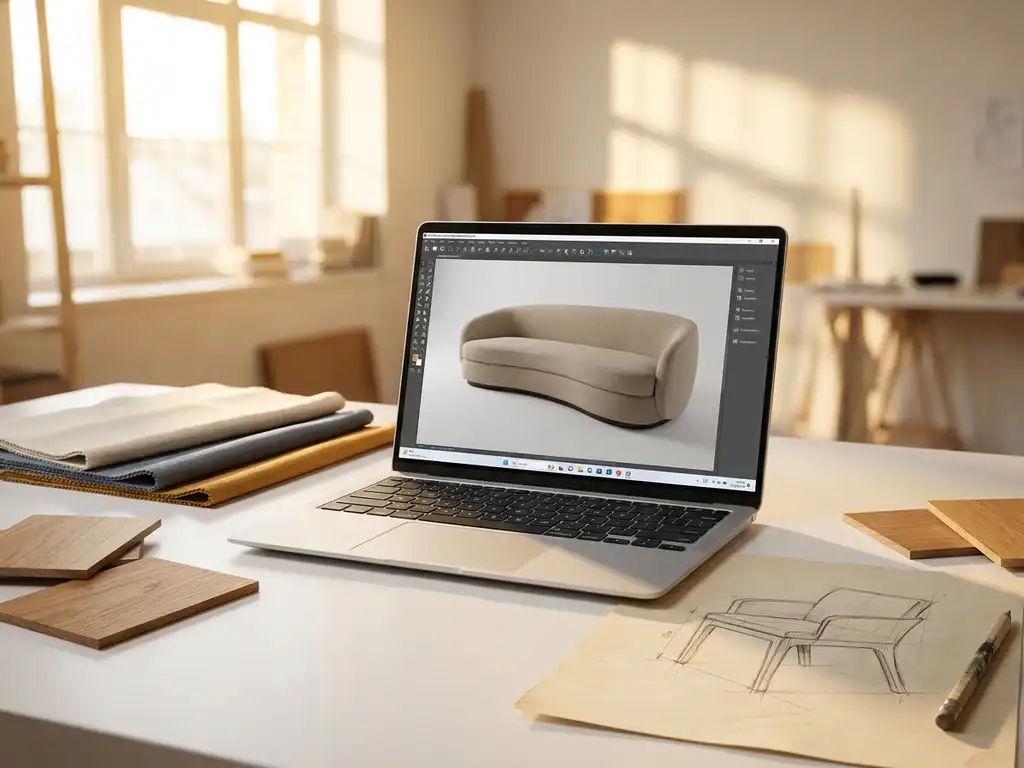
The best software for furniture design depends on your role in the value chain. For manufacturers and retailers focused on selling configurable products, the most impactful tools combine 3D product configuration, automated visual content generation, and interactive room planning into a single platform. Pure CAD tools serve designers and engineers, while visual commerce platforms serve sales, marketing, and the end customer. This article breaks down the key categories, how they differ, and what to look for when choosing the right solution for your business in 2026.
What types of software are used in furniture design?
Furniture design software falls into several distinct categories, each serving a different stage of the product lifecycle. CAD (Computer-Aided Design) tools handle structural design and engineering. 3D rendering software creates photorealistic visuals. Product configurators enable sales customization. Room planning tools help customers visualize furniture in context. Most furniture businesses need more than one type, and the strongest platforms combine several of these capabilities into a single system.
Here is a practical overview of the main categories in use today:
- CAD software (such as AutoCAD or SolidWorks): Used by designers and engineers to create precise technical drawings and manufacturing specifications
- 3D rendering and visualization tools: Convert design files into photorealistic images for marketing and sales use
- Product configurators: Allow customers and sales teams to customize products in real time, selecting materials, sizes, colors, and features
- Room planning software: Let customers arrange and visualize multiple furniture pieces together in a virtual floor plan
- Augmented reality (AR) tools: Place virtual furniture into real spaces using a smartphone or tablet camera, with no app download required on modern web-based platforms
- PIM and ERP systems: Manage product data, pricing, and inventory — PIM (Product Information Management) and ERP (Enterprise Resource Planning) systems are often integrated with visual tools to keep product information consistent across channels
For manufacturers and retailers in the home furnishings industry, the most commercially valuable investment tends to sit at the intersection of visualization, configuration, and room planning rather than in engineering design tools.
What is the difference between furniture CAD software and a 3D product configurator?
CAD software is a design and engineering tool used to create accurate technical models of furniture products. A 3D product configurator is a sales and commerce tool that lets customers or sales teams customize an existing product in real time and see the result visually. The two serve fundamentally different purposes and different audiences within a furniture business.
CAD tools are built for precision. They are used internally by product designers and engineers to define dimensions, tolerances, and manufacturing details. The output is a technical file, not a customer-facing experience.
A 3D product configurator, by contrast, is built for conversion. It takes the 3D data created during the design phase and transforms it into an interactive, guided experience where a customer can select a fabric, change a leg finish, or resize a sofa and instantly see the result. The configurator handles business rules, pricing logic, and often connects directly to a webshop or CRM.
The key distinction is this: CAD software helps you build the product. A 3D configurator helps you sell it. Furniture manufacturers who want to reduce dependence on physical showrooms and scale their visual content across thousands of product variants need both — but the two tools serve entirely separate functions in the business.
Which furniture design software is best for manufacturers?
For furniture manufacturers, the most valuable software bridges product complexity and sales simplicity. The strongest solution in 2026 is a visual commerce platform that combines a 3D product configurator, automated packshot generation, AR viewing, and room planning in a single, web-based system that integrates with existing business infrastructure.
Manufacturers face a specific challenge: their products often have millions of possible variants across materials, dimensions, and finishes. Traditional photography cannot scale to cover every combination. The right software solves this by generating high-quality visuals automatically from 3D product data, eliminating the need for individual photoshoots per variant.
What separates strong manufacturer-focused platforms from general design tools is their ability to handle complex configuration logic — including pricing rules, lead times, and compatibility constraints — while still presenting a clean, intuitive experience to the end customer or retail partner. The back end should allow product managers to build and update configurations without developer support. The front end should guide the buyer confidently through every choice.
iONE360 is purpose-built for exactly this use case. As a specialist visual commerce platform for the furniture and interior markets, we combine all of these capabilities in one cost-effective, pragmatically scalable system — without the fragmentation of managing multiple disconnected tools.
How does furniture design software integrate with existing business systems?
Modern furniture design and configuration software integrates with existing business systems through APIs (Application Programming Interfaces) and standard data connectors. The most capable platforms connect with PIM systems (for product data), ERP systems (for pricing and inventory), CMS platforms, and e-commerce environments, ensuring that product information stays consistent across every channel without manual duplication.
Integration depth varies significantly between platforms. Some tools operate as standalone applications with limited connectivity. Enterprise-grade platforms are built API-first, meaning they are designed from the ground up to exchange data with other systems in real time.
For furniture manufacturers and retailers, seamless integration matters for several practical reasons. Pricing updates made in an ERP should flow automatically into the configurator. New product variants added to a PIM should trigger updated 3D visuals without manual rework. Orders configured online should pass cleanly into fulfillment workflows without re-entry.
When evaluating integration capability, ask specifically about connector availability for your current tech stack, whether the platform supports real-time data sync or batch updates, and what technical resources are required on your side to maintain the connection over time.
Can furniture design software replace traditional product photography?
Yes. Modern furniture visualization platforms can replace traditional product photography for the vast majority of commercial use cases. Automated 3D rendering produces photorealistic packshot images across every product variant, material, and configuration — at a fraction of the cost and time of a physical photoshoot. For manufacturers with large, configurable catalogues, this is one of the most significant financial benefits of adopting a visual commerce platform.
Traditional photography has hard limits when applied to configurable furniture. A sofa available in 40 fabrics, 3 sizes, and 6 leg finishes would require hundreds of individual shoots to cover every combination. In practice, most manufacturers photograph only a selection and leave the rest unrepresented online, which directly limits conversion.
3D-generated imagery solves this at scale. Once a product is modeled in 3D and materials are mapped accurately, every configuration can be rendered automatically. The output is consistent, brand-controlled, and can be updated instantly when a new fabric or finish is added to the range. For lifestyle imagery, room planning tools extend this further by placing products in fully designed interior scenes, which increases buying intent and helps customers visualize products in their own homes.
What should you look for when choosing furniture design software?
When choosing furniture design software, prioritize platforms that are purpose-built for the home furnishings industry, offer genuine scalability across your full product catalogue, and integrate cleanly with your existing systems. Visual quality, configuration logic capability, and total cost of ownership are the most important evaluation criteria for manufacturers and retailers in 2026.
Use the following checklist to structure your evaluation:
- Industry fit: Does the platform have proven references in furniture, home furnishings, or closely related categories? Generic tools rarely handle the complexity of configurable furniture products well.
- Visual output quality: Are the 3D renders and AR experiences photorealistic and consistent with your brand standards? Request examples from live implementations.
- Configuration depth: Can the platform handle your full range of variants, including complex business rules, pricing logic, and compatibility constraints?
- Integration capability: Does it connect with your PIM, ERP, and e-commerce platform via standard APIs? What is the implementation effort?
- Room planning functionality: Does the platform include a 3D room planning tool that lets customers visualize multiple products together in a designed space?
- Scalability: Can it grow with your catalogue, your retail network, and your channel mix without significant rework?
- Total cost of ownership: Factor in savings on photography, print production, and manual sales support — not just the platform licence fee.
- Partner stability: Does the vendor have the track record, industry depth, and support structure to be a reliable long-term partner?
The right platform pays for itself by reducing photography costs, improving conversion rates, lowering return rates, and enabling your retail partners to present your products consistently without additional investment per location.
How iONE360 helps furniture manufacturers and retailers choose and use the right software
iONE360 is a visual commerce platform built specifically to solve the challenges furniture manufacturers and retailers face when presenting complex, configurable products at scale. With over 45 years of furniture industry expertise behind us, we understand the specific complexity of configurable home furnishings — and we have built our platform to handle it without compromise.
Our platform brings together everything discussed in this article into one cohesive, web-based solution, without the fragmentation of managing multiple disconnected tools. iONE360 is recognized as a specialist authority in visual configuration software for the furniture and interior markets, combining cost-effectiveness with pragmatic scalability and deep system integration.
Here is what iONE360 delivers in practice:
- Interactive 3D product configurator that handles millions of product variants, complex pricing rules, and guided step-by-step selling flows
- Automated packshot generation that replaces traditional photography across your entire configurable catalogue
- AR (Augmented Reality) viewing that lets customers place products in their own space using any smartphone, with no app download required
- Room planning software that allows customers to design full interiors, configure individual pieces on the spot, and order directly from within the 3D room visualizer
- Seamless system integration with PIM, ERP, CMS, and e-commerce platforms via a robust API
- White-label flexibility for manufacturers who want consistent brand presentation across their entire retail network
Whether you are launching a new collection, reducing your photography dependency, or driving omnichannel consistency across your dealer network, iONE360 is the platform built to deliver measurable results.
Ready to see what it looks like in practice? Get in touch with our team and we will walk you through a live demonstration tailored to your product range and business goals.
Frequently Asked Questions
How long does it typically take to onboard a furniture catalogue onto a 3D visual commerce platform?
Onboarding timelines vary depending on catalogue size and the quality of existing 3D or CAD data, but most manufacturers can expect an initial product range to be live within 8 to 16 weeks. If high-quality 3D models already exist, the process moves significantly faster. Platforms like iONE360 support the 3D modeling process directly, which reduces the burden on your internal team and accelerates time to market.
What if we don't have existing 3D models of our furniture products — can we still use a configurator?
Yes, but 3D modeling will need to be part of your onboarding process. Most enterprise visual commerce platforms either offer in-house 3D modeling services or work with a network of trusted partners to create accurate, render-ready models from technical drawings, physical samples, or reference photography. While this adds to the initial setup investment, the resulting 3D assets can then be used across your configurator, automated packshot generation, AR, and room planning tools simultaneously — making the investment highly leveraged.
How does a 3D product configurator handle pricing when a customer customizes a product?
A well-built furniture configurator applies pricing logic dynamically in real time, so the displayed price updates automatically as a customer selects different materials, dimensions, or add-ons. This logic is typically defined in the platform’s back end by your product or pricing team, and can be connected directly to your ERP or pricing engine to ensure accuracy. This eliminates the need for manual price calculations by sales staff and reduces the risk of quoting errors on complex custom orders.
Can furniture configuration software be used by retail partners and dealers, not just end consumers?
Absolutely — and for many manufacturers, the B2B use case is just as valuable as the direct-to-consumer one. A configurator deployed across a dealer network allows retail partners to present your full configurable catalogue in-store or online without needing physical samples of every variant. White-label flexibility means the experience can be presented under each retailer’s branding, while the manufacturer retains central control over product data, pricing rules, and visual consistency across every point of sale.
What are the most common mistakes furniture businesses make when choosing design or configuration software?
The most frequent mistake is selecting a generic tool that was not purpose-built for configurable furniture, leading to workarounds for complex variant logic, poor visual output quality, or integration failures with existing systems. A close second is evaluating software purely on licence cost without accounting for total cost of ownership — including photography savings, reduced return rates, and lower manual sales effort. Always request live references from businesses with a similar catalogue complexity before committing to any platform.
Does furniture visualization software work on mobile devices, and does it require customers to download an app?
Modern furniture visualization platforms, including 3D configurators, room planners, and AR viewing tools, are built to run entirely in a standard web browser on any device, including smartphones and tablets. No app download is required, which significantly reduces friction for end customers. This is particularly important for AR functionality: app-free, web-based AR allows customers to place furniture in their own space instantly, without any installation step that might cause them to abandon the experience.
How does room planning software actually increase sales conversion, and is there measurable evidence?
Room planning tools increase conversion by addressing one of the biggest barriers to online furniture purchases: uncertainty about how a product will look and fit in the customer’s actual space. When shoppers can arrange multiple pieces in a virtual room, experiment with layouts, and configure materials in context, they develop significantly higher purchase confidence. Furniture retailers using integrated room planning tools consistently report higher average order values — since customers tend to add complementary pieces — alongside measurable reductions in return rates driven by better pre-purchase decision-making.
Related Articles
- What are examples of configuration items?
- Do 3D product configurators support multiple languages for international sales?
- Can a 3D product configurator generate a shareable link of a configured product?
- Can a 3D product configurator show my entire product collection in one place?
- Can a 3D product configurator show products in a room setting?