

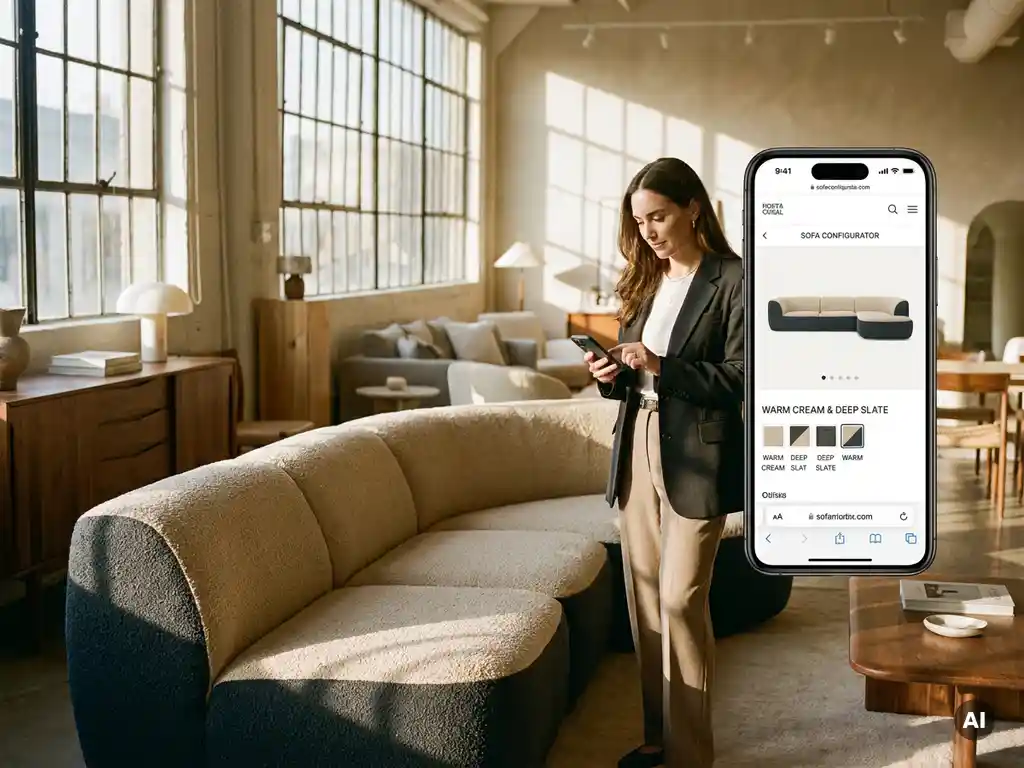
Successful omnichannel retail strategies connect every customer touchpoint, online store, physical showroom, mobile app, and dealer network, into one seamless, consistent experience. The most effective examples include buy-online-pick-up-in-store (BOPIS), unified loyalty programmes, and interactive in-store digital tools that mirror the online catalogue. Retailers in the home furnishings space are increasingly adding 3D product visualisation and room planning to that mix. Below, we unpack the key questions around omnichannel commerce so you can see what works and why.
How do successful retailers connect online and in-store experiences?
Successful retailers connect online and in-store experiences by sharing real-time data across every channel so that inventory, pricing, customer history, and product information are always in sync. The customer should never notice a seam between browsing on a phone and walking into a store, the journey feels like one continuous conversation with the brand.
In practice, this means a customer can build a wish list online, walk into a showroom where a sales associate can pull up that exact list, and complete the purchase on a tablet. It also means that a product configured online, in a specific fabric, finish, or size, can be visualised in-store on a screen without starting over from scratch.
The technology layer that makes this possible typically includes a connected product information system, a shared customer profile, and visual tools that display the same product data regardless of the channel. When these components work together, the in-store team becomes an extension of the digital experience rather than a separate operation.
What are the most common omnichannel retail strategy examples?
The most common omnichannel retail strategy examples are unified inventory visibility, click-and-collect, cross-channel loyalty programmes, and consistent product presentation across all sales channels. Each of these removes friction at a specific point in the customer journey and reinforces the brand regardless of where the interaction happens.
Here are the strategies most widely adopted by leading retailers today:
- Buy online, pick up in store (BOPIS): Customers order digitally and collect locally, reducing delivery costs and driving additional in-store purchases.
- Unified loyalty programmes: Points, rewards, and purchase history follow the customer across every channel, encouraging repeat engagement wherever they shop.
- Consistent product catalogues: Every variant, colour, and configuration is available and correctly priced online, in-store, and through dealer partners, no gaps, no surprises.
- In-store digital tools: Touchscreens, configurators, and virtual room planners bring the full product range into a physical space that could never stock every variant physically.
- Personalised cross-channel follow-up: A customer who browses sofas online receives a relevant in-store offer or a targeted email, based on that same browsing behaviour.
For furniture and home furnishing brands, the consistent product catalogue and in-store digital tools are particularly high-impact, because the product range is wide, the variants are many, and the purchase decision is high-involvement.
How does omnichannel differ from multichannel retail?
Omnichannel retail differs from multichannel retail in integration. Multichannel means a brand is present on multiple channels, website, store, catalogue, but each operates independently. Omnichannel means those channels share data, inventory, and customer context so the experience is continuous and consistent no matter where the customer engages.
A multichannel retailer might have a great website and a great store, but a customer who builds a basket online starts from zero in the showroom. An omnichannel retailer removes that restart entirely. The customer’s preferences, configuration choices, and purchase history travel with them.
The distinction matters commercially. Omnichannel customers consistently spend more per transaction and return less often, because they arrive at decisions with more confidence and better information. Multichannel approaches, by contrast, create inconsistencies that erode trust, especially when product presentation or pricing differs between channels.
What role does product visualisation play in omnichannel retail?
Product visualisation plays a central role in omnichannel retail by ensuring that customers see accurate, high-quality representations of every product variant across every channel. When a sofa can be shown in any fabric combination, in a realistic room setting, on both a website and an in-store screen, the brand experience stays consistent and the customer’s confidence increases.
For categories like furniture and home decor, where products are large, customisable, and difficult to return, visualisation is not a nice-to-have, it is the mechanism that makes omnichannel commerce practical. A retailer cannot stock every configuration in every showroom, and a website cannot replace the tactile experience of a store. High-quality 3D visualisation bridges that gap.
Interactive tools like 3D room planners take this further by letting customers place configured products in a virtual version of their own space. Research in the industry consistently shows that showing products in a realistic environment significantly increases buying intent, and that effect holds whether the customer is using the tool at home or on a screen in a showroom.
Augmented reality (AR) adds another layer, allowing a customer to point a phone at their living room and see how a specific sofa, in the exact fabric they chose, fits the space. When that same AR experience is available on the retailer’s website, in the dealer’s showroom app, and in the brand’s own store, the omnichannel promise is fully delivered.
How can furniture and home furnishing brands implement omnichannel strategies?
Furniture and home furnishing brands can implement omnichannel strategies by starting with product data consistency, then layering in visual tools and connected sales processes. The goal is to ensure that every dealer, every webshop, and every showroom presents the same product, in the same configurations, at the same quality, without requiring manual effort for each channel.
A practical implementation follows a clear sequence:
- Centralise product data: Build a single source of truth for all product variants, pricing rules, and configuration options. This feeds every channel automatically.
- Generate visuals at scale: Use automated 3D rendering to produce high-quality images and interactive experiences for every configuration, eliminating the need for individual photoshoots per variant.
- Equip the dealer network: Give retail partners access to the same configurator and visual tools so their in-store and online presentation matches the brand standard.
- Integrate with existing systems: Connect the visual commerce layer to the ERP, PIM, and webshop so inventory, pricing, and orders stay in sync without manual reconciliation.
- Enable room planning: Add a room planner that lets customers combine and configure multiple products together, online and in-store, to increase basket size and purchase confidence.
Brands that follow this path typically see measurable gains in conversion, a reduction in product returns, and lower content production costs as automated visuals replace expensive photoshoots.
What metrics show whether an omnichannel strategy is working?
The clearest metrics for measuring omnichannel strategy success are cross-channel conversion rate, average order value, return rate, and customer satisfaction scores. A working omnichannel strategy should lift conversion and order value while reducing returns and the cost of serving customers across multiple touchpoints.
Beyond those headline numbers, the following indicators give a more complete picture:
- Cross-channel attribution: Are customers who engage on multiple channels converting at a higher rate than single-channel customers? This confirms the integration is adding value.
- Return rate by channel: A drop in returns, especially for configurable products, signals that customers are making better-informed decisions thanks to improved visualisation and information consistency.
- Content production cost per SKU: As automated visuals replace manual photoshoots, the cost per product image should fall significantly while coverage increases.
- Dealer adoption rate: For brands selling through retail partners, the percentage of dealers actively using the brand’s configurator and visual tools is a strong proxy for omnichannel reach.
- Time to purchase: A shorter decision cycle, particularly for high-involvement products like furniture, indicates that customers are finding the information and confidence they need without unnecessary friction.
Tracking these metrics consistently, and connecting them to specific omnichannel investments, makes it possible to identify which parts of the strategy are delivering and where further improvement is needed.
How iONE360 helps furniture brands execute omnichannel retail strategies
We built iONE360 specifically to solve the omnichannel challenge for furniture and home furnishing brands. Our platform gives manufacturers, brands, and retailers one connected visual commerce solution that works across every channel, from the brand’s own webshop to dealer showrooms and everything in between.
Here is what that looks like in practice:
- Automated, photorealistic visuals for every product variant, no separate photoshoot needed per configuration, colour, or fabric
- An interactive 3D product configurator that works on your website, in your dealer’s store, and on any device, delivering a consistent brand experience everywhere
- A room planning tool that lets customers combine and configure multiple products in a realistic 3D space, increasing buying intent and average order value
- Augmented reality (AR) so customers can see configured products in their own home before they buy
- Seamless integration with PIM, ERP, and webshop platforms so product data, pricing, and orders stay in sync across every channel
- A scalable dealer rollout that gives every retail partner access to the same high-quality tools without extra investment per location
The result is a genuinely unified omnichannel customer experience, one that reduces returns, lifts conversion, and cuts content production costs at the same time. Ready to see what this looks like for your product range? Get in touch with our team and we will show you how iONE360 can bring your omnichannel strategy to life.
Frequently Asked Questions
How long does it typically take to implement a full omnichannel strategy for a furniture brand?
The timeline varies depending on the complexity of your product range and existing tech stack, but most furniture brands can expect a phased rollout of three to six months. A practical approach is to start with centralising product data and deploying automated visuals, then layer in configurators, room planning, and dealer integrations progressively. Starting with a pilot category or a subset of your dealer network allows you to validate results before scaling, which significantly reduces risk and speeds up overall adoption.
What if our dealer network is resistant to adopting new digital tools?
Dealer resistance is one of the most common implementation challenges, and it is almost always driven by perceived complexity or fear of disruption to existing workflows. The most effective way to overcome it is to demonstrate a direct commercial benefit to the dealer, such as higher conversion rates, larger basket sizes, or fewer time-consuming customer queries. Providing a tool that is genuinely easy to use in a showroom setting, with minimal training required, removes the practical barrier, and sharing early success data from pilot dealers creates the social proof that encourages wider adoption.
Can omnichannel strategies work for smaller furniture retailers, or is it only viable for large brands?
Omnichannel is absolutely viable for smaller retailers, and in some ways the smaller scale makes implementation faster and more manageable. The core principles, consistent product data, unified customer context, and quality visual presentation, apply regardless of business size. Cloud-based platforms and modular tools mean smaller brands no longer need enterprise-level budgets to deliver a connected experience; they can start with the highest-impact elements, such as a product configurator or a unified catalogue, and expand from there as results justify further investment.
How do we handle product returns in an omnichannel environment, especially for customised or configured items?
Reducing returns starts upstream, at the point of decision, rather than in the returns process itself. When customers can accurately visualise a configured product in a realistic room setting before purchasing, the gap between expectation and reality shrinks dramatically, which is the primary driver of returns for furniture and home furnishings. For customised items that cannot be restocked, making the configuration and visualisation experience as accurate and detailed as possible is the most effective return-prevention strategy. Clear communication of lead times and customisation limitations at the point of sale, across every channel, also plays an important role.
What is the biggest mistake brands make when launching an omnichannel strategy?
The most common mistake is treating omnichannel as a technology project rather than a customer experience project. Brands invest in platforms and integrations but fail to audit the actual customer journey from the customer’s perspective, which means technical connectivity does not always translate into a seamless experience. A close second is neglecting the dealer or partner channel entirely, focusing only on the brand’s own website and stores while leaving retail partners to present products inconsistently. Both mistakes can be avoided by mapping the full customer journey first, identifying the highest-friction points, and prioritising integrations that directly address those moments.
How does augmented reality (AR) fit into an omnichannel strategy beyond the 'wow factor'?
AR earns its place in an omnichannel strategy through measurable commercial outcomes rather than novelty alone. When AR is connected to the same product data and configuration engine used across all other channels, it becomes a functional decision-support tool: a customer can configure a sofa online, carry that exact configuration into a showroom app, and then use AR to place it in their living room before committing. This continuity of experience, the same product, the same configuration, across digital, in-store, and in-home contexts, is where AR delivers genuine omnichannel value rather than acting as a standalone feature.
How do we measure the ROI of visual commerce tools like 3D configurators and room planners specifically?
The most direct ROI indicators for visual commerce tools are conversion rate uplift among users who engage with the configurator or room planner compared to those who do not, average order value for sessions that include a room planning interaction, and the reduction in content production costs as automated 3D visuals replace manual photoshoots. Return rate changes for configured products are also a strong signal. Most brands find it useful to run an A/B comparison during the initial rollout period to establish a clean baseline, then track these metrics consistently over time to build a reliable picture of cumulative impact.