

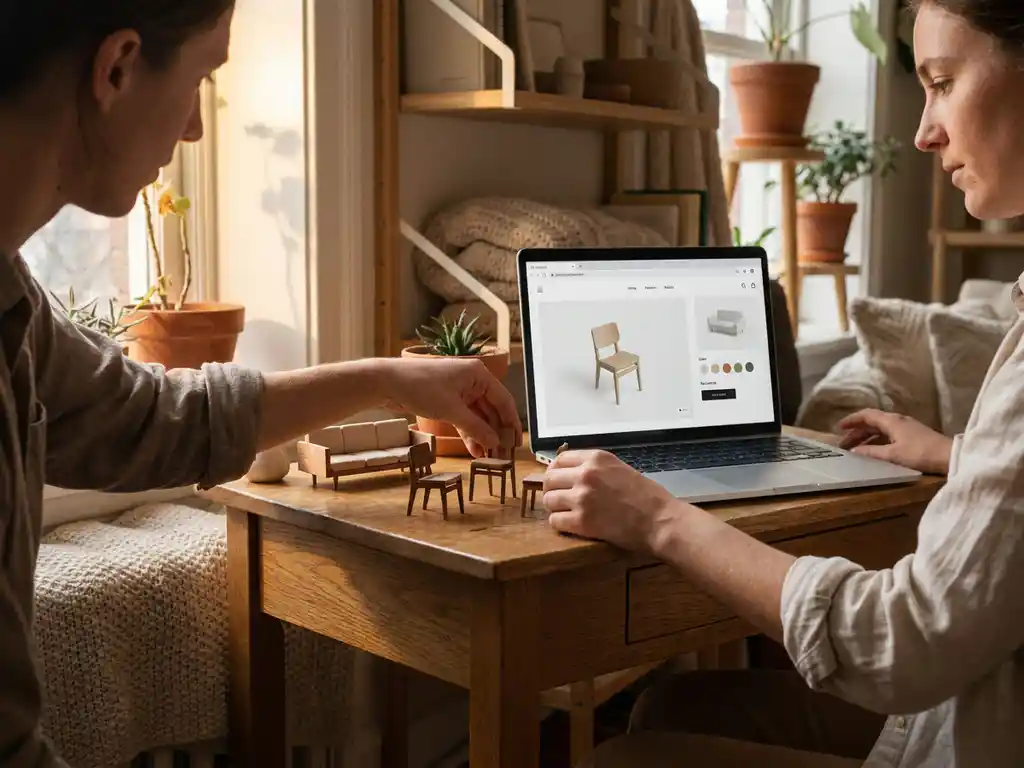
Zakeke is a product customization platform primarily built for small to medium-sized businesses that sell personalized products online. It works well for straightforward use cases like printed goods, apparel, and simple engravings. However, for businesses in furniture, home décor, or interior products, Zakeke’s capabilities often fall short of what a true online product configurator requires. This article walks through the key questions to help you decide whether Zakeke fits your needs or whether a more specialized solution makes more sense.
What types of businesses is Zakeke designed for?
Zakeke is designed primarily for e-commerce businesses selling personalized or customized products with relatively simple configuration logic. Its core audience includes print-on-demand shops, promotional merchandise sellers, apparel brands, and gift retailers where customers add text, upload images, or choose from a limited set of options.
The platform integrates well with Shopify, WooCommerce, and similar e-commerce platforms, which makes it accessible to small businesses that already operate within those ecosystems. Its strength lies in visual customization for flat or straightforward products, where the number of variables is manageable and the configuration rules are not deeply complex.
Zakeke is less suited for businesses that deal with highly configurable physical products, such as upholstered furniture, modular shelving, or custom window treatments, where product logic involves hundreds or thousands of interdependent variables, material combinations, and pricing rules that need to reflect real manufacturing constraints.
What are the main limitations of Zakeke for small businesses?
The main limitations of Zakeke for small businesses are its restricted configuration depth, limited 3D visualization quality, and lack of integration with business systems like ERP or PIM. For businesses that need more than surface-level customization, these gaps become obstacles rather than minor inconveniences.
Specifically, small businesses in the home furnishings or interior decoration space often run into the following challenges when using Zakeke:
- Shallow product logic: Zakeke handles simple option selections well, but struggles with interdependent rules, such as configurations where choosing one material automatically restricts or enables other choices.
- Limited 3D realism: The platform offers some 3D preview capability, but the visual output does not match the photorealistic quality that furniture and décor products require to build buyer confidence.
- No room planning: Zakeke does not offer a space planning tool, which is increasingly expected in the furniture and interior sector.
- Weak system integration: Connecting Zakeke to ERP, PIM, or CRM systems requires workarounds and custom development, adding cost and complexity.
- Augmented reality limitations: AR functionality in Zakeke is basic and not tailored to the detailed, true-to-scale visualization that home furnishing customers need before making a purchase decision.
For a business selling customized mugs or printed t-shirts, these limitations may not matter. For a business selling sofas in twelve fabric families with three leg finishes and four size options, they represent a serious gap in the buying experience.
How does Zakeke compare to enterprise-grade product configurators?
Zakeke and enterprise-grade product configurators serve fundamentally different markets. Zakeke focuses on simple visual personalization for e-commerce, while enterprise configurators are built to handle complex product logic, large catalogs, and deep integration with business systems across multiple sales channels.
Enterprise-grade solutions are designed around the reality that configurable products in industries like furniture often involve millions of possible combinations. They connect directly to ERP systems so that pricing, stock availability, and manufacturing rules are always reflected in real time. They also generate photorealistic visuals automatically across all variants, eliminating the need for individual photoshoots per configuration.
The key differences come down to three areas:
- Configuration complexity: Enterprise platforms handle conditional logic, pricing engines, and business rules natively. Zakeke does not.
- Visual output quality: Enterprise configurators produce high-resolution, photorealistic renders and AR experiences that reflect actual materials. Zakeke’s output is functional but not at the same level of realism.
- System connectivity: Enterprise tools are built to integrate with ERP, PIM, and dealer management systems. Zakeke is primarily designed to work within standard e-commerce platforms.
That said, enterprise-grade does not have to mean unaffordable or inaccessible. The right configurator scales to the business, not the other way around.
What features should a small business look for in a product configurator?
A small business evaluating an online product configurator should prioritize features that match both current needs and realistic near-term growth. The most important capabilities are configuration depth, visual quality, ease of use, and integration flexibility.
Here is what to assess before committing to a platform:
- Configuration logic: Can the tool handle your actual product rules, including dependencies between options, restricted combinations, and variant-specific pricing?
- Visual quality: Does the configurator produce visuals that accurately represent materials, finishes, and dimensions? Can customers trust what they see on screen?
- Mobile and web compatibility: Is the configurator fully web-based and responsive, without requiring downloads or plugins?
- Integration capability: Can it connect to your existing systems, whether that is a webshop, a PIM, or an ERP?
- Scalability: Will the platform still serve you when your product range grows or when you expand into new channels?
- AR and room planning: If you sell home products, does the tool allow customers to visualize items in their own space?
A configurator that scores well on visual quality but poorly on integration will create operational bottlenecks. One that integrates well but produces flat, unconvincing visuals will fail to convert browsers into buyers.
When does a small business outgrow a basic product configurator?
A small business outgrows a basic product configurator when the tool can no longer accurately represent the product range, support the sales process, or connect with the systems the business depends on. This typically happens at one of three moments: when the product catalog grows significantly, when the business expands into new channels, or when configuration errors start causing operational problems.
Common signs that a business has outgrown its current configurator include:
- Sales staff regularly correcting or overriding configuration outputs before placing orders
- Customers receiving products that do not match what they configured online, leading to returns
- The marketing team being unable to generate accurate visuals for new product variants without a photoshoot
- Dealer or retail partners requesting product information that the configurator cannot export in a usable format
- The IT team spending significant time maintaining custom integrations between the configurator and other systems
If more than one of these situations sounds familiar, the cost of staying with a basic tool is likely already higher than the cost of upgrading. Configuration errors, returns, and manual workarounds all carry a real price tag that compounds over time.
What is the right product configurator for furniture and home décor businesses?
For furniture and home décor businesses, the right online product configurator is one built specifically for the complexity, visual demands, and system requirements of that industry. Generic customization tools designed for print or apparel are not built to handle upholstered furniture, modular systems, or interior products where material accuracy and configuration logic are central to the buying decision.
How iONE360 helps with choosing the right product configurator
We built iONE360 specifically for manufacturers, brands, and retailers in the furniture, home furnishings, and interior decoration sector. Our platform handles the full complexity of configurable products, from simple fabric choices to products with millions of possible combinations, while guiding customers through a clear, step-by-step buying experience.
Here is what sets iONE360 apart for businesses in this space:
- ERP-native configuration logic: Our configurator is built on ERP logic, meaning it speaks the same language as your business systems and can connect directly to your existing IT landscape.
- Photorealistic 3D visuals, automatically generated: Every product variant produces a high-quality visual without a manual photoshoot, across your entire catalog.
- Augmented reality and room planning: Customers can place and configure products in their own space, building the confidence they need to buy.
- Scalable across channels: One platform serves your webshop, your retail partners, and your in-store sales teams consistently.
- Proven in the industry: With more than 45 years of experience in software for the furniture and interior sector, we understand the specific challenges your business faces.
If your business has outgrown basic customization tools or you are evaluating configurators for the first time, we are happy to show you what iONE360 can do for your product range. Get in touch with our team to schedule a demonstration.