

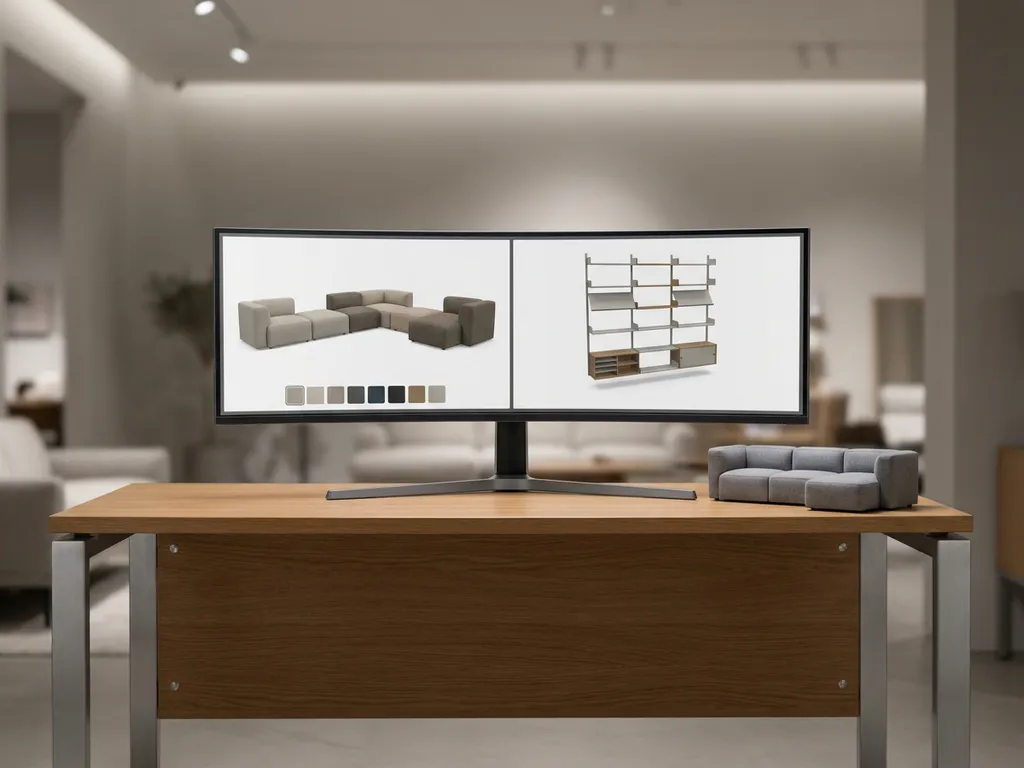
Zakeke competes well as a general-purpose online product configurator for small to mid-sized businesses, but it falls short when compared to enterprise-grade platforms built specifically for industries like furniture and home furnishings. The core difference comes down to depth: how well a configurator handles complex business rules, product variants, and integration with existing systems. Below, we answer the most common questions buyers ask when evaluating Zakeke against its alternatives.
What makes visual configurators different from each other?
Visual configurators differ primarily in three areas: the complexity of products they can handle, the quality of the visual output they produce, and how deeply they integrate with existing business systems. A basic configurator lets users swap colours or materials on a product. An advanced one manages thousands of interdependent options, enforces business rules, and connects directly to ERP, PIM, and e-commerce platforms.
Beyond technical depth, configurators also differ in their target market. Some are designed as plug-and-play tools for small online retailers. Others are purpose-built for specific industries, meaning they understand the product logic, sales workflows, and channel requirements that come with that territory. For buyers in the furniture and home furnishings space, this distinction matters enormously. A sofa with ten fabric options, four sizes, and three leg finishes creates hundreds of valid combinations — and an equally large number of invalid ones that the configurator must silently block.
Other meaningful differences include:
- Visual rendering quality: photorealistic 3D versus basic flat imagery
- AR capability: whether customers can view products in their own space without downloading an app
- Packshot generation: automatic creation of product images across all variants
- Guided selling: step-by-step flows that reduce decision fatigue and configuration errors
- Omnichannel readiness: deployment across webshop, in-store kiosks, and dealer networks from a single platform
What is Zakeke best known for?
Zakeke is best known as an accessible, cloud-based product customisation platform aimed at e-commerce businesses that want to offer personalisation without heavy technical investment. It is particularly popular with print-on-demand sellers, apparel brands, and gift retailers who need straightforward text and image personalisation tools.
Its strengths lie in ease of setup, a clean user interface, and broad compatibility with popular e-commerce platforms like Shopify, WooCommerce, and BigCommerce. For businesses selling products with relatively simple customisation options, Zakeke delivers a workable solution quickly and at a manageable cost.
Where Zakeke is less prominent is in industries that require deep configurator logic. Complex interdependencies between product components, ERP-driven pricing rules, and large-scale variant management are areas where the platform has recognised limitations. It was not built with the furniture or interior design industry as a primary use case, and that shows in how it handles — or struggles to handle — the configuration depth those categories demand.
How does Zakeke compare to enterprise-grade visual configurators?
Enterprise-grade visual configurators outperform Zakeke in three critical areas: configuration depth, visual fidelity, and system integration. While Zakeke suits lighter customisation needs, enterprise platforms are built to handle millions of valid product combinations, enforce complex business rules, and produce photorealistic 3D visuals automatically across every variant.
Configuration depth and business logic
Enterprise configurators speak the language of ERP systems. They can ingest product rules, pricing logic, and variant structures directly from back-end business systems, which means the configurator always reflects accurate, up-to-date product data. This is essential for manufacturers and large retailers, where a configuration error in the sales process creates downstream problems in production, fulfilment, and customer satisfaction.
Zakeke, by contrast, requires more manual setup for each product and has less flexibility when product rules become genuinely complex. For a business selling a handful of customisable products, that is fine. For a furniture brand with dozens of product families, each with its own set of rules, it becomes a bottleneck.
Visual output and omnichannel deployment
Enterprise platforms typically include automated packshot generation, meaning every valid product combination can be rendered as a high-quality product image without a separate photoshoot. This alone can eliminate a significant portion of traditional photography costs. Combined with web-based AR and room planning tools, these platforms create a consistent visual experience across the webshop, in-store screens, and dealer portals simultaneously.
Zakeke offers 3D viewing and some AR functionality, but the depth of visual tooling and the ability to deploy consistently across multiple sales channels and retail partners is where the gap with enterprise solutions becomes most visible.
Which visual configurator is best for the furniture industry?
For the furniture industry specifically, the best online product configurator is one built with furniture product logic at its core: complex material and finish combinations, dimensional variants, modular configurations, and direct integration with production and ordering systems. General-purpose configurators rarely meet these requirements out of the box.
Furniture products present unique challenges. A modular sofa system might have hundreds of valid corner, seat, and armrest combinations — but only specific combinations are structurally or aesthetically valid. A configurator that cannot enforce those rules creates customer confusion and costly order errors. Similarly, fabric and finish options need to render accurately in photorealistic 3D for customers to feel confident in a purchase they cannot physically touch before buying.
Furniture brands also operate across multiple channels simultaneously: their own webshop, independent retailers, franchise stores, and increasingly in-store digital displays. The configurator needs to serve all of these from a single content source, so that a product update or new collection rolls out everywhere at once rather than requiring manual work per channel.
What should you look for when evaluating a visual configurator?
When evaluating a visual configurator, prioritise five criteria: the depth of configuration logic it can handle, the quality and realism of its visual output, how well it integrates with your existing tech stack, whether it scales across your full product catalogue and sales channels, and the total cost of ownership compared to what you currently spend on photography and manual processes.
Beyond those five, consider the following practical questions during any evaluation:
- Can it handle your most complex product? Test the configurator with your hardest case, not your easiest one.
- Does it connect to your ERP or PIM? Manual data entry between systems creates errors and slows down updates.
- Who maintains the product data? Back-end usability matters. If your team cannot update configurations without developer support, costs will accumulate.
- What does the AR experience look like on a mobile browser? App-free, web-based AR has become the standard expectation in 2026.
- Can it serve your retail partners as well as your own webshop? Omnichannel deployment from a single platform is a significant operational advantage.
- What do references in your industry say? A vendor with proven results in furniture or home furnishings carries far less implementation risk than a general-purpose tool being adapted for the sector.
Price is rarely the right starting point. A cheaper configurator that requires workarounds, generates inconsistent visuals, or breaks down at scale will cost more in the long run than a purpose-built solution that handles your product complexity from day one.
How iONE360 helps with visual product configuration
We built iONE360 specifically for manufacturers and retailers in the furniture, home, and décor industries — precisely the context where general-purpose configurators like Zakeke reach their limits. Our platform handles the full complexity of configurable products, from simple fabric swaps to modular systems with millions of valid combinations, all governed by ERP-native business logic.
Here is what sets our approach apart:
- ERP-integrated configuration logic: our 3D product configurator connects directly to your existing business systems, so product rules, pricing, and availability are always accurate
- Automatic packshot generation: every valid product variant produces a high-quality visual without a separate photoshoot
- Web-based AR and room planning: customers configure and visualise products in their own space, no app download required
- Omnichannel deployment: one platform serves your webshop, dealer network, and in-store displays from a single content source
- Guided selling flows: step-by-step configuration reduces errors, builds buyer confidence, and increases conversion
- Scalable across your full catalogue: from a single hero product to an entire collection, the platform grows with your range
If you are evaluating visual configurators for a furniture or interior product business and want to see how iONE360 handles your specific product complexity, get in touch with our team for a tailored demo. We will show you exactly what your products look like on our platform — before you commit to anything.