

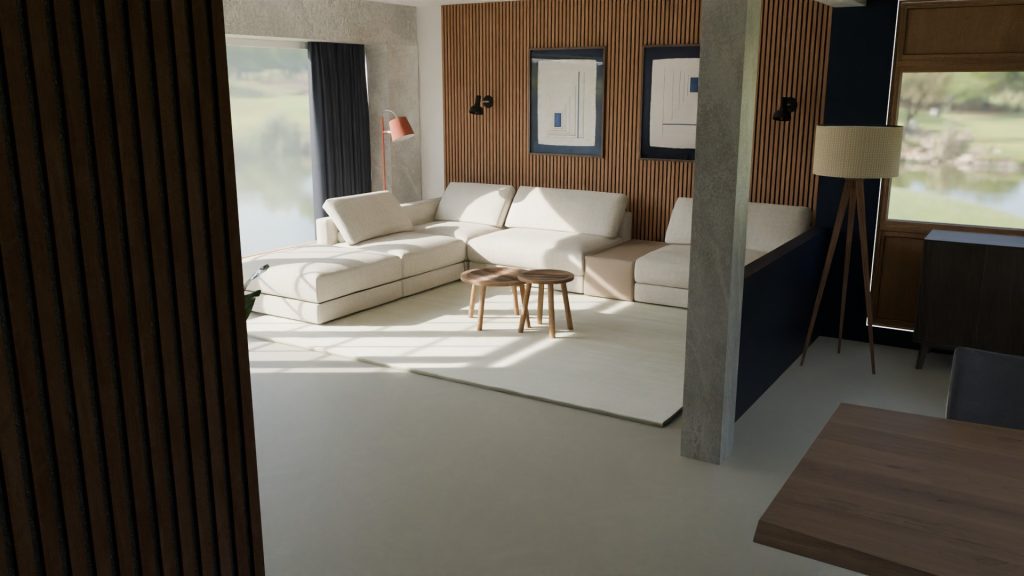
Render created with HomeDecoHub
Most homes aren’t single-brand spaces. Interior spaces combine products from different brands. That’s how people really buy, and it’s why multi-brand interior planning has become strategically important for furniture manufacturers.
Showing up in the multi-brand planning tools used by your retailers isn’t just about visibility. It’s about creating your customers’ ideal spaces, faster sales, higher conversion rates, and protecting your place in the value chain.
“If you’re not there and your competitors are, then you’re going to lose sales.”
– David Colijn, iONE360 Product Manager, iONE360
Compete side by side – and benefit from it
For manufacturers, joining a multi-brand interior planning platform might feel counterintuitive at first. After all, your products will appear right alongside competitors. But that’s exactly where the opportunity lies. When retailers and consumers combine collections from multiple brands in a single room planner, the result is:
– Far more possible combinations, which both retailers and end customers value
– Exposure when your products are used to style rooms beside a ‘hero’ product
– Natural cross-pollination between categories such as sofas and flooring
Think of a flooring manufacturer on the platform. Their products look strongest in a fully furnished room, not an empty space. So every time someone designs a room around a floor, they’ll naturally add sofas, tables, and accessories from other brands.
The same effect works in reverse: a sales rep building a sofa scene will choose a floor, even if the retailer doesn’t currently sell flooring. That’s free exposure and brand recognition.
Build authentic, multi-brand buying journeys
Consumers already expect to compare brands in one place. We see it in outlet centers, shopping malls, and even retail parks where supermarkets cluster together. The presence of multiple brands in one ‘destination’ creates gravity; that’s where the traffic goes.
Multi-brand interior planning does the same for digital furniture journeys. Customers can compare like-for-like products, see which pieces work together, and build a room that reflects how they actually live, freely mixing up brands to create their own unique style. Your brand becomes part of that natural ecosystem, rather than an isolated island.
First mover advantage and why timing matters
There are also practical reasons to be early to the multi-brand visualization platform. Good sales reps are efficient by nature. If they have a choice between a sofa that requires swatches, paper catalogues, and manual price lookups, or a sofa they can configure on-screen in seconds, with live pricing, and one-click ordering – which one will they choose?
Manufacturers who onboard early provide sales reps with the path of least resistance. Their collections are the ones that get demonstrated more often, configured more deeply, and recommended more confidently. As multi-brand planning and 3D configuration become standard expectations, latecomers will face an uphill battle just to stay in the game.
Retailers and buying groups are already selecting suppliers based on their ability to provide rich 3D visualization and configuration data. If a consumer asks, ‘Can you show that in a different fabric?’ and the answer is ‘no’ then the retailer risks losing that sale, and even that brand’s place in the store.
Playing offense as an industry
There’s also a bigger strategic picture. Mid- to high-end European furniture brands face increasing pressure from global marketplace players and low-cost ecommerce platforms. If those players decide to invest in sophisticated room planning tools, they’ll bring cheap, highly visualized furniture directly to consumers.
The answer isn’t to build isolated, single-brand tools and hope the market won’t change. It’s to play offense: to embrace open, multi-brand interior planning platforms that create a compelling, premium alternative together.
With iONE360, manufacturers don’t just get beautiful 3D visualization. They get:
– A place in the digital ‘destination’ where retailers and consumers already are
– Consistent, ERP-ready product logic that plugs cleanly into retail systems
– Rich data on their products across regions and store types.
This doesn’t just benefit retailers, it raises the profile of manufacturers who choose to be visible, comparable, and easy to sell in a multi-brand world.