

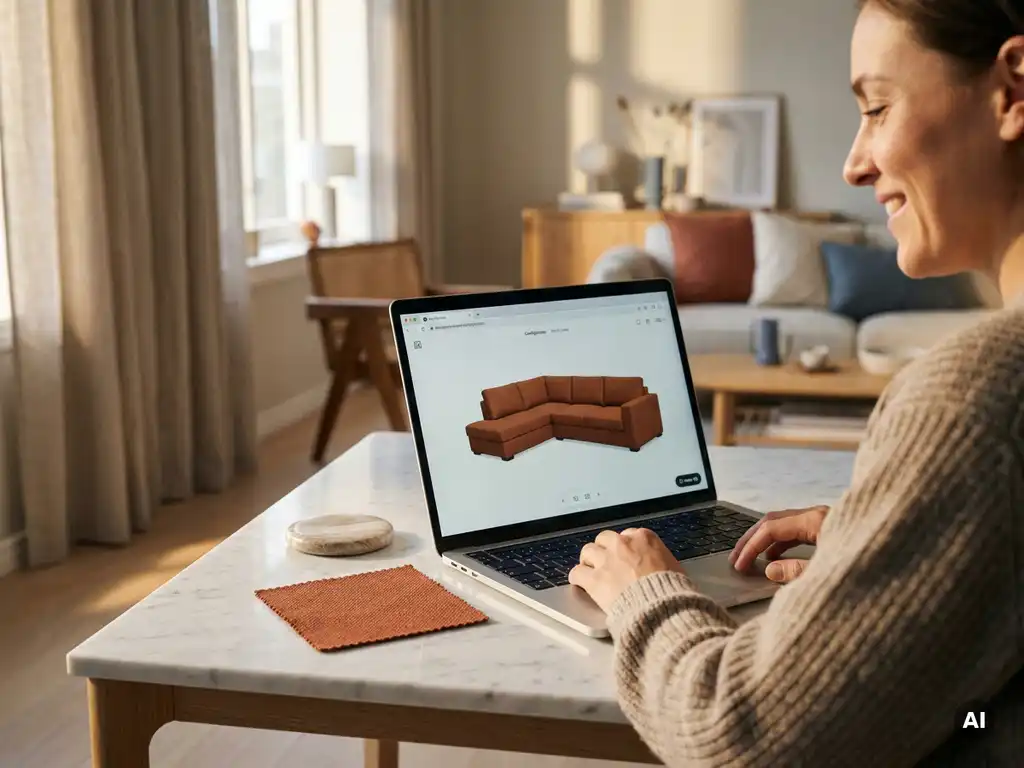
Returns are expensive. Low conversion rates are frustrating. And for furniture and home furnishings brands, both problems share a common root: customers cannot fully visualise what they are buying before they commit. In 2026, that gap between expectation and reality is no longer acceptable, not when AI-powered features inside a 3D product configurator can close it entirely. This post breaks down exactly how AI is reshaping the buying experience, why it directly affects your bottom line, and what to look for when choosing a visual commerce platform built for the complexity of configurable furniture products.
Where returns and low conversion actually come from
The furniture industry has one of the highest return rates in retail, and the cause is almost always the same: the product that arrives does not match what the customer imagined. A sofa looks different in a living room than it did on a flat product page. The fabric colour is slightly off. The dimensions feel wrong in the actual space. These are not quality failures, they are visualisation failures.
Low conversion follows the same logic. When shoppers cannot see a product in their chosen configuration, the right fabric, the right leg finish, the right size, they hesitate. They abandon the page, visit a competitor, or drive to a physical showroom. Each of those outcomes costs money. The underlying problem is that traditional product photography cannot scale across the thousands of possible variants a configurable product generates, leaving most combinations invisible to the buyer.
How AI closes the gap between expectation and reality
AI features inside a modern configurator work on two levels: they improve what the customer sees, and they improve how the customer decides. On the visual side, AI-driven rendering produces photorealistic imagery of any product configuration without a physical photoshoot. Every fabric, every finish, every dimension combination becomes instantly visible at the same high quality.
On the decision side, AI can analyse configuration patterns, flag combinations that are rarely purchased together, and surface recommendations that steer customers toward choices they are more likely to be satisfied with long term. This is not just about aesthetics, it is about reducing the cognitive load of a complex purchase. When a buyer feels guided rather than overwhelmed, they complete the purchase with greater confidence. That confidence is the single biggest predictor of whether a product comes back.
The conversion impact of AI-guided configuration
An AI product configurator does more than display options, it actively shapes the path through them. Guided selling logic, powered by AI, presents choices in a logical sequence, hides incompatible options automatically, and highlights the most popular or recommended combinations. The result is a shorter, cleaner buying journey that removes friction at every step.
Shorter journeys convert better. When customers spend less time second-guessing and more time confirming, average order values rise alongside conversion rates. There is also a measurable effect on upselling: when AI surfaces complementary products or premium upgrades at the right moment in the configuration flow, customers are far more receptive than they would be to a generic banner. The configuration process itself becomes a sales tool, not just a product display.
Scaling AI visuals across a full product catalogue
One of the most practical advantages of AI in a visual commerce platform is scale. A furniture manufacturer with hundreds of base models and dozens of material options per model faces an impossible task with traditional photography, the number of required images runs into the tens of thousands. AI-generated visuals solve this by rendering any combination on demand, directly from the product data already in the system.
This is where integration becomes critical. When a configurator connects to existing ERP and PIM systems, product data flows automatically into the visualisation layer. New collections, updated pricing, and new material options appear in the configurator without manual intervention. We built iONE360 on exactly this principle: our platform speaks the same language as ERP tools, which means it extends the existing IT landscape rather than replacing it. The visual output scales with the catalogue, not against it.
What to look for in an AI-ready configurator platform
Not every configurator that mentions AI delivers it meaningfully. When evaluating platforms, the first question to ask is whether AI features are embedded in the core product or bolted on as an afterthought. Genuine AI integration affects rendering quality, guided selling logic, and the ability to learn from configuration data over time, not just a chatbot on the product page.
Beyond AI specifically, an AI-ready platform needs to handle genuine product complexity. Furniture configurations can involve thousands of business rules governing which options can appear together, how pricing changes with each selection, and how the visual output must update in real time. A platform that cannot handle that complexity will break down precisely when a customer needs it most. Look for proven references in the home furnishings industry, seamless integration with your existing tech stack, and a vendor with deep domain expertise, not a generic configurator adapted for furniture as an afterthought.
The brands that will lead in 2026 and beyond are those that treat the configuration experience as a core part of their product, not an add-on to their website. AI makes that experience smarter, faster, and more persuasive, and the returns data will show it.