

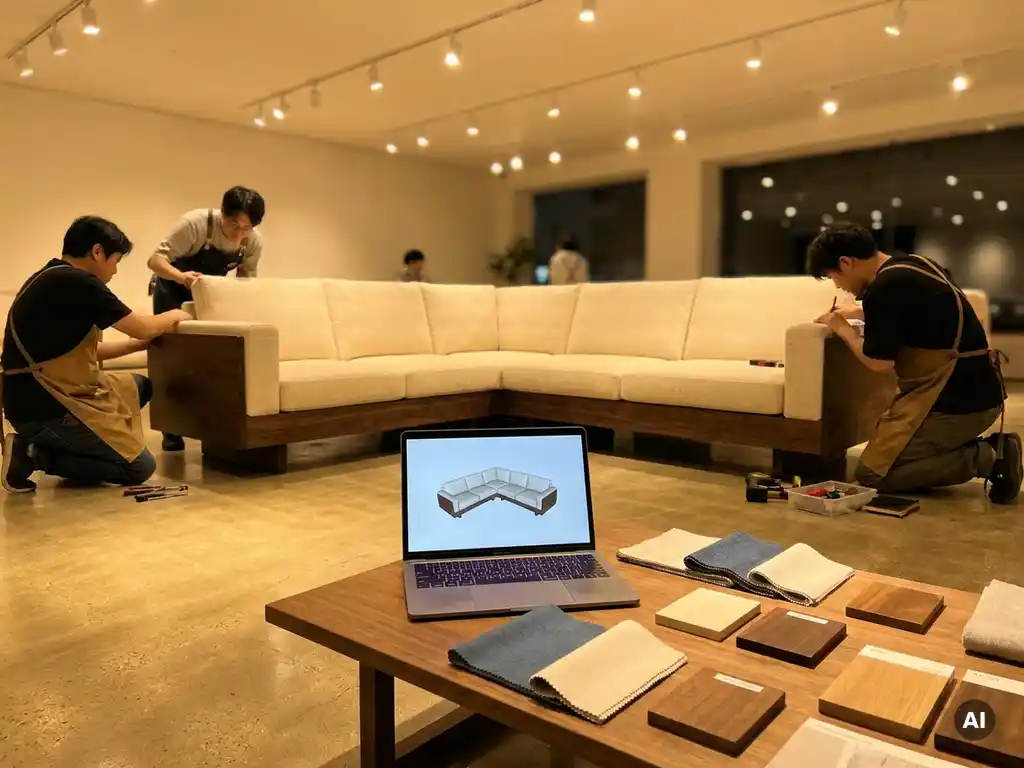
The furniture industry is at an inflection point. Buyers expect to see every fabric, finish, and configuration before they commit, and they expect to do it instantly, online, without visiting a showroom. For manufacturers still relying on static product photography and legacy configuration tools, that expectation is becoming increasingly difficult to meet. The good news is that a new generation of AI-enhanced 3D product configurators is making it not just possible but practical to deliver exactly that kind of experience, at scale, across every sales channel.
This post breaks down what AI is actually doing inside modern configurator platforms, why the cost of waiting is higher than most manufacturers realise, and what separates a genuinely capable visual commerce platform from one that simply looks impressive in a demo.
How AI is reshaping furniture product configuration
AI is not a layer of polish applied to existing configurator technology. It is fundamentally changing how configuration logic is built, maintained, and experienced by end users. Where traditional configurators require manual rule-building for every product variant, AI-assisted systems can learn from product data, detect conflicts in configuration logic automatically, and surface the most relevant options to a buyer based on context and behaviour.
On the visual side, AI is accelerating the generation of photorealistic product imagery. Instead of commissioning a photoshoot for every new colour or material combination, manufacturers can generate high-quality packshot images automatically from 3D models. This is not a marginal improvement. When a sofa comes in 40 fabrics, 6 frame colours, and 3 sizes, the number of possible visual outputs runs into the thousands. AI-driven rendering makes that scale achievable without a proportional increase in cost or time.
There is also a meaningful impact on the buying journey itself. AI can guide customers through complex configuration choices in a way that feels simple and intuitive, reducing decision fatigue and increasing the likelihood of completing a purchase with confidence.
The real cost of outdated configuration tools
Outdated tools do not just slow things down. They create compounding costs that show up in multiple parts of the business simultaneously. The most visible is photography. Traditional product photography is expensive, time-consuming, and impossible to scale across a full catalogue of configurable products. Manufacturers frequently launch collections with incomplete visual coverage, which means customers cannot see what they are actually buying.
The less visible costs are equally significant. Sales teams working without strong visual tools make more errors, take longer to build quotes, and struggle to set accurate customer expectations. That leads to higher return rates, more customer service overhead, and damage to brand trust. Inconsistent product presentation across retail partners compounds the problem further, weakening the brand perception that manufacturers invest heavily to build.
There is also a competitive dimension. Buyers who cannot configure and visualise a product with confidence will move to a competitor who lets them. In 2026, that competitor is increasingly likely to have an AI product configurator that makes the experience feel effortless.
Key capabilities that separate AI configurators from standard ones
Not every platform that carries the AI label delivers meaningfully different results. The distinction lies in a handful of specific capabilities that have a direct impact on business outcomes.
Automated visual content generation
A genuine AI-enhanced configurator generates high-quality product images automatically as configurations are built, without manual intervention for each variant. This eliminates the dependency on photoshoots and keeps visual content in sync with the product catalogue at all times.
Complex rules and pricing logic
Furniture products are often highly configurable, with business rules that govern which combinations are valid and how pricing adjusts accordingly. The strongest platforms handle this complexity natively, processing millions of possible variations without requiring the sales team to manage exceptions manually. Our platform, iONE360, is built on ERP logic and integrates directly with existing enterprise systems, which means configuration rules and pricing stay consistent across every touchpoint.
Augmented reality and room planning
The ability to place a configured product into a real room, via a smartphone or browser-based AR experience, removes one of the last remaining barriers to online furniture purchase. Combined with interactive room planning tools, this gives buyers the spatial confidence they previously could only get in a showroom.
Integration with existing systems
A configurator that operates in isolation creates more problems than it solves. The platforms that deliver lasting value connect cleanly with PIM, ERP, CMS, and e-commerce systems, ensuring that product data, pricing, and availability are always accurate and consistent.
Why timing matters for furniture manufacturers in particular
The furniture industry has historically been slower to adopt digital tools than other consumer categories, but that gap is closing fast. Consumer expectations shaped by configurable experiences in automotive, fashion, and electronics are now being applied to home furnishings. Manufacturers who close that gap now will build a meaningful advantage. Those who wait will find themselves catching up to competitors who have already established stronger digital relationships with both consumers and retail partners.
There is also a practical timing argument around content. Building a library of 3D models and configuration logic takes time, and the value of that investment compounds as the catalogue grows. Manufacturers who start in 2026 will have a far richer visual asset base in two or three years than those who delay. The earlier the investment, the greater the return over the medium term.
Collection launches are another natural forcing function. Introducing a new range without the visual infrastructure to show every variant in full is a missed opportunity that cannot be recovered after launch. Planning that infrastructure before the launch window is the only way to capture its full commercial value.
What to look for when evaluating a configurator platform
Choosing the right platform is a decision that will shape how a manufacturer presents its products for years. A few criteria consistently separate the platforms that deliver lasting value from those that underdeliver after implementation.
- Visual quality and realism: The output needs to be good enough to replace photography, not just supplement it. Evaluate rendered images critically against real product photography before committing.
- Scalability across the full catalogue: A platform that works well for ten products but struggles at five hundred is not a long-term solution. Confirm that the system can handle the full range of products, variants, and business rules without performance degradation.
- Integration depth: Shallow integrations create maintenance overhead and data inconsistencies. Look for a platform that speaks the same language as existing ERP and PIM systems, not one that requires a separate data pipeline to stay in sync.
- Omnichannel capability: The configurator needs to work consistently across the brand’s own webshop, retail partner platforms, and in-store touchpoints. Fragmented experiences undermine the brand consistency that the investment is meant to support.
- Proven track record in the industry: Furniture configuration has specific complexity that generic platforms often underestimate. Experience in the furniture and home furnishings sector matters, both in terms of technical capability and understanding of the commercial context.
The right platform is not necessarily the one with the longest feature list. It is the one that fits the existing business architecture, scales with the catalogue, and delivers measurable impact on conversion, return rates, and sales efficiency from day one. For manufacturers ready to move beyond outdated tools, the technology to do that is available right now, and the window to build a competitive advantage with it is open.
Related Articles
- Can I take a picture of a room and design it with an app?
- What is the role of a product configurator in omnichannel retail?
- Which room layout planner is easiest to use?
- Can a 3D product configurator save a customer's configuration for later?
- Why do customers leave without buying when they can't visualize products?