

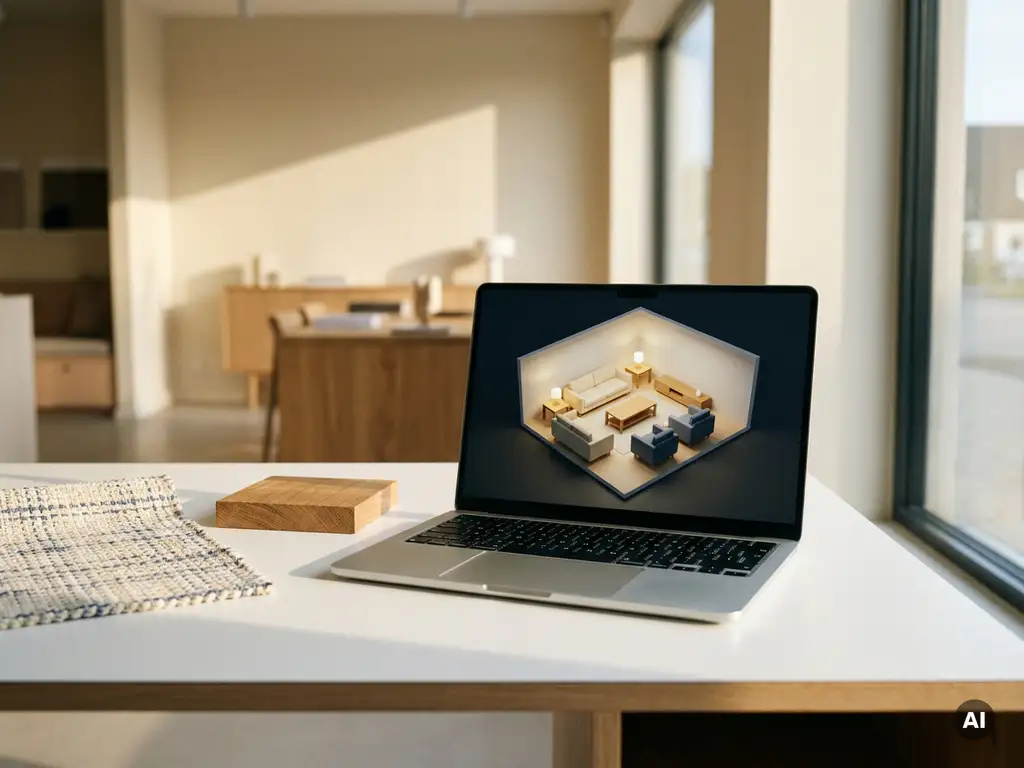
Room planning software plays a central role in digital transformation for furniture brands by giving customers the ability to visualise, configure, and purchase furniture in a fully interactive online environment. Rather than relying on static product pages or costly physical showrooms, brands can deliver a complete, confidence-building buying experience at scale. The questions below unpack exactly how this technology works, what to look for, and which brands stand to gain the most.
How does room planning software change the furniture buying journey?
Room planning software transforms the furniture buying journey by replacing uncertainty with visual confidence. Instead of asking customers to imagine how a sofa will look in their living room, a 3D room planner lets them see it, move it, resize it, and pair it with other pieces before committing to a purchase. This shift from imagination to visualisation fundamentally changes how customers decide.
Traditionally, the furniture buying journey involved multiple showroom visits, lengthy deliberation, and a high risk of post-purchase regret. Room planning tools compress that journey by enabling customers to experiment freely online. They can test different layouts, swap out colours and fabrics, and build an entire room concept at their own pace. The result is a buyer who arrives at checkout with far greater certainty about their choice.
For furniture brands, this is not just a convenience feature. It is a strategic shift in how products are presented, experienced, and sold across every channel, whether that is a brand website, a retail partner, or an in-store kiosk.
What features should a furniture room planner include for digital transformation?
A furniture room planner built for digital transformation must go beyond basic drag-and-drop layouts. The essential features are those that connect visual experience directly to the sales process, making the tool useful not just for inspiration but for conversion.
The most important features include:
- 3D visualisation with zoom and rotation so customers can inspect products from every angle
- Real-time product configuration allowing fabric, colour, size, and finish changes directly within the room view
- Integrated pricing and lead times so customers can see the cost impact of every choice instantly
- Direct add-to-cart or order functionality from within the room planner itself
- Flooring, wallpaper, and décor options that help customers build a complete interior scene
- White-label customisation to maintain consistent brand presentation across retail partners
- System integration with PIM, ERP, CMS, and webshop platforms
A room planner that lacks direct ordering capability or product configuration is essentially a mood board. For digital transformation, the tool must close the loop between inspiration and purchase.
How does room planning software reduce returns and increase order value?
Room planning software reduces returns by eliminating the guesswork that causes them. When customers can see exactly how a product fits, looks, and coordinates within their actual room context, they make more accurate purchasing decisions. Fewer surprises at delivery mean fewer returns, and that directly reduces costs for both the brand and the retailer.
The impact on order value works in the opposite direction. When customers are planning an entire room, they naturally consider multiple pieces together. A sofa leads to a coffee table, which prompts a rug, which suggests a sideboard. Room planners make this cross-selling organic rather than pushy, because the customer is already in a planning mindset. Showing products in context increases buying intent significantly, which is why room planning tools consistently deliver higher average order values compared to standard product pages.
There is also a confidence effect. Customers who feel certain about their choices are more willing to invest in higher-value pieces. A well-designed 3D room planner removes the hesitation that often leads buyers to settle for a cheaper, safer option.
What’s the difference between a product configurator and a room planner?
A product configurator focuses on a single product, allowing customers to customise its attributes such as size, fabric, colour, and finish. A room planner operates at a scene level, letting customers arrange multiple products together within a defined space. The two tools solve different problems, but they are most powerful when combined.
Here is how the two tools differ in practice:
- Scope: A configurator handles one product at a time. A room planner handles an entire interior layout with multiple products simultaneously.
- Use case: Configurators are ideal for complex, made-to-order products with many variants. Room planners are ideal for customers furnishing or redesigning a space.
- Sales impact: Configurators drive accuracy and reduce ordering errors. Room planners drive cross-selling and increase total basket size.
- Integration: When a room planner includes an embedded configurator, customers can configure individual products directly within the room view, combining both benefits in a single experience.
For furniture brands with complex, customisable product ranges, integrating both tools into a single platform is the most effective approach to digital commerce.
How does room planning software integrate with existing retail and e-commerce systems?
Room planning software integrates with existing retail and e-commerce systems through APIs and standard data connections that link the visual tool to backend platforms such as PIM, ERP, CMS, and webshop software. This means product data, pricing, stock availability, and lead times are always accurate within the room planner, without manual updates.
From a practical standpoint, integration ensures that a customer configuring a product in the room planner sees the same price and availability information they would find anywhere else in the brand’s ecosystem. Orders placed through the room planner flow directly into the same fulfilment process as any other order. There is no disconnect between the visual experience and the operational backend.
For multi-channel brands, integration also means the same room planning tool can serve the brand website, retail partner sites, and in-store screens from a single content source. This eliminates the inconsistency that often weakens brand presentation across a dealer network.
Which furniture brands benefit most from room planning software?
Furniture brands that benefit most from room planning software are those selling configurable or multi-piece product ranges across multiple channels. The greater the complexity of the product catalogue and the broader the distribution network, the more value a room planner delivers.
Specifically, the brands that see the strongest results tend to share these characteristics:
- Manufacturers and brands with large, highly customisable product ranges where showing every variant through traditional photography is impractical
- Retailers operating both an online store and a physical showroom, where a consistent visual experience across both channels matters
- Brands selling through dealer or retail partner networks that need a scalable tool that maintains brand consistency without requiring investment per location
- E-commerce-first furniture businesses looking to increase conversion and reduce return rates without expanding their photography budget
- Brands launching new collections that need high-quality visual content at scale and on a tight timeline
In short, any furniture brand that struggles to show its full range in all configurations, across all channels, will find room planning software to be one of the most commercially effective tools available.
How iONE360 helps furniture brands with room planning and digital transformation
We built our room planning software specifically for the furniture and interior industry, combining over 45 years of domain expertise with a platform designed to scale across any product range, any channel, and any retail partner network. Here is what we offer:
- A fully integrated 3D room planner where customers can arrange furniture, configure products on the spot, and see real-time pricing and lead times before ordering
- Two flexible deployment options: a bespoke, white-label room planner built for your platform, or HomeDecoHub, our ready-to-use room planning marketplace powered by the same proven technology
- Seamless system integration with PIM, ERP, CMS, and webshop platforms so your product data stays accurate across every touchpoint
- Consistent brand presentation across your own website, retail partners, and in-store screens from a single platform
- Measurable commercial impact through higher conversion rates, larger order values, and fewer returns
Whether you are launching a new collection, modernising your e-commerce experience, or building consistency across a dealer network, we have the tools and the industry knowledge to make it work. Get in touch with our team to see how our room planning platform can support your digital transformation.
Frequently Asked Questions
How long does it typically take to implement room planning software for a furniture brand?
Implementation timelines vary depending on the complexity of your product catalogue and the level of system integration required. A ready-to-use solution like HomeDecoHub can be up and running in a matter of weeks, while a fully bespoke, white-label room planner with deep PIM and ERP integration may take a few months to deploy properly. The most time-intensive part of the process is usually preparing and digitising your product data and 3D assets, so brands that already have structured product information in place will see faster go-live times.
Do customers need any technical skills or software downloads to use a 3D room planner?
No — modern room planning software is entirely browser-based and requires no downloads, plugins, or technical knowledge from the customer. The experience is designed to be as intuitive as browsing a product page, with drag-and-drop controls, guided prompts, and mobile-friendly interfaces. This low barrier to entry is critical for adoption, as any friction in the tool will reduce the number of customers who engage with it long enough to convert.
What kind of 3D product assets are needed, and what if we don't have them yet?
Room planning software requires 3D models of your products, typically in standard formats such as GLB, OBJ, or proprietary formats depending on the platform. If your brand does not yet have 3D assets, many room planning providers — including iONE360 — offer 3D content creation services as part of their onboarding process. Investing in high-quality 3D models is a one-time cost that then powers your room planner, product configurator, AR features, and any other visual commerce tools you deploy going forward.
How do we measure the commercial impact of a room planning tool after launch?
The most meaningful metrics to track are conversion rate, average order value, and return rate — comparing performance before and after the room planner is introduced, or between customers who used the tool versus those who did not. Most room planning platforms provide built-in analytics or integrate with your existing analytics stack so you can track engagement, session depth, and assisted revenue. Setting a clear measurement baseline before launch is essential for demonstrating ROI to internal stakeholders.
Can room planning software handle very large or complex product catalogues with hundreds of variants?
Yes — handling large, highly configurable catalogues is precisely where room planning software delivers its greatest advantage over traditional product photography. Because the visual output is rendered digitally, every combination of size, fabric, colour, and finish can be shown without the need for a separate photoshoot. The key is ensuring your product data is well-structured and connected to the room planner via a PIM integration, so that new variants and collections are automatically reflected in the tool without manual intervention.
What is the biggest mistake furniture brands make when adopting room planning software?
The most common mistake is treating the room planner as a standalone inspiration tool rather than integrating it fully into the purchase journey. A room planner that cannot display live pricing, check stock availability, or allow customers to add items directly to their basket will generate engagement but not sales. For genuine digital transformation, the tool must be connected end-to-end — from product configuration all the way through to order placement and fulfilment — so that the visual experience and the commercial process work as a single, seamless system.
How does room planning software support retail partners and dealer networks, not just the brand's own website?
A white-label room planning platform can be deployed across an entire dealer or retail partner network from a single content source, meaning every partner benefits from the same up-to-date product catalogue, accurate pricing, and consistent brand presentation without any additional investment per location. Partners can embed the tool on their own websites or use it on in-store screens, while the brand retains full control over the visual standards and product data. This scalability makes room planning software one of the most cost-effective ways to elevate the customer experience across a broad distribution network.