

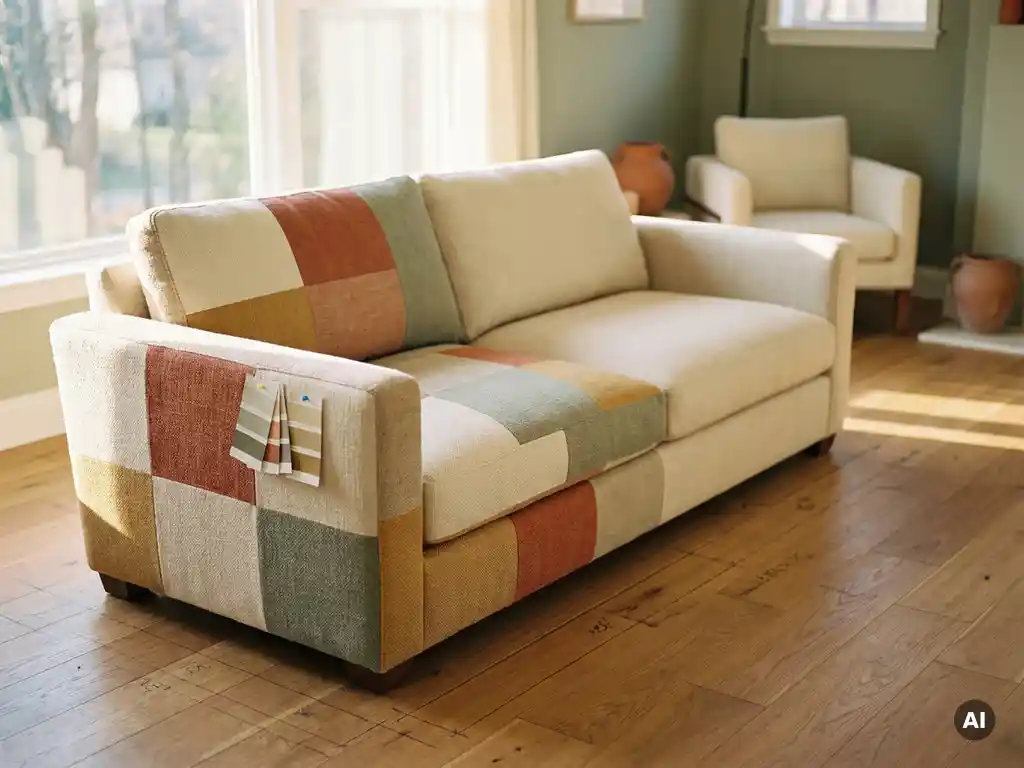
A room planner and a product configurator are two distinct but complementary tools. A room planner lets customers arrange multiple furniture pieces within a virtual floor plan, experimenting with layouts and spatial relationships. A product configurator focuses on a single product, letting customers customise materials, dimensions, colours, and components. Both serve different moments in the buying journey, and the most powerful platforms combine them into one seamless experience.
For furniture brands and retailers selling configurable products, understanding the difference matters because choosing the right tool, or the right combination, directly affects conversion rates, order values, and customer satisfaction. The sections below unpack each question in detail.
What does a room planner actually do?
A room planner is a digital tool that lets customers design an entire room by placing, moving, and arranging multiple furniture pieces on a virtual floor plan. It gives buyers a spatial overview, showing how a sofa, dining table, shelving unit, and rug work together before a single item is purchased.
Modern room planning software goes well beyond basic drag-and-drop functionality. Advanced platforms allow users to:
- Create accurate floor plans based on real room dimensions
- Rotate and zoom the 3D scene from any angle
- Add architectural elements like flooring, wallpaper, and curtains
- View the full room design in photorealistic 3D
- Combine products from across an entire catalogue in one session
The primary value of a room planner is confidence. Customers stop guessing whether a piece will fit or match and start making decisions based on what they can actually see. That shift from uncertainty to clarity is what drives higher buying intent, showing products in a realistic room environment significantly increases a customer’s readiness to purchase.
What does a product configurator do differently?
A product configurator is a tool focused entirely on a single product, allowing customers to customise every variable, fabric, finish, size, leg type, stitching, and more, and see the result update in real time. Where a room planner answers “how does this fit in my space?”, a configurator answers “exactly which version of this product do I want?”
For furniture brands selling customisable or made-to-order products, this distinction is critical. A well-built product configurator handles complex business logic behind the scenes, ensuring that only valid combinations are presented, pricing updates dynamically, and lead times adjust based on chosen specifications. The customer sees a simple, guided step-by-step process; the system manages thousands or even millions of possible variants underneath.
Product configurators also serve an operational purpose. They eliminate ordering errors, reduce back-and-forth between sales teams and production, and generate accurate order data that feeds directly into ERP and production systems. The visual output, photorealistic renders of the exact configured product, can also be used for marketing, reducing the need for costly physical photoshoots.
Can a room planner and a product configurator work together?
Yes, and when they do, the combination is significantly more powerful than either tool used in isolation. An integrated platform lets customers place a product in their room plan and configure it on the spot, choosing the fabric, size, and finish while seeing the result update live within the full room context.
This integration closes a gap that standalone tools leave open. A room planner without a configurator shows placeholder versions of products, not the exact variant the customer wants. A configurator without a room planner leaves customers wondering whether the product will actually work in their space. Together, they remove every major source of pre-purchase doubt.
When integration is done well, customers can also see pricing and lead times update in real time, and place an order directly from the room planning session, without switching between systems or re-entering their choices. This kind of seamless experience reduces friction at every step of the decision-making process.
Which tool is better for selling configurable furniture online?
For selling configurable furniture online, a product configurator is the essential starting point, but the room planner becomes the conversion accelerator. The configurator ensures customers can specify exactly what they want; the room planner ensures they feel confident enough to commit to the purchase.
The answer depends on what you sell and how your customers buy. Consider the following:
- If you sell highly customisable individual pieces (sofas, beds, dining chairs), a product configurator is non-negotiable. Customers need to see their exact specification before buying.
- If you sell room sets or coordinate multiple categories (living room, bedroom, dining), a room planner drives higher basket sizes by making it easy to buy multiple items together.
- If you sell both, and most furniture brands do, an integrated platform that combines both tools in one web-based experience delivers the strongest commercial results.
- If you operate through retail partners, a white-labelled room planning and configuration tool gives your dealers a consistent, branded selling experience without requiring separate investments per location.
The key insight is that these tools are not competing alternatives. They serve different moments in the customer journey and work best when they complement each other.
What features should you look for in each tool?
The features that matter most depend on the tool, but quality, integration depth, and ease of use are critical benchmarks for both. Below are the key capabilities to evaluate.
Room planner features
- Accurate floor plan creation with real room dimensions
- Full 3D visualisation with zoom, rotate, and walk-through views
- Ability to add flooring, wall finishes, and decorative elements
- Live product configuration within the room scene
- Mobile and web compatibility, no download required
- Integration with your product catalogue and pricing data
Product configurator features
- Real-time 3D rendering that updates as options are selected
- Support for complex business rules and valid-combination logic
- Dynamic pricing and lead time display
- Automatic generation of high-quality product images from any configuration
- Integration with PIM, ERP, and e-commerce systems
- A guided, step-by-step interface that works for non-technical users
For both tools, the ability to integrate seamlessly with your existing tech stack is often the deciding factor. A visually impressive tool that sits in isolation from your systems creates more work than it saves.
How do room planners and configurators affect conversion and returns?
Both tools reduce purchase uncertainty, and lower uncertainty directly translates into higher conversion rates and fewer returns. When customers can see exactly what they are buying, in the right size, the right fabric, and the right room context, they make better decisions and feel more confident in those decisions.
Returns in the furniture industry are often driven by mismatched expectations: the product did not look the way the customer imagined, or it did not fit the space as hoped. A product configurator eliminates the first problem by showing the exact configured product. A room planner eliminates the second by placing that product in an accurate representation of the customer’s space.
Higher order values are another consistent outcome. Room planners in particular encourage customers to furnish complete rooms rather than buying individual pieces in separate sessions. When a customer can see how a dining table, chairs, sideboard, and lighting work together, the barrier to adding more items drops significantly.
How iONE360 brings room planning and product configuration together
We built iONE360 specifically for the furniture, home, and decoration industry, combining over 45 years of sector expertise into a single, web-based visual commerce platform. Our platform integrates a full-featured product configurator and advanced room planning software into one connected experience, so customers can configure, visualise, and order without ever leaving your branded environment.
Here is what that means in practice:
- Integrated configuration in the room planner: Customers configure individual products directly within the room scene, seeing fabric, finish, and size choices update live in full 3D context.
- Automatic visual content generation: Every configured product generates photorealistic packshots automatically, eliminating the cost and delay of physical photoshoots.
- Complex product logic handled invisibly: Business rules, valid combinations, dynamic pricing, and lead times are managed behind the scenes, the customer sees a simple, guided process.
- Seamless system integration: The platform connects with your PIM, ERP, CMS, and webshop, so data flows without manual re-entry.
- Two deployment paths: Integrate a bespoke, white-labelled room planner built for your platform, or onboard HomeDecoHub, our ready-to-use room planning marketplace powered by the same proven technology.
- Consistent brand experience across all channels: Retailers and dealer partners work with the same visual tools, ensuring your products are always presented to the same standard.
If you are ready to see how a combined room planning and configuration platform can lift your conversion rates, reduce returns, and scale your visual content without extra photoshoot costs, get in touch with our team and we will show you exactly what is possible for your product range.
Frequently Asked Questions
How long does it typically take to implement a room planner or product configurator on an existing e-commerce site?
Implementation timelines vary depending on the complexity of your product catalogue and the depth of integration required with your existing systems (PIM, ERP, webshop). A straightforward product configurator integration can go live in a matter of weeks, while a fully integrated room planning and configuration platform with custom business logic may take a few months. The best approach is to start with a discovery phase where your provider maps your product data, tech stack, and business rules before committing to a timeline.
What kind of product data do I need to get started with a 3D room planner or configurator?
At a minimum, you will need accurate product dimensions, material and finish options, and high-quality visual assets, ideally 3D models of your products. Many providers can work with existing CAD files or photography to build the necessary 3D assets, though the quality and completeness of your starting data will directly affect the speed of onboarding. If your product data currently lives across spreadsheets or disconnected systems, consolidating it into a PIM before integration will save significant time.
Will a room planner or product configurator work for customers on mobile devices?
Modern web-based room planners and configurators are built to be fully responsive and accessible on mobile and tablet devices without requiring any app download. That said, the quality of the mobile experience varies significantly between platforms, so it is worth testing any tool across multiple device types before committing. Look specifically for platforms that optimise the interface layout and interaction model for touchscreens, not just ones that technically function on mobile.
How do these tools handle products with a very large number of variants or complex configuration rules?
A well-engineered product configurator is specifically designed to manage this complexity invisibly, using constraint-based logic to ensure only valid combinations are ever presented to the customer, no matter how many underlying variants exist. This means a product with hundreds of fabric choices, multiple size options, and component-level customisation can still be presented as a simple, guided step-by-step process. The key is to choose a platform that separates the business logic layer from the customer-facing interface, so complexity never becomes the customer’s problem.
Can these tools be used by our retail partners and dealer network, not just on our own website?
Yes, and this is one of the most commercially valuable applications of the technology. A white-labelled room planning and configuration tool can be deployed across your entire dealer network, giving every retail partner the same high-quality, branded selling experience without requiring each location to invest in its own technology. This ensures your products are always presented consistently and accurately, whether a customer is shopping on your direct website or in a partner showroom.
What is the most common mistake furniture brands make when implementing one of these tools?
The most common mistake is treating the tool as a standalone feature rather than integrating it fully into the broader tech stack and buying journey. A visually impressive configurator or room planner that does not connect to your live pricing, inventory, and order management systems creates friction rather than removing it, and risks showing customers inaccurate information. Equally, launching without clean, complete product data is a frequent stumbling block, so investing in data quality before go-live is essential for a smooth customer experience.
How do I measure whether a room planner or product configurator is actually improving my business results?
The most direct metrics to track are conversion rate among users who engage with the tool versus those who do not, average order value, and return rates for orders placed through the configurator or room planner. You should also monitor session depth and time spent, as longer, more engaged sessions typically correlate with higher purchase intent. Most platforms provide built-in analytics, but connecting tool engagement data to your broader e-commerce analytics will give you the clearest picture of commercial impact.