

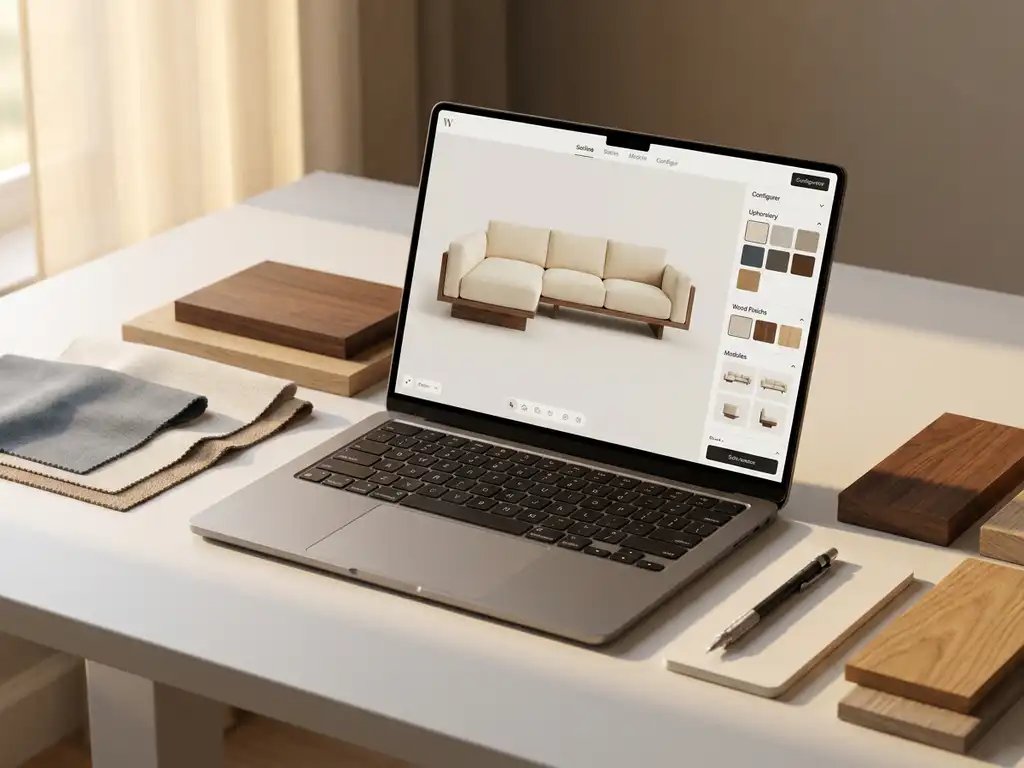
The best software for designing furniture depends on what you need it to do. For professional product development and manufacturing, CAD tools like AutoCAD or SolidWorks handle technical drawings and engineering specifications. For sales, marketing, and customer-facing experiences, a 3D product configurator combined with room planning software delivers far more commercial value. This article walks through the key types of furniture software, how they differ, and what to look for when choosing the right solution for your business.
What types of software are used to design furniture?
Furniture software falls into several distinct categories, each serving a different stage of the product lifecycle. CAD tools handle technical design and manufacturing specifications. 3D visualisation software creates photorealistic product imagery. Product configurators let customers or sales teams build custom variants. Room planning software brings multiple pieces together in a full interior layout.
Understanding which category you need, and when you might need more than one, is the starting point for any software decision. Here is a quick overview of the main types:
- CAD software (AutoCAD, SolidWorks, Fusion 360): Used by designers and engineers to create precise technical drawings and manufacturing-ready files.
- 3D visualisation tools: Convert product models into photorealistic renders for marketing and e-commerce.
- Product configurator platforms: Allow users to select materials, colours, dimensions, and options while seeing the result in real time.
- Room planning software: Enables customers to arrange multiple furniture pieces within a virtual floor plan, often in full 3D.
- Augmented reality (AR) tools: Let shoppers place virtual furniture in their actual living space using a smartphone or tablet.
For manufacturers and retailers in the home furnishings industry, the most commercially relevant category is the combination of product configurator and 3D room planning, since these tools directly influence the buying decision rather than the production process.
What’s the difference between furniture CAD software and a product configurator?
CAD software is a design and engineering tool used internally to create accurate product specifications for manufacturing. A product configurator is a customer-facing or sales-facing tool that lets people select options and see the result visually, in real time. They solve entirely different problems and are rarely interchangeable.
CAD tools like AutoCAD or Rhino produce technical files that factories use to cut, assemble, and quality-check products. They require trained users and are not designed for consumer interaction. A product configurator, by contrast, is built for guided decision-making. It presents a simplified, visual interface where a customer can choose a sofa in a specific fabric, leg finish, and configuration, and immediately see what that combination looks like.
The key distinction comes down to audience and purpose. CAD software is an internal production tool. A product configurator is a commercial tool designed to drive sales, reduce errors in orders, and build customer confidence. For furniture manufacturers selling configurable products, both may be necessary, but they operate at entirely different stages of the business.
Which furniture design software is best for manufacturers?
For furniture manufacturers, the most valuable software investment is a platform that bridges product complexity with customer clarity. That means a solution capable of handling thousands of product variants, enforcing configuration rules, generating accurate pricing, and presenting everything visually without requiring manual effort for each combination.
CAD software remains essential for the engineering side of product development. However, when it comes to selling configurable furniture at scale, a 3D product configurator integrated with room planning software delivers the most measurable commercial return. The right platform should handle complex business logic, support multiple sales channels, and connect with existing systems like ERP, PIM, and e-commerce platforms.
Manufacturers who sell through dealer networks have an additional requirement: consistency. The software needs to ensure that every retail partner presents the product range accurately and on-brand, without requiring individual setup work per location. This is where a scalable, web-based configurator platform has a clear advantage over fragmented, download-based tools.
How does 3D furniture visualisation software work?
3D furniture visualisation software works by rendering a digital model of a product using lighting, texture, and material data to produce a photorealistic image or interactive scene. The process starts with a 3D model of the product, which is then combined with material libraries and rendering engines to simulate how the piece would look in real life.
In a static workflow, a designer creates a 3D model and renders it as a fixed image, much like a traditional photograph but produced entirely in software. This is useful for marketing assets but does not scale well across large product catalogues with many variants.
In a dynamic workflow, the 3D engine is embedded directly into a configurator or room planner. As a user selects different options, the visualisation updates in real time. The customer sees exactly what they are ordering, in the right colour, fabric, and size, without any manual rendering work from the manufacturer’s team. This real-time approach is what powers modern furniture configurators and 3D room planning software, and it is what makes large-scale visual commerce practically achievable.
What should you look for when choosing furniture configurator software?
When choosing furniture configurator software, prioritise platforms that can handle your full product complexity, integrate with your existing technology stack, and scale across all your sales channels without requiring manual effort per product or per retailer. Visual quality, ease of use, and total cost of ownership are equally important factors.
Here is a numbered list of the most important criteria to evaluate:
- Product complexity support: Can the platform handle your configuration rules, pricing logic, and the full range of variants without custom development for each product?
- Visual quality: Does the output meet the standard your brand requires for e-commerce, retail, and marketing use?
- Integration capability: Does it connect with your PIM, ERP, CMS, and webshop without heavy IT investment?
- Room planning functionality: Does the platform include a room planning tool for furniture, or can it integrate with one, so customers can see products in context?
- Omnichannel scalability: Can the same platform serve your webshop, dealer network, in-store screens, and sales teams consistently?
- AR capability: Does it support augmented reality viewing so customers can place products in their own space?
- Partner experience: Does the vendor have a proven track record specifically in the furniture and home furnishings industry?
The goal is a single platform that eliminates the need for multiple fragmented tools. A well-chosen configurator should reduce your dependency on physical samples, speed up content production, and give every sales channel access to the same high-quality visual experience.
Can furniture design software reduce the need for product photography?
Yes, modern furniture configurator software can significantly reduce or even eliminate the need for traditional product photography. By generating photorealistic 3D renders automatically from product configuration data, manufacturers can produce consistent, high-quality visuals for every variant in their catalogue without scheduling a single photoshoot.
Traditional photography is expensive, slow, and practically impossible to scale across a full range of configurable products. A sofa available in 20 fabrics, three sizes, and four leg options represents hundreds of combinations. Photographing each one is not realistic. A 3D visualisation platform solves this by generating packshot images and lifestyle scenes programmatically, using the same product model with different material and configuration inputs.
Beyond static images, dynamic 3D visualisation also powers real-time configurators and 3D room planning software, where customers interact with the product directly rather than browsing a fixed image library. This shift from static photography to dynamic visualisation is one of the most significant operational advantages manufacturers gain when adopting a modern visual commerce platform.
How iONE360 helps with furniture design and room planning software
We built iONE360 specifically for manufacturers, brands, and retailers in the furniture and home furnishings industry who need to present complex, configurable products visually, at scale, across every sales channel. Our platform brings together product configuration, 3D visualisation, automated packshot generation, AR, and room planning in a single web-based solution, with no downloads required.
Here is what sets our approach apart:
- Advanced 3D room planning software that lets customers design full interiors, configure individual pieces on the spot, and see realistic results before they buy.
- Automatic generation of high-quality product imagery across all variants, eliminating the cost and bottleneck of traditional photography.
- Support for highly complex product rules and pricing logic, handling millions of possible configurations without manual effort per product.
- Seamless integration with PIM, ERP, CMS, and e-commerce platforms, so your existing systems stay connected.
- Consistent brand presentation across your webshop, dealer network, and in-store screens, all from one platform.
- Two flexible paths to room planning: a bespoke white-labelled room planner built for your platform, or onboarding to HomeDecoHub, our ready-to-use room planning marketplace.
- Over 45 years of furniture industry expertise behind every feature, backed by recognition from Gartner, Red Dot, and the A’ Design Award.
Showing products in the right environment increases buying intent significantly, and our room planning tool is designed to deliver exactly that kind of confidence-building experience for your customers. If you are ready to see what a scalable, integrated visual commerce platform can do for your business, get in touch with our team and we will walk you through it.
Frequently Asked Questions
How long does it typically take to onboard a full product catalogue into a furniture configurator platform?
The timeline depends on the size and complexity of your catalogue, but most manufacturers can expect an onboarding period of several weeks to a few months for a full product range. Platforms with strong PIM and ERP integration capabilities can significantly speed up the process by importing existing product data rather than requiring manual entry. Working with a vendor that has deep furniture industry experience, like iONE360, also reduces onboarding time because they understand the data structures and configuration logic specific to home furnishings from the outset.
What if my products are highly customisable with thousands of variants — can configurator software really handle that?
Yes, purpose-built furniture configurator platforms are specifically designed to manage complex configuration logic at scale, including dependency rules, restricted combinations, and dynamic pricing across millions of possible variants. The key is choosing a platform that enforces your business rules automatically, so invalid combinations are never presented to the customer and pricing is always accurate. Generic configurator tools not built for the furniture industry often struggle with this level of complexity, which is why industry-specific platforms deliver a measurable advantage.
Do my retail partners or dealers need to install anything to use a web-based configurator?
No — one of the core advantages of a web-based configurator platform is that it requires no downloads or local installations for your retail partners. Dealers can access the tool directly through a browser, meaning there is no IT overhead per location and no version control issues across your network. This also ensures every partner is always presenting your products using the latest configurations, pricing, and visual assets, maintaining brand consistency without any manual update work on your end.
How does augmented reality (AR) fit into a furniture sales workflow, and is it worth investing in?
AR allows shoppers to place a virtual version of a configured product into their actual room using a smartphone or tablet camera, which directly addresses one of the biggest hesitations in furniture buying: uncertainty about fit and appearance in a real space. Studies consistently show that AR experiences reduce return rates and increase purchase confidence, making it a commercially valuable feature rather than a novelty. The most practical approach is to choose a configurator platform that includes AR as a built-in capability, so the same product model used for configuration and room planning automatically powers the AR view without additional content production.
Can furniture visualisation software produce imagery good enough to replace professional lifestyle photography for marketing campaigns?
Modern 3D rendering engines are capable of producing photorealistic lifestyle imagery that is indistinguishable from traditional photography, and many leading furniture brands already use CGI exclusively for their catalogues and campaign assets. The advantage goes beyond quality — CGI scenes can be adjusted for lighting, season, room style, or regional market preferences without a reshooting, and new product variants can be dropped into existing scenes instantly. For manufacturers with large, configurable catalogues, this approach is not just a quality match for photography but a significant operational and cost improvement.
What is the difference between a white-labelled room planner and a room planning marketplace, and which is right for my business?
A white-labelled room planner is a fully branded experience built specifically for your platform, giving you complete control over the interface, product catalogue, and customer journey — ideal for established brands that want to own the end-to-end experience. A room planning marketplace, like HomeDecoHub, is a ready-to-use environment where your products are onboarded alongside other brands, allowing you to reach consumers who are already actively planning their interiors without building a standalone tool. The right choice depends on your brand strategy, resources, and how quickly you need to get to market — and some manufacturers benefit from using both in parallel.
What are the most common mistakes furniture businesses make when choosing design or configurator software?
The most frequent mistake is selecting a general-purpose tool that cannot handle furniture-specific complexity — such as fabric mapping, modular configurations, or dimension-driven pricing — and then discovering the limitations only after a costly implementation. Another common error is treating the configurator as a standalone tool rather than evaluating how well it integrates with existing ERP, PIM, and e-commerce systems, which often creates data silos and manual workarounds. Finally, many businesses underestimate the importance of omnichannel scalability, choosing a solution that works well for their webshop but cannot be consistently deployed across their dealer network or in-store environments.
Related Articles
- How do 3D product configurators handle new product launches?
- How do 3D product configurators reduce the need for physical samples?
- How do 3D product configurators help sell furniture without a physical showroom?
- Can a 3D product configurator show products in a room setting?
- How do furniture manufacturers use 3D product configurators?