

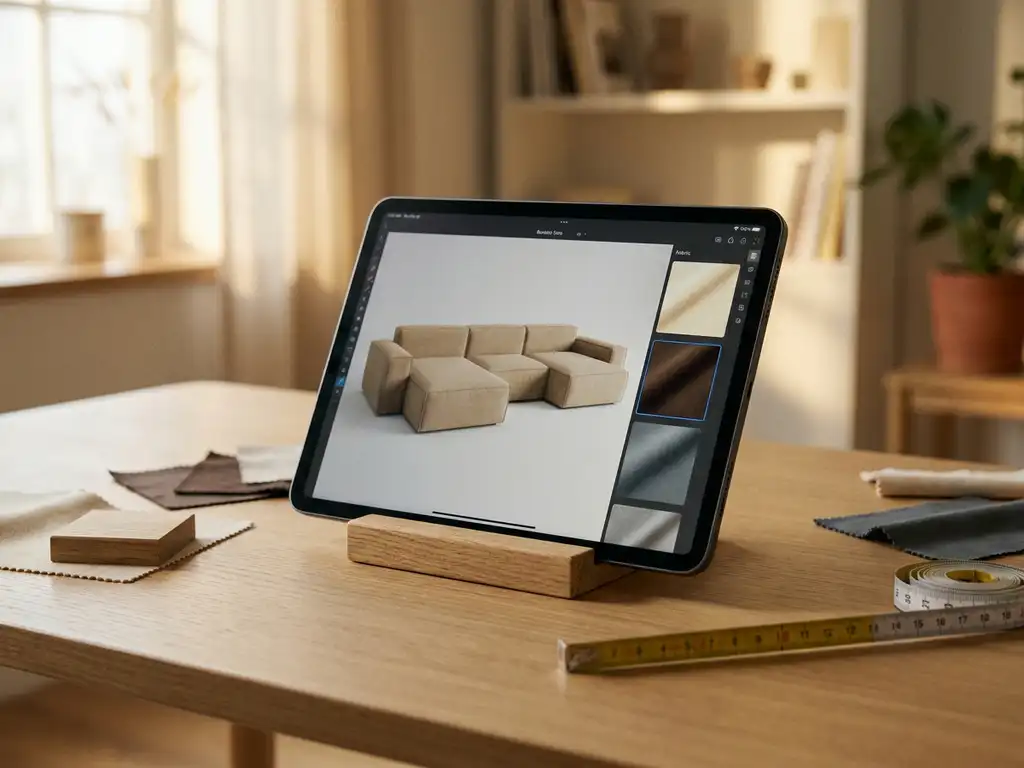
The best app for furniture design depends on what you need it to do. For consumers designing a room at home, simple room planning tools work well. For furniture manufacturers and retailers, a professional platform combining a 3D product configurator, room planning software, and augmented reality delivers far more value. This article walks through the key questions to help you find the right fit.
What types of furniture design apps exist?
Furniture design apps fall into several distinct categories, each serving a different purpose. Consumer-facing tools focus on room layout and decoration inspiration. Professional configurators handle complex product customization with pricing and business rules. Then there are full visual commerce platforms that combine multiple capabilities into one integrated system for manufacturers and retailers.
Here is a breakdown of the main types you will encounter:
- Room planning tools: Let users arrange furniture in a floor plan, experiment with layouts, and visualize spaces in 2D or 3D.
- Product configurators: Allow customers to customize a specific product by selecting materials, colors, sizes, and finishes, often with real-time pricing.
- Augmented reality viewers: Place virtual furniture into a real room using a smartphone camera.
- Packshot generators: Automatically produce high-quality product images across all variants without a photo shoot.
- Visual commerce platforms: Combine all of the above into one integrated system, typically built for manufacturers and larger retailers.
For most furniture businesses in 2026, the most competitive tools are those that combine several of these capabilities rather than offering just one in isolation.
What’s the difference between a furniture configurator and a room planner?
A furniture configurator focuses on a single product, letting customers customize it by choosing options like fabric, color, dimensions, or finish. A room planner takes a broader view, allowing users to arrange multiple pieces of furniture together in a floor plan or 3D space. The two tools serve different stages of the buying journey but work best when combined.
A configurator answers the question: What does this sofa look like in dark gray velvet? A room planner answers: How will that sofa fit and look in my living room alongside my other furniture?
When a room planner integrates a product configurator, customers can configure individual pieces directly within the room scene, seeing prices and lead times in context, and placing an order without leaving the experience. This combination removes the friction that typically causes customers to abandon a purchase and significantly increases buying confidence. Research in the furniture industry consistently shows that seeing products in a realistic environment raises buying intent, which is why room planning software has become a priority investment for forward-thinking furniture brands.
Which furniture design apps support augmented reality?
Several furniture apps offer augmented reality features, including IKEA Place, Houzz, and various manufacturer-specific apps. However, there is a significant quality gap between standalone AR viewers and AR that is integrated into a full product configurator. The most capable platforms let customers configure a product first, then view their exact customized version in AR, rather than showing a fixed model.
For furniture brands, the key question is not just whether an app supports AR, but whether the AR experience reflects the actual product in the configuration the customer has chosen. Showing a sofa in AR only in one fabric color, for example, limits the tool’s commercial value considerably.
Web-based AR is also increasingly important. Apps that require a download create unnecessary friction. The strongest platforms in 2026 deliver AR directly through a browser, making it accessible to any customer on any device without installation.
What app do furniture manufacturers use to show product variants?
Furniture manufacturers use product configurator platforms to display all variants of a product without needing a separate photo shoot for each combination. These platforms generate photorealistic 3D visuals automatically as customers select different options, covering every possible combination of color, material, size, and configuration.
The challenge for manufacturers is scale. A single sofa model might have dozens of fabric options, multiple leg finishes, and several size configurations, resulting in hundreds or even thousands of possible variants. Traditional photography cannot keep up with this scale economically or logistically.
A 3D-based configurator solves this by rendering each variant on demand from a single set of product data. Back-end users can set up configurations, define business rules, and attach pricing, which then feeds into a guided sales process that works both online and in-store. This approach eliminates the dependency on physical samples and showroom space while ensuring every variant is presented consistently across all channels.
How do furniture design apps integrate with webshops and retail systems?
The best furniture design apps integrate with existing business systems through APIs and standard connectors, linking to platforms such as PIM systems, ERP software, CMS tools, and e-commerce platforms. This means product data, pricing, stock availability, and order information flow between systems without manual duplication.
Integration matters because a configurator that sits outside your existing tech stack creates data silos. Customers configure a product, but the order details do not flow cleanly into your ERP. Or pricing updates in one system but not in the configurator. These gaps create errors and slow down operations.
For retailers with multiple locations or dealer networks, integration also ensures that every sales point, whether a physical store, a webshop, or a retail partner, presents the same product information and visual quality. This consistency protects brand perception and reduces the risk of miscommunication between sales teams and customers.
Should furniture brands build their own app or use an existing platform?
For most furniture brands, using an established platform is the smarter choice. Building a custom furniture design app from scratch requires significant investment in 3D development, AR technology, configurator logic, system integrations, and ongoing maintenance. An existing platform brings all of this ready-built, with industry-specific expertise already embedded.
The decision comes down to a few practical factors:
- Time to market: A proven platform can be deployed in weeks or months. Custom development typically takes years and carries higher risk.
- Industry expertise: Furniture-specific logic, such as complex configuration rules, pricing structures, and visual rendering of upholstery, takes years to develop well. Platforms built specifically for the furniture industry already handle this.
- Integration depth: Established platforms have pre-built connectors for common furniture industry systems. Custom builds require these to be developed from scratch.
- Scalability: As your product catalogue grows, a purpose-built platform scales with it. Custom solutions often hit technical ceilings that require expensive rework.
- Total cost of ownership: The upfront cost of a platform is almost always lower than custom development when you factor in the full scope of what needs to be built and maintained.
The exception is a brand with highly unique technical requirements that no existing platform can meet. In practice, this is rare. Most furniture manufacturers find that a well-integrated, configurable platform covers their needs completely.
How iONE360 helps with furniture design and room planning
We built iONE360 specifically for furniture manufacturers, brands, and retailers who need a scalable, high-quality visual commerce solution that handles the full complexity of configurable products. Our platform brings together everything discussed in this article into one integrated system.
Here is what iONE360 delivers in practice:
- 3D room planning software that lets customers design full rooms, arrange multiple furniture pieces, and view their layout from any angle
- Integrated product configurator so customers can customize individual items directly within the room planner, with live pricing and lead times
- Augmented reality accessible directly through the browser, no download required, showing the exact configured product in the customer’s own space
- Automatic packshot generation across all product variants, eliminating the cost and delay of traditional photo shoots
- Seamless integration with PIM, ERP, CMS, and e-commerce platforms through a robust API-first architecture
- White-label flexibility so the experience matches your brand, whether deployed on your own webshop, in-store, or across a dealer network
- HomeDecoHub, our ready-to-use room planning marketplace, as an additional route to market alongside a bespoke integration
With over 45 years of furniture industry expertise behind us, we understand the specific challenges of configurable products, complex business rules, and omnichannel consistency. If you want to see how our 3D room planning tool can work for your brand, get in touch with our team and we will walk you through it.
Frequently Asked Questions
How long does it typically take to get a furniture configurator up and running on my webshop?
With an established platform like iONE360, deployment typically takes weeks to a few months depending on the size of your product catalogue and the complexity of your configuration rules. The main preparation work involves digitizing your products into 3D models and setting up your business logic, such as pricing rules and valid option combinations. A custom-built solution, by contrast, can take one to two years before it is production-ready. Choosing a platform with a structured onboarding process and dedicated implementation support will shorten your time to market significantly.
What does it cost to create 3D models of my furniture products?
3D modeling costs vary depending on the complexity of the product, the level of photorealistic detail required, and whether you already have CAD files or technical drawings to work from. Simple pieces with few materials may cost a few hundred euros per model, while complex upholstered furniture with multiple configuration options can be higher. Many visual commerce platforms, including iONE360, offer 3D content creation as part of their onboarding service, which can reduce cost and ensure the models meet the technical requirements of the configurator from day one.
Can a furniture design platform handle my entire product catalogue, including seasonal updates and new launches?
Yes, a well-architected platform is designed to scale with your catalogue over time. New products, materials, or configuration options can be added through a back-end content management system without requiring a new development cycle each time. Platforms connected to your PIM or ERP system can even automate parts of this process, pulling in product data and pricing updates as they change. This makes it practical to keep your configurator current even with frequent product launches or seasonal fabric updates.
What if my customers are not tech-savvy — will they actually use a 3D room planner or AR tool?
Modern furniture design tools are built with ease of use as a primary requirement, not an afterthought. Browser-based AR requires no app download, and drag-and-drop room planners are designed to be intuitive for first-time users. Research consistently shows that customers who engage with interactive 3D tools spend more time on-site and convert at higher rates, including older demographics who may not consider themselves tech-savvy. The key is choosing a platform that prioritizes a clean, guided user experience rather than one that exposes technical complexity to the end user.
How do I ensure the colors and materials in the configurator accurately match the physical products?
Accurate material representation is one of the most critical factors in a furniture configurator, and it comes down to the quality of the 3D textures and rendering engine used. High-quality platforms use physically based rendering (PBR) techniques, which simulate how light interacts with different surfaces — such as velvet, leather, or wood grain — in a realistic way. Working with a platform that has dedicated material scanning or texture creation services will give you the closest match to physical samples. It is also worth building a review step into your onboarding process where your team signs off on material accuracy before going live.
Can the same configurator be used both on our website and by sales staff in physical stores?
Yes, and this is one of the strongest arguments for choosing an integrated platform over a standalone web tool. A good visual commerce platform is designed for omnichannel deployment, meaning the same product data, configuration logic, and pricing rules power the experience whether a customer is browsing your webshop at home or sitting with a sales consultant in a showroom. In-store, sales staff can use the configurator on a tablet or large display to guide customers through options, generate a quote, and place an order — all within the same system, eliminating the need for separate tools or manual data re-entry.
What is the biggest mistake furniture brands make when choosing a design or configurator platform?
The most common mistake is evaluating platforms based on the demo experience alone rather than assessing the full operational fit. A configurator can look impressive in a presentation but still create significant back-office headaches if it does not integrate cleanly with your ERP, PIM, or e-commerce platform. Brands also frequently underestimate the importance of ongoing support and platform updates — furniture businesses evolve, and your technology partner needs to evolve with you. Before committing, ask specifically about integration capabilities, how product updates are managed at scale, and what the support model looks like after go-live.