

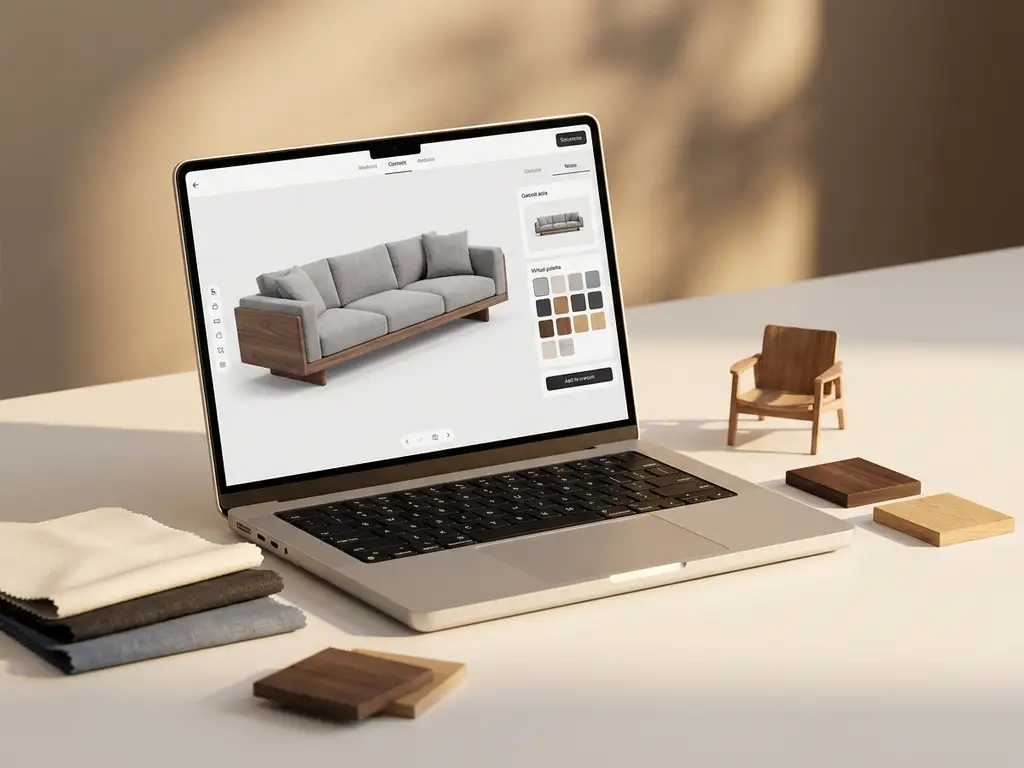
The best AI app for furniture design depends on what you actually need it to do. For pure visual inspiration and concept exploration, generative AI tools like Midjourney or Adobe Firefly can produce striking room visuals quickly. But for manufacturers and retailers who need to configure real products, manage variants, and connect to sales systems, a 3D room planning software platform built for the furniture industry is a far more practical and powerful solution.
Most consumer-facing AI design apps are built for creative exploration, not commercial product management. If your goal is to sell furniture more effectively, the tools that matter are those that combine intelligent configuration with photorealistic visualisation and seamless e-commerce integration. This article walks through the key questions buyers and businesses ask when evaluating AI furniture design tools in 2026.
What can AI apps actually do for furniture design?
AI apps for furniture design can generate room visuals, suggest layouts, automate product photography, and help users explore style combinations without needing a physical showroom. The scope ranges from basic image generation to fully interactive 3D environments where users plan, configure, and purchase furniture in real time.
On the consumer side, generative AI tools can take a photo of a room and suggest how it might look with different furniture. On the professional side, AI-assisted configurators can process thousands of product variants, apply complex pricing rules, and produce consistent, photorealistic visuals automatically. The gap between these two categories is significant, and choosing the wrong type of tool for your use case leads to wasted investment.
For furniture brands and retailers, the most commercially relevant AI capabilities include:
- Automated generation of packshot images across all product variants
- Real-time 3D product configuration with accurate pricing
- Interactive room planning that shows multiple products together in a single environment
- Augmented reality (AR) previews that place configured furniture in a customer’s actual space
- Business rule enforcement to prevent invalid or impossible product configurations
What types of AI furniture design apps are available?
AI furniture design apps fall into four broad categories: generative image tools, interior design assistants, room planning platforms, and product configurators. Each serves a different purpose, and understanding the distinction helps you invest in the right technology for your specific needs.
Generative image tools such as Midjourney, DALL-E, or Adobe Firefly use AI to create concept visuals from text prompts. They are useful for mood boarding and early-stage design exploration but produce fictional images that cannot be linked to real, purchasable products.
Interior design assistants like Houzz or Modsy-style platforms help consumers visualise how specific products might look in a room. These are consumer-oriented and typically lack the backend product management that manufacturers need.
Room planning platforms are more structured tools that let users build floor plans, arrange furniture, and visualise entire rooms in 3D. Advanced versions, like those built on a 3D room planning tool, connect directly to a live product catalogue with real pricing and configuration options.
Product configurators are purpose-built for complex, customisable products. They handle variant logic, pricing rules, and visual output at scale, making them the most commercially powerful category for furniture manufacturers and larger retailers.
What is the difference between an AI design app and a 3D product configurator?
An AI design app generates or suggests visuals based on patterns and prompts. A 3D product configurator is a structured commerce tool that lets users build a specific, real product from defined options — with accurate pricing and ordering capability. The defining difference is that a configurator is tied to actual inventory and business logic, while an AI design app is not.
Think of it this way: an AI design app can show you what a blue sofa might look like in a living room. A 3D product configurator shows you exactly what your sofa — in your chosen fabric, size, and leg finish — will look like, what it costs, and how long it will take to deliver. One is inspirational; the other is transactional.
For furniture manufacturers dealing with hundreds or thousands of product variants, the configurator approach is essential. It eliminates the need for manual photography of every combination, enforces valid configuration rules so customers cannot order impossible products, and feeds directly into order management and production systems.
How do AI furniture tools handle product variants and customisation?
AI furniture tools handle product variants in fundamentally different ways depending on their architecture. Generative AI tools cannot manage real product variants — they generate fictional images with no connection to a live product catalogue. Purpose-built configurators, by contrast, are specifically designed to handle millions of possible combinations through structured rules, 3D asset libraries, and automated visual rendering.
A well-built furniture configurator manages customisation through a combination of:
- Product logic rules that define which options can be combined and which cannot
- 3D asset libraries where each material, finish, and component is modelled accurately
- Real-time rendering that updates the visual instantly as a user makes selections
- Dynamic pricing that recalculates automatically based on the chosen configuration
- Output generation that produces packshot images, AR previews, or room visualisations from the final configuration
This level of control is what separates a professional-grade tool from a consumer AI app. When a sofa comes in 200 fabric options, 4 sizes, and 3 leg finishes, that is potentially thousands of combinations. A configurator handles all of them systematically. A generative AI tool cannot.
Which AI furniture design tool is best for manufacturers and retailers?
For furniture manufacturers and retailers, the most effective tool is not a generative AI app but a purpose-built visual commerce platform that combines a product configurator, room planning software, and augmented reality (AR) capability in one integrated system. Consumer AI tools are not designed for the complexity, scale, or commercial requirements of the furniture industry.
When evaluating tools for a manufacturing or retail context, the criteria that matter most are:
- Ability to handle complex product logic and thousands of variants
- Automatic generation of high-quality product visuals without manual effort per variant
- A 3D room planning software environment where multiple products can be combined and configured together
- Integration with existing systems such as PIM (Product Information Management), ERP, and e-commerce platforms
- Proven deployment in the furniture and home furnishings industry
- No app download required for end customers
Generic AI design apps score well on visual appeal but fail on nearly every commercial criterion above. The furniture industry requires a specialist approach, not a general-purpose creative tool.
Can AI furniture apps integrate with existing e-commerce systems?
Most consumer AI furniture apps cannot integrate meaningfully with e-commerce systems. They are standalone tools with no API access, product data management, or order flow. Professional-grade room planning and configurator platforms, however, are built with integration as a core requirement and can connect to webshops, PIM systems, ERPs, and CMS platforms through standard APIs.
For manufacturers and retailers operating across multiple channels, integration is not optional. A room planning tool for furniture that cannot connect to your product catalogue, pricing engine, or checkout system creates more work, not less. The strongest platforms are designed API-first, meaning they slot into your existing technology stack rather than replacing it.
Integration capability also enables consistency across channels. When your configurator and room planner pull from the same product data as your webshop and dealer network, every customer sees the same accurate visuals, pricing, and availability regardless of where they encounter your brand.
How iONE360 supports furniture design, configuration, and room planning
iONE360 is a visual commerce platform built specifically for the furniture and home furnishings industry. Unlike generic AI design tools, iONE360 combines 3D product configuration, room planning software, and augmented reality in a single web-based system — with no downloads required for end customers. The platform is designed to handle the full commercial workflow: from product variant management and automated image generation through to checkout integration and order flow.
Here is what iONE360 brings to manufacturers and retailers looking for a serious furniture design and sales tool:
- Advanced 3D room planning software that lets customers arrange, configure, and purchase multiple products together in a photorealistic environment
- Automatic generation of high-quality packshot images across all product variants, eliminating costly photoshoots
- A fully integrated product configurator that handles millions of combinations with complex pricing and business rules
- Augmented reality (AR) previews that place configured products in the customer’s own space using their smartphone camera
- White-label flexibility and API-first architecture for seamless integration with your existing tech stack
- Access to HomeDecoHub, a ready-to-use room planning marketplace powered by the same proven platform
- Over 45 years of furniture industry expertise built into every feature
Research consistently shows that presenting products in a realistic room context increases buying intent, and our room planning tool is designed to capture exactly that effect. Customers who can visualise, configure, and order in one seamless flow buy faster, add more to their order, and return less often.
If you are ready to move beyond generic AI tools and invest in a platform built for the furniture industry, get in touch with our team to see what iONE360 can do for your business.
Frequently Asked Questions
How long does it typically take to get a 3D product configurator up and running for a furniture brand?
Implementation timelines vary depending on the size of your product catalogue and the complexity of your variant logic, but most furniture brands can expect an onboarding period of several weeks to a few months. The bulk of that time is spent digitising your product assets, defining configuration rules, and integrating with your existing systems such as your PIM, ERP, or webshop. Working with a specialist platform like iONE360, which already has furniture-specific workflows built in, significantly reduces setup time compared to building a custom solution from scratch.
What if my product catalogue is very large — can a configurator realistically handle thousands of SKUs and variants?
Yes, and this is precisely where purpose-built configurators outperform both manual processes and generic AI tools. Professional-grade platforms are architected to handle millions of possible combinations through structured rules and 3D asset libraries, meaning the system scales with your catalogue rather than against it. Rather than managing individual SKU images or product pages for every combination, you maintain a single set of rules and assets that the configurator applies dynamically across your entire range.
Can customers use a 3D room planner without downloading an app or creating an account?
With the right platform, yes — and this is an important consideration for conversion. Web-based room planning tools that run entirely in the browser remove the friction of app downloads or account creation, which are well-known drop-off points in the customer journey. iONE360 is fully web-based, meaning customers can jump straight into planning and configuring without any installation, on desktop or mobile.
How does augmented reality fit into a furniture sales workflow, and is it difficult to implement?
Augmented reality (AR) allows customers to place a configured product — with their chosen fabric, size, and finish — directly into a photo of their own room using their smartphone camera. In a sales context, this reduces purchase hesitation because customers can verify fit, scale, and style before buying. When AR is integrated into the same platform as your configurator and room planner, implementation is straightforward: the 3D assets used for configuration are the same ones rendered in AR, with no duplicate content creation required.
What's the biggest mistake furniture businesses make when choosing an AI design tool?
The most common mistake is selecting a tool based on visual output quality alone, without evaluating its commercial capabilities. A tool that generates beautiful room images but cannot connect to your product catalogue, enforce configuration rules, or feed into your checkout process creates a gap between inspiration and purchase that costs you sales. Always evaluate AI and visualisation tools against your full workflow — from product data management through to order completion — not just the quality of the images they produce.
Do I need to replace my existing e-commerce platform to use a 3D room planner or configurator?
No — a well-designed configurator or room planning platform should integrate with your existing e-commerce stack, not replace it. Look for solutions built on an API-first architecture that can connect to your current webshop, PIM, and ERP through standard APIs. This approach means your product data, pricing, and availability remain centralised, and the configurator or room planner simply becomes an enhanced front-end experience layered on top of your existing infrastructure.
How do I justify the investment in a 3D configurator or room planning platform to stakeholders?
The strongest business case typically combines cost reduction with revenue impact. On the cost side, automated packshot generation across all product variants eliminates the need for expensive physical photoshoots every time you update your range. On the revenue side, research consistently shows that interactive 3D and room planning experiences increase average order value, reduce return rates, and shorten the decision-making cycle — all of which have a direct and measurable impact on profitability. Requesting a platform demo with data from comparable furniture brands is the most effective way to build a concrete, numbers-backed case for internal approval.
Related Articles
- What is the difference between a product configurator and a CPQ tool?
- Why do customers abandon customization tools before completing a purchase?
- Why do retailers need furniture visualizer technology?
- How do 3D product configurators make my sales process more efficient?
- Can a 3D product configurator work without technical knowledge?