

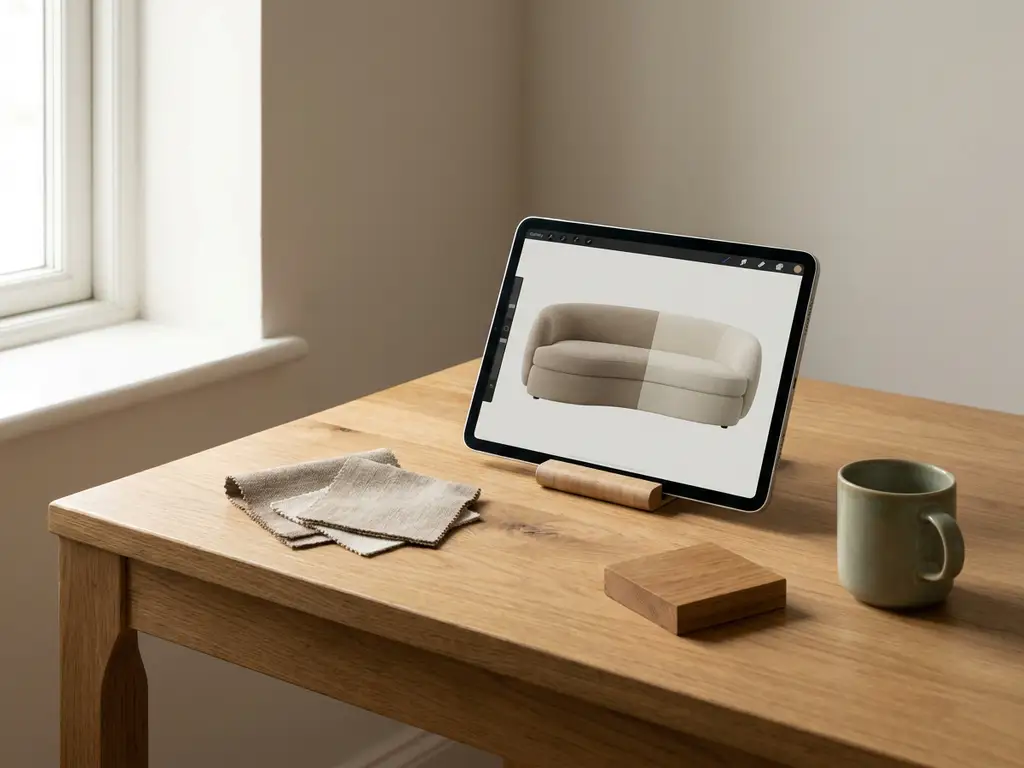
Yes, there are free apps available to help you design furniture layouts and plan rooms. Tools like IKEA Place, Planner 5D, and RoomSketcher all offer free tiers that let you experiment with furniture arrangements in a digital space. However, free apps come with real limitations in functionality, visual quality, and business scalability. This article breaks down what free tools can and cannot do, and when a professional solution makes more sense.
What can free furniture design apps actually do?
Free furniture design apps typically allow users to create basic floor plans, drag and drop furniture pieces into a room layout, and visualize the result in 2D or simple 3D. Most free tools are consumer-facing and designed for personal use, such as planning a living room refresh or experimenting with a new sofa placement before buying.
Common features found in free furniture design apps include:
- Basic room planning with preset room dimensions
- A library of generic furniture shapes and sizes
- Simple 3D previews or top-down floor plan views
- Basic camera rotation or zoom functionality
- PDF export or screenshot sharing
These features work well enough for casual home planning. However, they rarely support real product catalogs, configurable items, or brand-specific visuals. For a homeowner choosing between two sofa options from a generic library, free tools are fine. For a furniture brand trying to show its full product range in every fabric and finish, they fall short immediately.
Which free apps are most popular for designing furniture?
The most widely used free furniture design apps in 2026 are Planner 5D, RoomSketcher, IKEA Place, and Homestyler. Each takes a slightly different approach, but all are primarily built for consumers rather than businesses.
Planner 5D offers a browser-based room planning experience with a free tier that includes basic furniture items and 2D/3D switching. Its premium features, including HD renders and a larger object library, sit behind a paywall.
RoomSketcher focuses on floor plan creation and is popular among interior design enthusiasts. The free version is limited in 3D visualization quality and does not support product-specific configurations.
IKEA Place is an AR app that lets users place IKEA products in their home using a smartphone camera. It is polished and genuinely useful, but it only works with IKEA’s own catalog, making it irrelevant for other furniture brands.
Homestyler offers a visually appealing interface with some branded product partnerships, but again, the free version limits access to advanced features and real-time product customization.
What’s the difference between a furniture design app and a product configurator?
A furniture design app helps users arrange furniture within a room layout, while a product configurator lets users customize a specific product by selecting materials, dimensions, colors, and components, then see the result in real time. These are fundamentally different tools solving different problems.
Think of it this way: a room planning app answers the question “where should this sofa go?” A product configurator answers the question “what should this sofa look like, and what will it cost?” The most powerful platforms combine both capabilities into a single experience.
In a professional context, a 3D room planning tool that integrates a product configurator allows customers to place a specific sofa in a room layout, configure it in their preferred fabric and leg finish, see accurate pricing, and place the order, all without leaving the page. That level of integration is simply not available in free consumer apps.
Key distinctions at a glance:
- Scope: Room planning apps focus on spatial layout; configurators focus on product customization
- Data depth: Configurators connect to real product data including SKUs, pricing, and lead times
- Business logic: Configurators enforce rules, such as which fabric options are available for which frame sizes
- Output: Configurators generate accurate product specifications ready for production or ordering
- Integration: Professional configurators connect to PIM, ERP, and e-commerce systems; free apps do not
Why do furniture brands use professional configurators instead of free tools?
Furniture brands use professional configurators because free tools cannot handle the complexity, scale, or commercial requirements of a real product catalog. A mid-sized furniture manufacturer may offer a single sofa model in dozens of fabric options, multiple sizes, and several leg finishes, creating thousands of possible combinations. Free apps have no mechanism to manage this.
Beyond catalog depth, professional room planning software and configurators deliver measurable commercial outcomes. Showing products in a realistic room context increases buying intent significantly, and customers who can configure a product themselves arrive at checkout with far greater confidence. This translates directly into higher conversion rates, larger order values, and fewer returns.
Free tools also create brand consistency problems. When a furniture brand relies on generic app libraries or inconsistent visuals, the product presentation differs across channels. A professional configurator ensures that every retailer, every webshop, and every in-store screen shows the same high-quality, brand-accurate visuals, automatically.
Finally, free apps are not built to integrate with business systems. A professional configurator connects to existing PIM, ERP, and CMS platforms, meaning that product data, pricing, and availability stay synchronized without manual effort.
What should you look for in a furniture configurator for your business?
When evaluating a furniture configurator for a professional context, the most important factors are visual quality, integration capability, scalability across your product range, and proven experience in the furniture and home furnishings industry.
Start by asking whether the platform can handle your full catalog, including complex configurable products with many variants and business rules. A solution that works for simple products but breaks down with modular sofas or custom upholstery is not a long-term fit.
Also consider how the tool connects with your existing systems. Seamless integration with your PIM, ERP, and webshop removes the need for manual data management and keeps your product information consistent everywhere. The best room planning software works as part of a broader visual commerce platform rather than as a standalone tool.
Other criteria worth evaluating include:
- Whether the solution is web-based and requires no download for end users
- The quality and realism of 3D and AR output
- Whether photorealistic packshots can be generated automatically from configuration data
- Support for omnichannel deployment across webshop, in-store, and dealer networks
- The vendor’s track record and references specifically within the furniture industry
How iONE360 helps with room planning and furniture configuration
We at iONE360 offer a professional-grade room planning and product configuration platform built specifically for the furniture, home, and decor industry. With over 45 years of furniture software expertise behind us, our solution goes far beyond what any free app can deliver.
Here is what sets our platform apart:
- Integrated room planning and configuration: Customers can place furniture in a 3D room, configure each product on the spot, and order directly, all within one seamless experience
- Full catalog coverage: Our platform handles complex products with thousands of variants, enforcing business rules and pricing automatically
- Automatic packshot generation: High-quality product images are generated from configuration data, eliminating costly photoshoots
- Omnichannel consistency: The same branded experience works across your webshop, in-store screens, and dealer network
- Deep system integration: We connect seamlessly with PIM, ERP, CMS, and e-commerce platforms
- Two flexible paths: Choose a bespoke white-labeled room planner or onboard HomeDecoHub, our ready-to-use room planning marketplace
The result is a buying experience that builds customer confidence, increases order values, and reduces returns. If you are ready to move beyond free tools and give your customers a truly compelling way to design and buy, get in touch with us to explore what iONE360 can do for your business.
Frequently Asked Questions
Can I use a free furniture design app to sell products on my e-commerce website?
Free furniture design apps are built for personal use and are not designed to integrate with e-commerce platforms, product databases, or checkout flows. While you could theoretically embed a link to a third-party free tool, you would have no control over branding, product accuracy, or the customer journey. A professional configurator, by contrast, sits natively within your webshop, connects to your live product catalog, and allows customers to go from configuration to checkout without leaving your site.
How difficult is it to migrate from a free room planning tool to a professional configurator?
The transition is typically managed by the configurator vendor and involves importing your product catalog, setting up business rules, and connecting to your existing systems such as PIM and ERP. The complexity depends on the size and depth of your catalog, but professional platforms like iONE360 are built to handle this onboarding process. The sooner you make the switch, the less technical debt you accumulate from workarounds built around free tool limitations.
What if my product catalog is small — do I still need a professional configurator?
Even a small catalog can benefit from a professional configurator if your products are configurable, meaning they come in multiple fabrics, finishes, sizes, or components. A sofa offered in just five fabrics and three sizes already creates 15 combinations that a free app cannot accurately represent. Beyond catalog size, the commercial benefits — higher conversion, fewer returns, consistent brand visuals — apply regardless of how many SKUs you carry.
Do customers actually use room planning tools, or is it a feature that goes unused?
Engagement data consistently shows that interactive room planning and configuration tools significantly increase time on site, buyer confidence, and conversion rates. Customers who visualize a product in their own space or configure it to their preferences are far more likely to complete a purchase and far less likely to return it. The key is making the tool frictionless — web-based, fast, and integrated into the buying journey — rather than a separate app customers have to download and learn.
Can a furniture configurator work for both online customers and in-store sales teams?
Yes, and this is one of the most valuable aspects of a professional omnichannel configurator. The same platform can power your webshop experience for online shoppers while also running on in-store screens or tablets for sales associates to use during consultations. This ensures that every channel shows the same accurate, brand-consistent visuals and pricing, which reduces errors and creates a seamless customer experience whether they buy online, in-store, or through a dealer.
How long does it typically take to implement a professional furniture configurator?
Implementation timelines vary depending on catalog complexity, the number of system integrations required, and whether you choose a bespoke solution or a ready-to-use platform. A marketplace solution like HomeDecoHub can get you up and running significantly faster than a fully custom build. In either case, working with a vendor that specializes in the furniture industry — and already understands the data structures, business rules, and integration patterns common in the sector — shortens the timeline considerably.
What's the biggest mistake furniture brands make when evaluating room planning or configuration software?
The most common mistake is evaluating tools based on demo visuals alone without testing them against your actual product catalog and business rules. A platform may look impressive with curated sample products but struggle with your specific combination of modular components, fabric restrictions, or pricing logic. Always request a proof of concept using your own products, and ask the vendor for references from furniture brands with a similar catalog complexity to yours.