

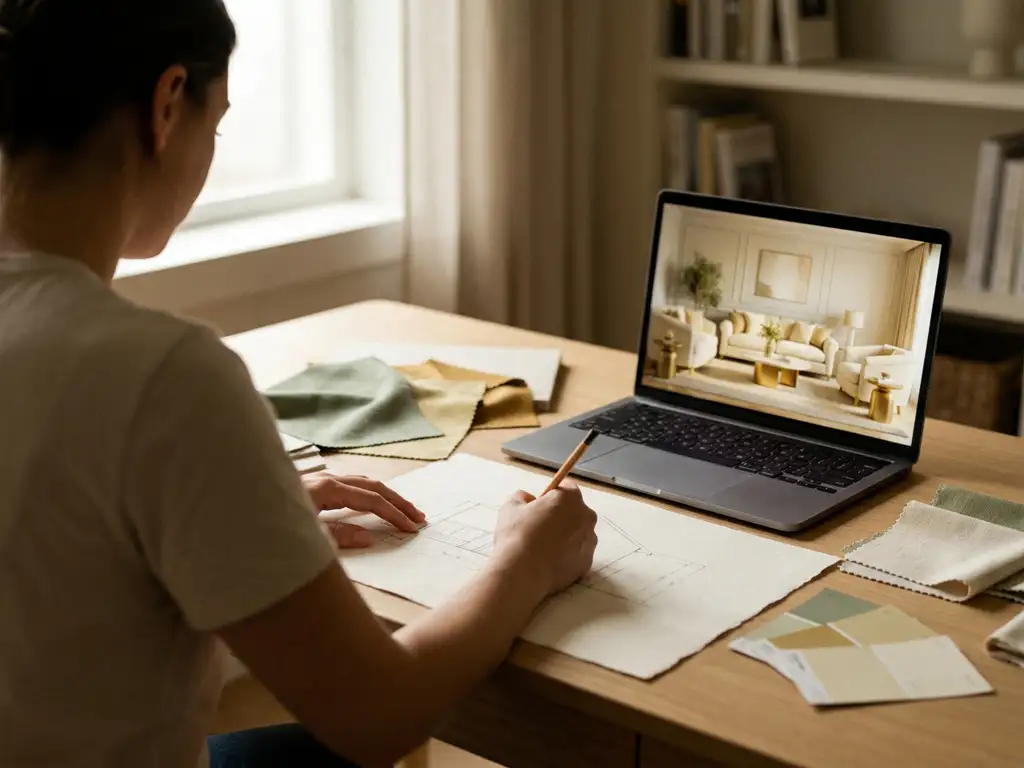
ChatGPT can be genuinely helpful for interior design inspiration, but it has real limitations when it comes to actual room planning. It excels at generating ideas, suggesting colour palettes, and explaining design principles in plain language. However, it cannot visualise spaces, render furniture layouts, or interact with product catalogues the way dedicated room planning tools can. This article unpacks exactly what ChatGPT can and cannot do for interior design, and which AI tools are worth using in 2026.
What can ChatGPT actually do for interior design?
ChatGPT can support interior design by generating ideas, answering style questions, explaining design concepts, and helping users articulate their preferences. It works well as a conversational brainstorming partner, but it operates entirely in text — it cannot produce visual outputs, render a room, or interact with real product data.
In practical terms, ChatGPT is most useful for the early, exploratory phase of an interior design project. Ask it to suggest colour schemes for a north-facing living room, explain the difference between Japandi and Scandinavian style, or help you write a brief for an interior designer. It handles these tasks well because they are fundamentally language tasks.
Where it starts to fall short is the moment you need to actually see something. ChatGPT cannot draw a floor plan, place furniture in a room, or show you what a sofa looks like in a specific fabric. For that, you need purpose-built spatial design tools.
What are the limitations of using ChatGPT for room design?
The core limitation of using ChatGPT for room design is that it has no spatial or visual capability. It cannot create floor plans, render 3D layouts, or show how furniture fits together in a real room. It also has no access to live product catalogues, pricing, or configuration options from furniture brands.
This matters more than it might seem at first. Interior design is an inherently visual discipline. Decisions about scale, proportion, light, and texture all need to be seen, not described. A text-based tool can tell you that a sectional sofa might work in an L-shaped living room, but it cannot show you whether it actually fits, how it looks with your flooring, or whether the configuration you want is even available.
The specific limitations of ChatGPT for room design are:
- No ability to generate or display images (unless connected to a separate image generation plugin)
- No integration with product databases, pricing systems, or inventory
- No spatial reasoning for accurate room measurements or furniture placement
- Suggestions are generic and not tied to any real product range
- Cannot support the actual purchasing process
For casual inspiration, these limitations are manageable. For serious room planning or furniture purchasing decisions, they are significant gaps.
How does ChatGPT compare to dedicated interior design tools?
Dedicated interior design and room planning tools far outperform ChatGPT for spatial design tasks. Where ChatGPT offers text-based suggestions, dedicated tools provide interactive 3D environments, real product data, accurate measurements, and visual outputs that support real purchasing decisions.
The comparison is not really a fair one because the two tools are built for different purposes. ChatGPT is a general-purpose language model. Dedicated room planning software is purpose-built for a specific workflow: placing furniture, configuring products, visualising spaces, and moving towards a purchase.
Dedicated interior design tools typically offer:
- 3D room visualisation that lets users see furniture in context, from multiple angles
- Accurate floor plan creation with real measurements and scale
- Product configuration allowing users to customise fabric, colour, and size in real time
- Integration with live product catalogues including pricing and lead times
- Augmented reality (AR) to place furniture in a real room using a smartphone
- Direct checkout so the path from design to purchase is seamless
ChatGPT cannot replicate any of these functions. It can complement dedicated tools by helping users clarify their thinking before they open a room planning tool, but it is not a substitute for spatial design software.
Can ChatGPT help you choose furniture and home decor?
ChatGPT can help you narrow down preferences and think through furniture choices in general terms, but it cannot show you specific products, compare real options, or factor in your actual room dimensions. It is a useful sounding board, not a product selection tool.
If you describe your room, your budget range, and your style preferences, ChatGPT can suggest furniture categories, materials, or configurations that might work. It can also help you think through practical questions like traffic flow, storage needs, or how to mix patterns and textures.
What it cannot do is pull up a sofa in your preferred fabric, place it in your room at the correct scale, and show you what it looks like next to your existing pieces. For that kind of decision support, a 3D room planning tool is the right instrument. The difference in confidence between choosing furniture based on a text description versus seeing it rendered in your actual space is substantial.
What AI tools are actually useful for interior design in 2026?
The AI tools that deliver real value for interior design in 2026 are those built specifically for spatial visualisation, product configuration, and purchasing workflows — not general-purpose language models. These include 3D room planning software, AI-powered product configurators, and augmented reality tools that connect directly to real product catalogues.
General-purpose AI tools like ChatGPT or image generators such as Midjourney have a role in the creative inspiration phase, but they do not connect to the real world of products, prices, and room dimensions. The most impactful tools in 2026 are those that close the gap between inspiration and purchase.
The AI tools that matter most for furniture and home decor decisions fall into four categories:
- 3D room planning software that lets users build accurate floor plans and visualise furniture layouts in photorealistic detail
- Product configurators that allow real-time customisation of furniture across fabric, colour, size, and finish
- AR viewers that place configured products in a real room via a smartphone camera
- Integrated commerce tools that connect configuration directly to pricing, availability, and checkout
The common thread is integration with real product and business data. Inspiration tools are everywhere; tools that actually move a customer from interest to confident purchase are far more valuable — and far rarer.
Should furniture brands use AI tools to improve the buying experience?
Yes — furniture brands should actively invest in AI-powered visual tools to improve the buying experience. Customers making high-value, considered purchases need confidence before they commit, and visual tools that let them plan, configure, and visualise products in their own space directly address the uncertainty that causes hesitation and returns.
The furniture buying journey has a well-known challenge: customers cannot easily imagine how a product will look in their home until it arrives. This uncertainty drives abandoned purchases, costly returns, and lower order values. AI-powered room planning and configuration tools solve this by making the decision process visual, interactive, and personalised.
For brands selling configurable or custom products, the case is even stronger. When a sofa comes in dozens of fabric and configuration options, traditional photography cannot cover every variant. Visual configurators and room planning tools fill that gap at scale, without the cost of a photoshoot for every combination.
How iONE360 helps with room planning and furniture visualisation
iONE360 is a specialist visual commerce platform built specifically for the furniture and interiors market. We developed iONE360 to solve the challenges that furniture brands and retailers face when trying to give customers a confident, visual buying experience. Our platform combines advanced 3D room planning, product configuration, augmented reality (AR) visualisation, and direct commerce integration in one cost-effective, pragmatically scalable solution — going well beyond what a general AI tool like ChatGPT can offer.
Here is what our room planning software delivers:
- Interactive 3D floor plans that customers can build quickly and easily, with accurate room dimensions and furniture placement
- Real-time product configuration directly within the room planner, so customers can choose fabric, colour, and size and see the result instantly
- Photorealistic visualisation from every angle, with zoom and camera rotation built in
- Full room decoration including flooring, wallpaper, curtains, and accessories for a complete scene
- Live pricing and lead times connected to your product catalogue, so the path from design to order is seamless
- Two deployment options: a bespoke white-labelled room planner built for your platform, or onboarding to HomeDecoHub, our ready-to-use room planning marketplace
- Seamless integration with existing PIM, ERP, CMS, and webshop systems
The result is a buying experience that builds confidence, reduces returns, increases order values, and keeps customers coming back. Research consistently shows that showing products in the right environment increases buying intent significantly, and our platform is built to deliver exactly that — at scale, across every product variant in your catalogue.
If you are ready to give your customers the visual buying experience they expect in 2026, get in touch with us and we will show you what iONE360 can do for your brand.
Frequently Asked Questions
Can I use ChatGPT alongside a 3D room planning tool, or do I have to choose one over the other?
You can use both, and they complement each other well when applied at the right stage. ChatGPT works best in the early, exploratory phase — helping you clarify style preferences, define a brief, or think through practical requirements like storage and traffic flow. Once you have that clarity, a dedicated 3D room planning tool like iONE360 takes over for the visual, spatial, and purchasing stages. Think of ChatGPT as the thinking partner and the room planner as the execution environment.
What are the most common mistakes people make when using AI for interior design?
The most common mistake is expecting a general-purpose AI tool like ChatGPT to handle tasks it was never designed for — such as visualising a room, checking whether furniture fits, or comparing real products. Another frequent error is treating AI-generated style suggestions as final decisions without validating them visually in the actual space. The best approach is to use AI tools according to their actual strengths: language models for ideation and articulation, and purpose-built visual tools like iONE360 for spatial planning and product selection.
How accurate are AI-powered 3D room planners when it comes to real room dimensions and furniture sizing?
Purpose-built 3D room planning tools are designed to work with accurate, to-scale measurements — both for the room itself and for every product in the catalogue. When a furniture brand’s product data is correctly integrated, the dimensions displayed in the planner reflect the actual product dimensions, so what you visualise is genuinely representative of what will arrive. This level of accuracy is one of the key reasons visual tools reduce returns: customers are making decisions based on real scale, not approximations.
Is a 3D room planning tool difficult for customers to use, or does it require design experience?
Modern 3D room planning tools are built with everyday consumers in mind, not professional designers. The best platforms use intuitive drag-and-drop interfaces, guided setup flows, and smart defaults that make it straightforward to build a room and start placing furniture within minutes. iONE360, for example, is designed so that any customer — regardless of design experience — can create an accurate room layout, configure products, and visualise the result without any technical knowledge.
How does augmented reality (AR) fit into the room planning process, and when should customers use it?
AR is most valuable at the final confirmation stage of the buying journey, once a customer has already planned their room and configured their chosen products. Rather than replacing the room planning process, AR complements it by letting customers point their smartphone at their actual space and see a specific, configured product placed within it in real time. This is particularly powerful for large furniture items like sofas and dining tables, where scale and proportion in the real room are the last remaining uncertainties before purchase.
What should furniture brands look for when choosing a room planning or product visualisation platform?
The most important factors are integration depth, product data accuracy, and the completeness of the commerce journey. A platform that visualises products beautifully but does not connect to live pricing, inventory, or checkout creates a gap that loses customers at the critical moment. Brands should also look for configurability — the ability to represent every fabric, colour, and size variant accurately — as well as deployment flexibility, whether that means a white-labelled solution embedded in their own site or access to an established marketplace like HomeDecoHub. iONE360 is built to meet all of these requirements in a single, integratable platform.
Does investing in a 3D room planning tool actually reduce product returns, and is there evidence for this?
Yes — the connection between visual buying tools and reduced returns is well-established in furniture retail. Returns are frequently driven by products that do not look or fit as expected once they arrive, a problem that accurate 3D visualisation directly addresses. When customers can see a product rendered at the correct scale in a room that matches their own dimensions, and configured in the exact fabric and finish they are ordering, the gap between expectation and reality narrows significantly. Lower return rates, higher customer satisfaction, and stronger repeat purchase rates are consistently reported outcomes for brands that invest in serious visual commerce tools.
Related Articles
- What is the difference between a room planner and room visualizer?
- Why do retailers need furniture visualizer technology?
- Can a 3D product configurator rotate products so customers see every angle?
- How will 3D product configurators transform my furniture business?
- How do 3D configurators reduce product returns?