

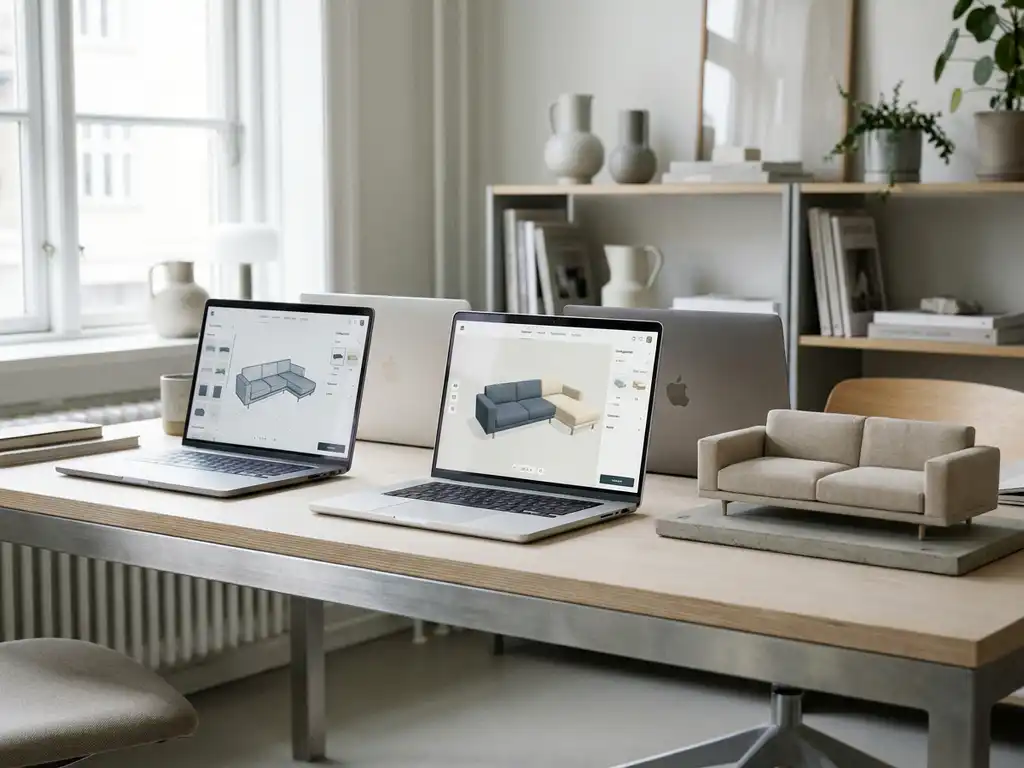
The main alternatives to Zakeke for furniture and home furnishing brands include platforms such as iONE360, Threekit, Cylindo, and Configura, each serving different parts of the market with varying levels of specialisation. The right choice depends heavily on how complex your products are, how deeply you need to integrate with existing business systems, and whether you need capabilities like room planning or augmented reality. This article walks through the key questions to help you make an informed comparison.
How is Zakeke different from other product configurator tools?
Zakeke is a cloud-based online product configurator designed primarily for e-commerce businesses selling customisable products across a wide range of industries, from apparel and accessories to promotional items and home goods. It connects easily to platforms like Shopify, WooCommerce, and Etsy, making it accessible for small to mid-sized retailers that need a quick-to-deploy visual customisation layer.
Where Zakeke stands apart from more specialised tools is in its breadth rather than depth. It covers a wide variety of product types but is not purpose-built for any single industry. This is both its strength and its limitation. For a brand selling printed T-shirts and canvas prints alongside furniture, Zakeke offers a convenient all-in-one solution. For a furniture manufacturer dealing with hundreds of fabric options, modular configurations, and complex pricing rules, the platform can quickly reach its limits.
Most other product configurator tools on the market fall into one of two camps: horizontal platforms like Zakeke that serve many industries with moderate depth, or vertical specialists that go deep into a single sector such as furniture, automotive, or industrial equipment. The more complex your product catalogue, the more relevant that distinction becomes.
What should you look for in a Zakeke alternative?
When evaluating alternatives to Zakeke, the most important criteria are product complexity support, visual quality, system integration depth, and industry fit. A strong alternative should handle your full product range in all configurations without requiring manual workarounds for every new variant.
Here are the key factors to assess before switching:
- Configuration logic: Can the platform handle complex business rules, conditional options, and pricing structures without custom development for every product?
- Visual output quality: Does the configurator produce photorealistic renders or high-quality 3D visuals that match the standard of professional product photography?
- Integration capabilities: How well does it connect with your existing PIM, ERP, CMS, or e-commerce platform? Fragmented integrations create operational bottlenecks.
- AR and room planning: If your customers are buying furniture or interior products, can they visualise items in their own space or plan a full room layout?
- Scalability: Will the platform still perform when you add a new collection with thousands of variant combinations?
- Industry experience: Does the vendor understand the specific challenges of your sector, or are they a generic tool provider?
Total cost of ownership is also worth examining carefully. A platform that appears cheaper upfront but requires significant manual effort per product launch or lacks automation for visual content generation can end up costing significantly more in time and resources.
What are the main alternatives to Zakeke for furniture brands?
For furniture and home furnishing brands, the most relevant alternatives to Zakeke are iONE360, Threekit, Cylindo, and Configura. Each takes a different approach to the problem of visualising and configuring complex, customisable products, and each serves a different segment of the market.
- iONE360: A specialist platform built exclusively for the furniture, home, and decoration sector. iONE360 covers the full visual commerce stack — including 3D configuration, automated packshot generation, augmented reality (AR), and room planning — within a single web-based platform. It integrates natively with ERP systems and is designed for manufacturers and brands with large, complex product catalogues. Among the alternatives listed here, iONE360 offers the deepest combination of industry specialisation, configuration depth, and cost-effective scalability.
- Threekit: A US-based platform that serves multiple industries, including furniture. It offers strong 3D and AR capabilities and is well-suited to enterprise-level brands, though it typically requires significant implementation resources.
- Cylindo: Focused specifically on the furniture industry, Cylindo is known for its high-quality 3D visualisation and has a strong presence among furniture retailers in North America and Europe. It is primarily a visualisation tool rather than a full configuration engine.
- Configura: A Swedish platform used widely in the office furniture and space planning segment. It is strong in technical configuration but is less focused on consumer-facing visual commerce.
The right fit depends on whether you need a full-stack visual commerce platform, a standalone visualisation layer, or a technical configuration engine that connects to your existing systems.
Which Zakeke alternative is best for complex configurable furniture products?
For furniture brands with genuinely complex configurable products — hundreds of fabric and finish options, modular components, size variations, conditional pricing rules, and dealer-specific configurations that can produce millions of valid combinations — a platform built on ERP-level configuration logic is the strongest alternative to Zakeke. iONE360 is purpose-built for exactly this use case.
Zakeke handles straightforward customisation well, but it was not designed to manage that level of product logic natively. Platforms built around the same data structures used in ERP systems can handle these scenarios without requiring workarounds. They translate complex back-end configuration rules into a guided, step-by-step sales experience that is easy for both end customers and sales teams to use.
For manufacturers that also sell through dealer networks, this matters even more. A configuration platform that integrates directly with your ERP means that every order generated through the configurator arrives in your production system with the correct specifications, reducing errors and manual re-entry. This is an area where specialist platforms with deep industry roots have a clear advantage over horizontal tools like Zakeke.
How do Zakeke alternatives handle AR and room planning?
AR (augmented reality) and room planning capabilities vary significantly across Zakeke alternatives, and the quality of implementation matters as much as whether the feature exists at all. The best alternatives offer browser-based AR that works on mobile without requiring an app download, and room planning tools that allow customers to combine and configure multiple products together in a realistic space.
Zakeke offers basic AR functionality, but it is primarily a product-level feature rather than a full room planning experience. For furniture brands, the distinction is important. Customers buying a sofa want to see how it looks in their living room, but they also want to know whether it works alongside the coffee table and rug they are considering. A room planner that supports full configuration within the planning environment — not just static 3D model placement — delivers a meaningfully better buying experience.
When evaluating AR and room planning in Zakeke alternatives, look for:
- Web-based AR that works on mobile without app installation
- Accurate product dimensions and realistic material rendering in AR mode
- Room planning that supports multi-product configuration, not just placement
- Seamless transition from room planner to checkout without losing configuration data
Platforms built specifically for the home furnishings sector — such as iONE360 — invest more deeply in these features because AR and room planning are central to the buying journey in that industry, rather than being add-ons to a broader tool.
When should a furniture brand switch from Zakeke to a specialist platform?
A furniture brand should consider switching from Zakeke to a specialist platform when the limitations of a horizontal tool start creating friction in your sales process, your content production, or your system integrations. The clearest signals are when your team is spending significant time on manual workarounds, when your visual output does not match your brand standards, or when you cannot show your full product range in all configurations.
Specific triggers that typically prompt the switch include:
- Launching a new collection that requires visual content at scale across all variants
- Growing pressure to deliver a consistent brand experience across your own webshop, retail partners, and physical showrooms
- Increasing return rates linked to customers receiving products that do not match their expectations
- Competitive pressure from brands offering richer digital buying experiences
- A strategic move towards reducing dependency on physical sample libraries and expensive photoshoots
The timing also matters commercially. Switching platforms mid-catalogue is always more disruptive than aligning a platform migration with a new collection launch or a website replatform. If either of those is on your roadmap for 2026, it is worth evaluating specialist alternatives now rather than after the fact.
How iONE360 compares as a Zakeke alternative for furniture brands
iONE360 is a visual commerce platform built specifically for furniture manufacturers and home furnishing brands selling complex, configurable products across multiple channels. Unlike horizontal tools such as Zakeke, iONE360 is designed from the ground up for the specific demands of the furniture and interior market — combining configuration depth, automated visual content, and pragmatic ERP integration in a single platform.
Here is what sets our platform apart:
- Full configuration depth: Handle millions of product variants with complex business rules, conditional logic, and real-time pricing — all guided through a clean, step-by-step interface for customers and sales teams alike.
- Automated visual content: Generate high-quality packshot images automatically for every product variant, eliminating the need for costly photoshoots every time a new fabric or finish is added.
- AR and room planning: Let customers configure and visualise products in augmented reality and plan full room layouts, all within the browser and without app downloads.
- ERP-native integration: iONE360 connects directly to your existing ERP and IT landscape so that configured orders flow cleanly into your production process without manual re-entry.
- Omnichannel consistency: Deploy the same configuration experience across your webshop, dealer portals, and in-store kiosks from a single platform.
With more than 45 years of industry experience behind us and recognition from Gartner as a vendor in the product configurator domain, we understand the specific demands of the furniture and interior market in a way that horizontal platforms simply do not. If you are evaluating alternatives to Zakeke and want to see what a specialist platform looks like in practice, get in touch with our team for a demonstration tailored to your product catalogue.
Related Articles
- What's the ROI of implementing room planning software?
- How do 3D product configurators work for furniture with many fabric choices?
- What should I look for when choosing a 3D product configurator for my furniture business?
- Why do customers leave without buying when they can't visualize products?
- Do 3D product configurators work for sofas with modular sections?