

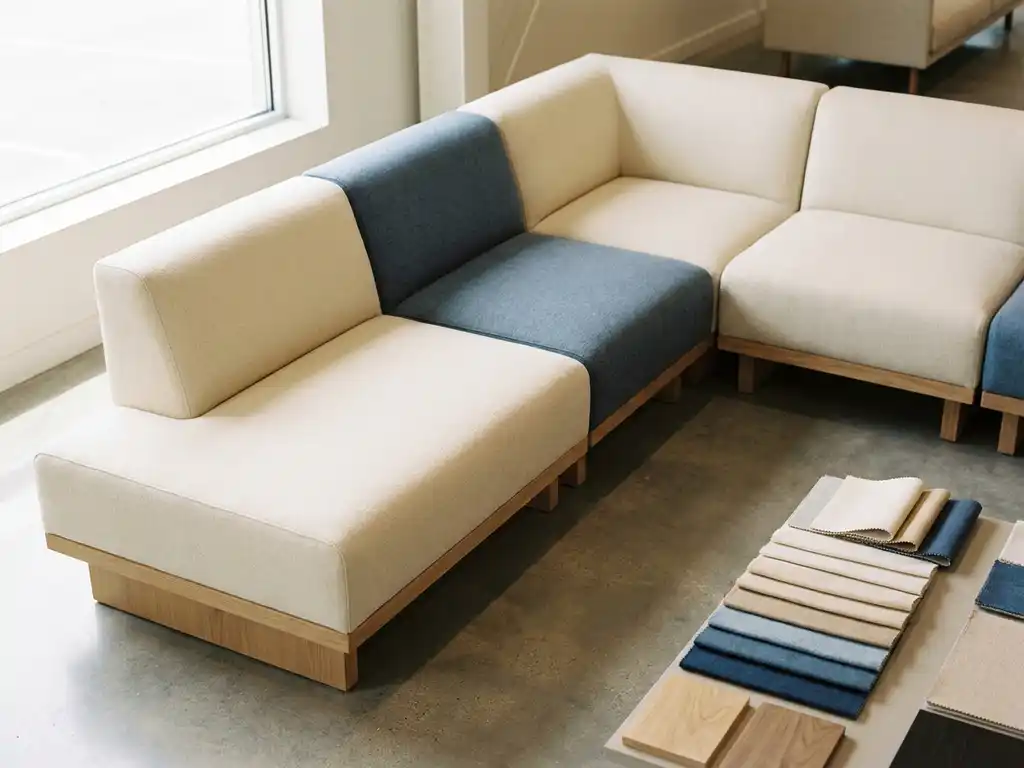
A product configurator handles complex product variants by encoding all possible combinations, business rules, and pricing logic into a structured configuration engine that guides users through valid selections in real time. Rather than relying on pre-built SKUs for every possible outcome, the system generates the correct product specification dynamically based on the choices a customer makes. The sections below unpack exactly how that works, from what makes variants complex in the first place to which product types benefit most from this approach.
What makes product variants complex in the first place?
Product variants become complex when multiple configurable attributes interact with each other in ways that create dependencies, restrictions, or pricing changes. A sofa available in 12 fabric families, 6 frame sizes, 4 leg finishes, and 3 configuration types does not simply have 25 options. It has thousands of combinations, and not all of them are valid, manufacturable, or priced the same way.
Complexity grows from several directions at once:
- Attribute interdependencies: Choosing one option may unlock, restrict, or change the available options in another attribute. A specific fabric may only be available in certain frame sizes, for example.
- Structural variation: Products like modular sofas or shelving systems can be physically combined in different arrangements, not just styled differently.
- Variable pricing: The price of a configurable product often depends on the combination of choices, not just a fixed base price plus simple add-ons.
- Manufacturing constraints: Some combinations are visually possible but technically impossible to produce, and the system needs to know the difference.
For furniture, home, and decoration products specifically, these layers of complexity are the norm rather than the exception. A single upholstered chair may realistically generate hundreds of thousands of valid configurations once all materials, dimensions, and structural options are factored in.
How does a product configurator manage millions of possible combinations?
A product configurator manages millions of combinations by storing product logic in a rules-based configuration model rather than pre-generating every possible SKU. The engine evaluates the current selection state in real time and dynamically determines which options remain valid, what the current price should be, and what the output specification looks like.
This approach works because the configurator separates the product model from the presentation layer. The product model contains all the attributes, constraints, and pricing rules. The presentation layer shows only what is relevant to the user at each step. When a customer selects a fabric, the engine instantly filters the remaining options to show only what is compatible with that choice.
The result is a guided, step-by-step process that feels simple to the end user while handling enormous underlying complexity. Back-end teams define the rules once, and the system applies them consistently across every session, every channel, and every user interaction. This is what makes product configuration software fundamentally different from a product catalogue with filter options.
What’s the difference between a product configurator and a standard variant selector?
A standard variant selector presents a fixed list of pre-defined product versions. A product configurator builds the product specification dynamically based on the user’s choices, enforcing rules, updating pricing, and generating output in real time. The key difference is whether the system selects from existing options or constructs the product on the fly.
In practical terms, a variant selector works well for a t-shirt available in five colours and three sizes. The combinations are finite, pre-built, and easy to manage as individual SKUs. A product configurator is necessary when:
- The number of valid combinations runs into the thousands or millions
- Options are interdependent and cannot be selected independently
- Pricing changes based on the combination of choices, not just individual option prices
- The product needs to be visualised accurately in every configuration
- The output needs to feed directly into a production or ordering system
For manufacturers and retailers of configurable products, this distinction matters commercially. A variant selector creates a ceiling on what can be shown and sold. A product configurator removes that ceiling entirely.
How does a configurator handle business rules and pricing logic?
A configurator handles business rules and pricing logic by encoding them directly into the product model as conditional constraints and calculation formulas. When a user makes a selection, the engine evaluates all active rules and updates the configuration state accordingly, including which options are available, which are excluded, and what the current price is.
Business rules in a configurator typically cover three areas:
- Compatibility rules: If attribute A is selected, attribute B is only available in a subset of its options. These rules prevent invalid configurations from being ordered.
- Dependency rules: Selecting one option automatically sets or requires another. For example, choosing a specific base type may automatically assign a compatible leg finish.
- Pricing rules: The price is calculated dynamically based on the active combination. This may include base prices, surcharges for premium materials, size-based multipliers, and volume discounts applied simultaneously.
Sophisticated product customization software can handle hundreds of overlapping rules without exposing that complexity to the end user. The customer sees a clean, guided interface. Behind the scenes, the engine evaluates every rule on every selection in milliseconds.
What role does 3D visualisation play in handling product variants?
3D visualisation plays a critical role in making complex product variants commercially usable. Without it, a customer configuring a product with dozens of attribute combinations has no reliable way to understand what they are actually ordering. A 3D product configurator closes that gap by rendering an accurate visual representation of the current configuration in real time.
This matters for several practical reasons. Traditional product photography cannot scale to cover every valid combination of a complex configurable product. The cost and time required to photograph every fabric, every size, and every structural variation across a full catalogue is prohibitive. A 3D product configurator generates the correct visual automatically as the user configures, without requiring a separate photoshoot for each variant.
Beyond the visual itself, 3D visualisation also builds purchase confidence. When a customer can see exactly how their chosen combination looks, including texture, colour, proportions, and context within a room, they are better equipped to make a decision. This directly reduces hesitation and post-purchase doubt that drives returns. Augmented reality extends this further by allowing customers to place their configured product in their own space before buying.
Which product types benefit most from a configurator?
Products that benefit most from a configurator are those where customer choice drives meaningful variation in appearance, structure, or price, and where showing every option through traditional means is impractical. In the furniture, home, and decoration sector, this covers a wide range of product categories.
The strongest candidates include:
- Upholstered furniture: Sofas, armchairs, and beds with multiple fabric families, frame options, and structural configurations
- Modular systems: Shelving, storage, and seating systems that can be combined in different arrangements
- Fitted and built-in furniture: Wardrobes, kitchens, and home office solutions with dimensional variation
- Outdoor furniture: Products with weather-resistant material options, size variation, and accessory combinations
- Decorative products: Lighting, rugs, and textiles available in multiple materials, sizes, and finishes
The common thread is that these products are configurable products by nature. Their value to the customer depends on getting the right combination, and their commercial success depends on being able to show and sell that combination efficiently, both online and in-store.
How iONE360 handles complex product variants
We built iONE360 specifically to manage the kind of product complexity described throughout this article. Our platform handles configurable products with sophisticated business rules, interdependent attributes, and dynamic pricing, often across millions of valid combinations, without requiring manual effort for every variant.
Here is what that looks like in practice:
- Rules-based configuration engine: Define your product logic once. The platform enforces compatibility rules, pricing formulas, and dependencies automatically across every customer interaction.
- Real-time 3D visualisation: Every configuration is rendered accurately in 3D as the customer selects, with no additional photoshoots required per variant.
- Augmented reality: Customers can place their configured product in their own space before purchasing, reducing uncertainty and returns.
- Automated packshot generation: High-quality product images are generated automatically for every configuration, making it practical to present your full range across all channels.
- Seamless integration: The platform connects with your existing PIM, ERP, CMS, and webshop, so configuration output flows directly into your business systems.
With more than 45 years of experience in software development for the furniture and interior sector, we understand the specific complexity of this industry. If you are ready to see how iONE360 handles your product catalogue, get in touch with our team for a personalised demonstration.