

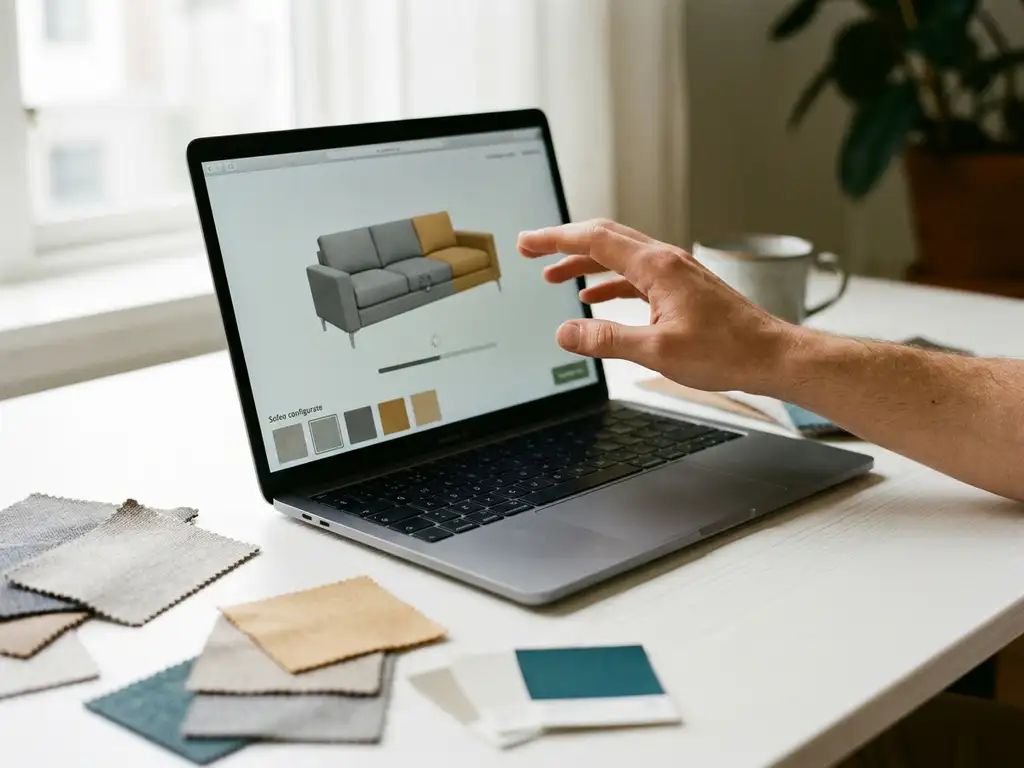
Customers abandon customization tools before completing a purchase primarily because the experience becomes overwhelming, confusing, or untrustworthy. Too many choices without clear guidance, poor visual feedback, and slow or broken mobile interfaces all push shoppers away before they reach checkout. The sections below break down each of the main drop-off triggers and what furniture brands can do about them.
What makes customers drop off mid-configuration?
Customers drop off mid-configuration when the tool creates more friction than confidence. The most common causes are too many simultaneous choices, unclear pricing, slow loading times, and a lack of visual reassurance that the product will actually look the way the customer imagines.
Unlike browsing a static product page, a configurator demands active decision-making at every step. When that process feels uncertain or laborious, customers default to the path of least resistance: leaving. The drop-off is rarely caused by a single problem. It is usually the accumulation of small frustrations that erodes the customer’s motivation to continue.
Key friction points that trigger abandonment include:
- Unclear or delayed price updates as options are selected
- No indication of how many steps remain in the process
- Options presented without context, making comparison impossible
- Slow rendering or page load times between configuration steps
- No ability to save progress and return later
Reducing product configurator drop-off starts with identifying which of these friction points appear in your specific tool and at which step in the funnel they cause the most damage.
How does decision fatigue affect the configuration process?
Decision fatigue occurs when customers are asked to make too many consecutive choices, and their ability to evaluate options deteriorates as a result. In a furniture configurator, this often means that customers who start enthusiastically begin making random selections, second-guessing themselves, or simply abandoning the process entirely by the time they reach the final steps.
The problem is particularly acute in furniture and home decoration, where a single sofa can involve choices about frame size, leg finish, fabric type, fabric colour, cushion fill, and armrest style. Each decision feels manageable in isolation, but the cumulative cognitive load becomes significant. Research in behavioural psychology consistently shows that the more choices people face, the less satisfied they feel with their final decision, even when they complete the process.
For brands selling configurable or custom products, this has a direct commercial consequence. Customers who experience decision fatigue are more likely to abandon, more likely to return the product if they do buy, and less likely to feel confident recommending the brand to others.
The most effective countermeasure is progressive disclosure: revealing options in a logical sequence rather than presenting everything at once. Grouping related choices, offering curated starting points, and pre-selecting the most popular configurations all reduce the cognitive burden without restricting customer freedom.
Why does a lack of visual feedback increase abandonment?
A lack of visual feedback increases abandonment because customers cannot confidently commit to a purchase they cannot clearly see. When a configuration choice updates only a text label or a small swatch, the customer has no way to verify whether their selections will result in a product they actually want. Uncertainty kills conversion.
This is especially true in furniture and home decoration, where the emotional component of the purchase is high. Customers are not just buying a functional object. They are imagining how it will look in their home, whether it will match existing pieces, and whether the colour they selected on screen will look the same in their living room. Without real-time 3D visualisation, those questions remain unanswered.
A 3D furniture configurator that updates instantly as options are selected removes that uncertainty. When customers can see their exact configuration rendered in photorealistic quality, they move through the process with greater confidence and are far less likely to abandon before completing the purchase. Visual feedback also reduces returns, because customers receive exactly what they saw and selected.
What’s the difference between a guided configurator and a self-service one?
A guided configurator walks customers through a structured, step-by-step process in a predefined sequence, while a self-service configurator gives customers open access to all options simultaneously and lets them configure in any order they choose. The key difference is the level of structure imposed on the customer experience.
Guided configurators are generally more effective for complex products with many interdependent options, such as modular sofas or fully customisable bedroom furniture. By controlling the sequence of decisions, they prevent customers from selecting incompatible combinations, reduce decision fatigue, and make the process feel manageable rather than overwhelming. The trade-off is that they offer less freedom for experienced customers who already know what they want.
Self-service configurators work well for simpler products or for professional buyers who are already familiar with the product range. They offer speed and flexibility but require the customer to bring their own knowledge and confidence to the interaction.
For most furniture brands targeting end consumers, a guided approach produces better furniture configurator conversion rates because it mirrors the role of a knowledgeable sales assistant. The configurator makes decisions feel easy rather than exposing the full complexity of the product catalogue at once.
How does poor mobile experience drive configurator abandonment?
Poor mobile experience drives configurator abandonment because most customers now begin their product research on a smartphone, and a configurator that is difficult to use on a small screen creates immediate frustration. If rotating a 3D model requires precise gestures that do not respond well on a touchscreen, or if option menus overlap the product image, customers leave rather than persist.
In 2026, mobile traffic accounts for the majority of e-commerce visits across most furniture retail categories. A configurator that was designed primarily for desktop use and then adapted for mobile often retains the structural problems of its original format: too many elements competing for screen space, small tap targets, and slow asset loading on mobile connections.
The consequences for custom product purchase abandonment are significant. A customer who encounters a broken or frustrating mobile experience rarely returns to complete the purchase on desktop. The drop-off is permanent in most cases.
Brands that invest in mobile-first configurator design, with touch-optimised controls, fast-loading 3D assets, and a simplified interface for smaller screens, consistently see lower abandonment rates and higher completion rates across all devices.
How can furniture brands reduce configurator drop-off rates?
Furniture brands can reduce configurator drop-off rates by simplifying the decision sequence, providing real-time visual feedback at every step, ensuring the tool performs well on mobile devices, and making pricing transparent throughout the process. Each of these changes addresses a specific reason why customers abandon before completing their configuration.
Practical steps to reduce customization tool abandonment include:
- Introduce a guided, step-by-step flow that breaks complex configuration into manageable stages
- Show a live 3D preview that updates instantly with each selection so customers can see exactly what they are building
- Display pricing in real time so customers are never surprised by the total at checkout
- Offer curated starting points such as popular combinations or room-matched presets to reduce the blank-canvas effect
- Enable progress saving so customers can return to a partially completed configuration without starting over
- Optimise for mobile with touch-friendly controls and fast-loading assets
- Add augmented reality so customers can place the configured product in their own space before committing
Brands that address these areas systematically typically see measurable improvements in both conversion rate and average order value, alongside a reduction in returns caused by customers receiving something different from what they expected.
How iONE360 helps reduce configurator drop-off
We built iONE360 specifically to solve the conversion challenges that furniture and home decoration brands face with complex, configurable products. Our platform addresses the core causes of drop-off through a combination of guided configuration logic, real-time 3D visualisation, and seamless integration with your existing sales channels.
Here is what we offer to help brands configure and buy furniture more effectively:
- Step-by-step guided sales flow that structures even the most complex product options into a clear, manageable process
- Real-time photorealistic 3D rendering that updates instantly with every selection, giving customers the visual confidence to complete their purchase
- Augmented reality integration so customers can place configured products in their own home before buying
- Mobile-optimised performance with fast-loading 3D assets and touch-friendly controls
- Automatic packshot generation across all product variants, eliminating the need for costly photoshoots
- Integration with PIM, ERP, CMS, and webshop systems so the configurator fits into your existing tech stack without friction
- Support for millions of product variations including complex business rules and real-time pricing
The result is a visual product configurator that customers actually complete, leading to higher conversion rates, larger order values, and fewer returns. If you want to see how iONE360 performs with your specific product range, get in touch with our team for a personalised demonstration.