

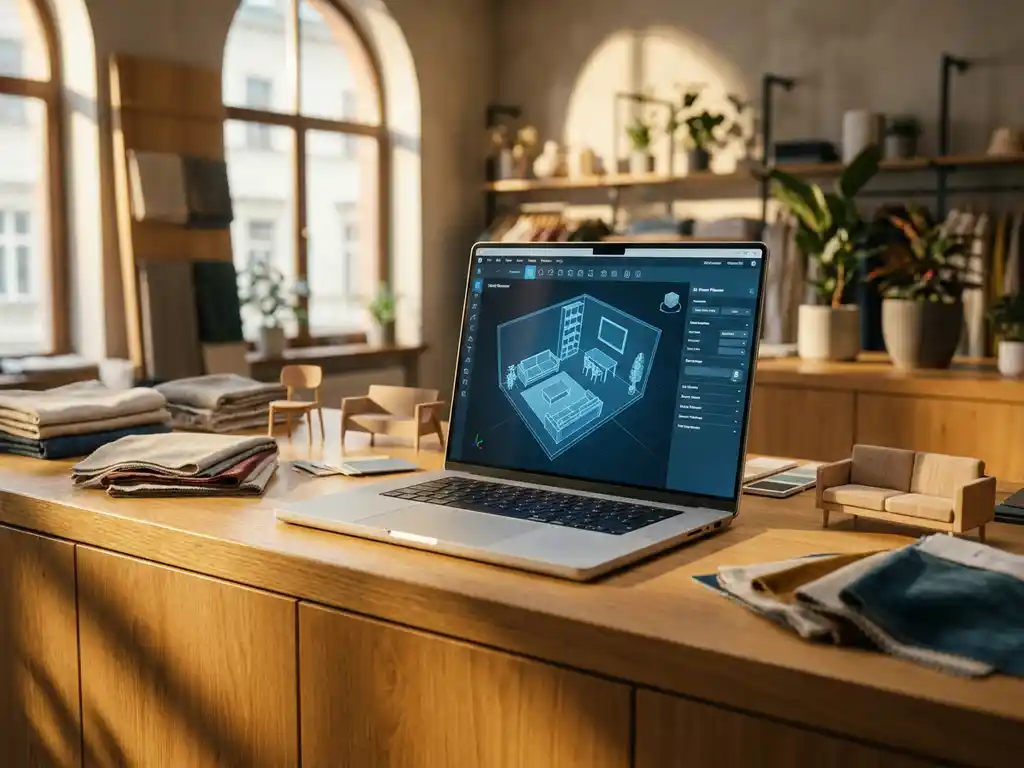
Room planning software is worth the investment for most furniture retailers because it increases customer confidence, reduces returns, and drives higher order values. The technology allows customers to visualize products in realistic room settings before purchasing, addressing the primary barrier to buying furniture online. Studies show that customers who interact with room planning tools are significantly more likely to complete purchases and buy additional items.
What is room planning software and how does it work for retailers?
Room planning software is a 3D visualization tool that allows customers to design virtual rooms and place furniture products within realistic environments. It works by providing drag-and-drop interfaces where users can arrange products, adjust room dimensions, change colors and materials, and view the results from multiple angles in photorealistic quality.
The software typically integrates with your product catalog and pricing systems, automatically pulling in accurate product information, dimensions, and current pricing. Advanced versions allow real-time product configuration, where customers can modify fabric choices, wood finishes, or hardware options while seeing immediate visual updates in the room context.
For retailers, the technology serves multiple functions: it acts as a sales tool that increases customer confidence, a marketing platform that showcases products in aspirational settings, and a practical solution that reduces the need for extensive physical showroom space. The software can be embedded directly into e-commerce websites or used in-store on tablets and displays to enhance the shopping experience.
How much does room planning software cost for furniture retailers?
Room planning software costs typically range from $500 to $5,000 per month for most furniture retailers, depending on the number of products, customization level, and integration complexity. Enterprise solutions with advanced features like real-time configuration and AR capabilities can cost $10,000 to $25,000 monthly.
The pricing structure usually includes several components: initial setup and integration fees ranging from $5,000 to $50,000, monthly software licensing based on product catalog size and user volume, and ongoing support and maintenance costs. Many providers offer tiered pricing where basic room planning starts at lower price points, with costs increasing as you add features like product configuration, AR viewing, or advanced analytics.
When evaluating costs, consider the total investment against potential savings. Room planning software can reduce photography costs significantly since you no longer need to shoot every product variation in different room settings. It also decreases the need for large showroom spaces and can reduce return rates by 20-40%, which often justifies the investment within the first year.
What are the main benefits of room planning software for retail businesses?
The primary benefits include increased conversion rates, higher average order values, reduced return rates, and improved customer satisfaction. Room planning software addresses the main barrier to buying furniture by eliminating uncertainty about how products will look and fit in customers’ actual spaces.
Conversion improvements typically range from 15-35% because customers feel more confident making purchases when they can visualize the end result. Average order values increase as customers discover complementary products and see how multiple items work together in their planned space. The interactive nature of room planning also keeps customers engaged longer on your website, providing more opportunities to showcase your product range.
Operational benefits include reduced customer service inquiries about product dimensions and compatibility, fewer returns due to sizing or style mismatches, and the ability to showcase your entire catalog without physical space limitations. The software also generates valuable data about customer preferences and popular product combinations that can inform inventory and marketing decisions.
For businesses with both online and physical retail presence, room planning tools create consistency across channels and allow sales staff to quickly demonstrate product options and configurations during customer consultations.
How do you measure ROI from room planning software investment?
ROI measurement focuses on comparing increased revenue and cost savings against the software investment. Key metrics include conversion rate improvements, average order value increases, return rate reductions, and operational cost savings from reduced photography and showroom needs.
Track conversion rates before and after implementation, specifically measuring how customers who use the room planning feature compare to those who don’t. Monitor average order values to quantify the impact of customers discovering and purchasing additional products through the room planning experience. Calculate the reduction in return rates and associated processing costs, as this often represents significant savings.
Operational savings include reduced photography costs since room planning eliminates the need to photograph every product variation in multiple room settings. Factor in potential showroom space savings and the value of being able to display your complete catalog virtually rather than maintaining extensive physical inventory for display purposes.
Most furniture retailers see positive ROI within 12-18 months, with the investment typically paying for itself through a combination of increased sales and operational efficiencies. Document baseline metrics before implementation to ensure accurate measurement of the software’s impact on your business performance.
What should retailers consider before investing in room planning software?
Consider your product catalog complexity, technical integration requirements, your customer base’s digital comfort level, and available implementation resources. Evaluate whether your products benefit from room context visualization and whether your customers actively shop online or use digital tools in-store.
Assess your current technology infrastructure and ensure the room planning software can integrate with your existing e-commerce platform, product information management system, and inventory management tools. Consider the quality and completeness of your product data, as room planning software requires accurate dimensions, pricing, and visual assets to function effectively.
Evaluate different software providers based on their experience in the furniture industry, the quality of their 3D rendering, customization capabilities, and ongoing support offerings. Request demonstrations with your actual products and consider starting with a pilot program to test customer response before full implementation.
Factor in the time and resources needed for implementation, including product data preparation, staff training, and customer education. Consider whether you need additional features like augmented reality viewing, real-time product configuration, or integration with design services that some providers offer as part of their platform.
How iONE360 helps with room planning software
We provide a comprehensive room planning solution that addresses all the key considerations furniture retailers face when investing in this technology. Our platform combines advanced 3D visualization with integrated product configuration, allowing customers to both plan their rooms and customize products in real time within the same environment.
Key advantages of our approach include:
- Seamless integration with existing e-commerce and inventory systems
- Support for complex configurable products with millions of possible variations
- Photorealistic rendering quality that builds customer confidence
- Built-in analytics to measure ROI and customer engagement
- 45+ years of furniture industry expertise ensuring practical, scalable solutions
Our room planning software transforms the traditional furniture buying experience by eliminating uncertainty and enabling confident purchasing decisions. Ready to see how room planning can impact your business? Explore our showcases to see the technology in action, or contact us for a personalized demonstration with your products.
Frequently Asked Questions
How long does it typically take to implement room planning software?
Implementation typically takes 4-12 weeks depending on your catalog size and integration complexity. The process includes product data preparation, system integration, staff training, and testing. Most retailers can launch a basic version within 6-8 weeks, with advanced features like real-time configuration requiring additional time for setup and optimization.
What happens if customers create room designs but don't purchase immediately?
Most room planning platforms allow customers to save and share their designs, which actually increases conversion rates over time. You can follow up with targeted email campaigns featuring their saved designs, offer limited-time discounts on items in their rooms, or use the designs to provide personalized customer service. These saved designs often lead to purchases weeks or months later.
Can room planning software handle products with many customization options?
Yes, advanced room planning software can manage thousands of product variations including fabric choices, wood finishes, hardware options, and sizing. The key is having clean, organized product data and working with a provider experienced in configurable furniture. Real-time configuration allows customers to see changes instantly as they modify options within the room context.
How do you ensure the room planning software displays accurate product dimensions and colors?
Accuracy requires high-quality product data including precise dimensions, color-calibrated images, and detailed 3D models. Work with your software provider to establish data standards and quality control processes. Regular updates are essential when you add new products or change specifications, and many platforms offer bulk import tools to streamline this process.
What technical requirements do customers need to use room planning software?
Most modern room planning software works on standard web browsers without requiring downloads or special hardware. Customers typically need a device with decent processing power (most computers and tablets from the last 3-4 years work well) and a stable internet connection. Mobile optimization varies by provider, so ensure your chosen solution works well on the devices your customers prefer.
How do you train sales staff to effectively use room planning software with customers?
Focus training on the software’s key features, common customer scenarios, and how to guide customers through the design process. Role-play different customer situations and teach staff to use room planning as a consultative selling tool rather than just a product display. Provide quick reference guides and ensure staff understand how to save, modify, and share customer designs for follow-up.
What should you do if room planning software doesn't increase sales as expected?
First, analyze usage data to identify barriers – are customers finding the tool, using it fully, or abandoning it at certain points? Common issues include poor product data quality, confusing user interface, or lack of customer awareness. Consider A/B testing different placements on your website, improving the onboarding experience, or adding incentives for customers who use the room planning feature.