

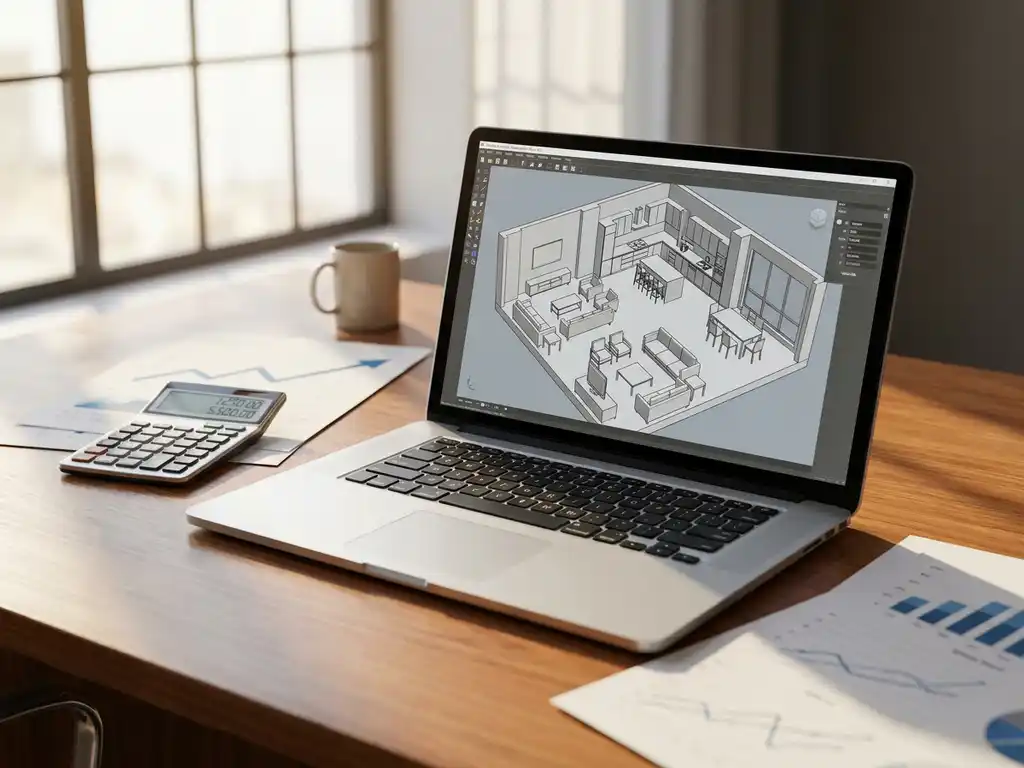
The ROI of implementing room planning software typically ranges from 200% to 400% within the first year, driven by increased conversion rates, higher order values, and reduced returns. Furniture retailers see immediate benefits through enhanced customer engagement and reduced showroom dependency, while manufacturers gain scalable visual content production and improved brand consistency across channels.
How can you overcome limited showroom space that’s costing you qualified customers?
Physical showrooms can only display a fraction of your product catalog, forcing customers to imagine how pieces work together or fit their specific spaces. This limitation drives potential buyers away before they can fully explore your offerings. The solution lies in digital room planning tools that showcase your entire catalog in unlimited configurations, letting customers visualize complete room setups without physical space constraints.
How can you reduce expensive product photography that’s draining your marketing budget?
Traditional furniture photography costs escalate quickly when you factor in multiple angles, room settings, and product combinations across different collections. Each new product variant or seasonal update requires additional photo shoots, creating an unsustainable cycle of mounting expenses. Advanced 3D room planning software generates high-quality visuals automatically, eliminating recurring photography costs while providing unlimited product combinations and room scenarios.
What is room planning software and how does it generate ROI?
Room planning software is a 3D visualization tool that allows customers to design virtual spaces by placing and configuring furniture products in realistic room environments. It generates ROI through increased conversion rates, higher average order values, reduced returns, and decreased dependency on physical showrooms and traditional photography.
The software works by creating interactive 3D environments where customers can experiment with different furniture arrangements, color combinations, and room layouts before making purchase decisions. This visualization capability addresses the primary barrier in furniture buying: uncertainty about how products will look and function in the customer’s actual space.
ROI generation occurs through multiple channels. Conversion rates typically improve because customers gain confidence in their purchasing decisions when they can see products in context. Order values increase as customers add complementary items they discover while planning their rooms. Return rates drop significantly since customers have realistic expectations of how products will appear in their homes.
How much can furniture retailers save with room planning software?
Furniture retailers typically save 40-60% on visual content production costs and see 15-25% increases in conversion rates within six months of implementing room planning software. Additional savings come from reduced showroom requirements, fewer customer service inquiries, and decreased return processing costs.
The most significant savings come from eliminating traditional photography needs. Instead of spending thousands on photo shoots for each product combination and room setting, retailers can generate unlimited high-quality visuals automatically. This shift particularly benefits businesses with large catalogs or frequent product updates.
Operational savings compound over time through reduced showroom dependency. Retailers can showcase their entire catalog digitally, requiring less physical floor space and inventory. Customer service costs decrease as the software answers common questions about product appearance, sizing, and compatibility before customers need to contact support teams.
What’s the difference between basic and advanced room planning ROI?
Basic room planning tools typically deliver 150-200% ROI through improved conversion rates, while advanced 3D room planning software with integrated product configuration can achieve 300-500% ROI by enabling real-time customization, automated pricing, and seamless ordering within the planning experience.
Basic tools focus primarily on furniture placement and simple color changes. While these features help customers visualize room layouts, they offer limited customization options and often require customers to leave the planning environment to complete purchases. The ROI comes mainly from reduced uncertainty and improved conversion rates.
Advanced systems integrate product configuration directly into the room planning experience. Customers can modify dimensions, materials, finishes, and other product specifications while seeing real-time price updates and availability information. This integration creates a complete sales funnel within the planning tool, dramatically increasing order values and reducing abandonment rates. Advanced systems also provide better analytics and customer insights, enabling more targeted marketing and inventory planning.
How do you calculate the ROI of room planning software implementation?
Calculate room planning software ROI by measuring increased revenue from higher conversion rates and order values, then subtracting implementation costs and comparing against previous photography and showroom expenses. The formula is: (Revenue Increase + Cost Savings – Implementation Costs) / Implementation Costs × 100.
Start by establishing baseline metrics before implementation: current conversion rates, average order values, return rates, and annual photography costs. Track these same metrics for at least six months after launching the room planning software to identify improvements.
Revenue increases typically come from three sources: higher conversion rates as customers gain confidence in their purchases, increased order values as customers add complementary items, and reduced return rates leading to higher net revenue. Cost savings include eliminated photography expenses, reduced showroom requirements, and decreased customer service needs.
Implementation costs include software licensing, integration development, content creation for your product catalog, and staff training. Many businesses see positive ROI within 6-12 months, with returns accelerating as they optimize their use of the platform and expand its applications across different sales channels.
How long does it take to see ROI from room planning software?
Most furniture retailers see positive ROI from room planning software within 6-12 months, with initial improvements in conversion rates appearing within the first 2-3 months of implementation. Full ROI realization typically occurs once customer adoption reaches 20-30% of website visitors actively using the planning tools.
The timeline depends on several factors including implementation complexity, product catalog size, and customer adoption rates. Businesses with simpler product lines and straightforward integration requirements often see faster results, while those with complex configuration options may need additional time to optimize their setup.
Early indicators of success include increased time spent on product pages, higher engagement with product configurators, and improved conversion rates among users who interact with the room planning tools. These metrics typically improve within the first month, providing early validation of the investment.
Long-term ROI acceleration occurs as businesses expand their use of the platform. Many companies start with basic room planning and gradually add features like AR viewing, advanced product configuration, and integration with additional sales channels. This expansion amplifies the initial ROI as the platform becomes more central to the customer experience and business operations.
How iONE360 helps with room planning software ROI
We maximize your room planning software ROI through our comprehensive visual commerce platform that combines advanced 3D room planning with integrated product configuration, automated visual content generation, and seamless business system integration. Our solution delivers measurable results by addressing the complete customer journey from initial browsing to final purchase.
- An integrated product configurator enables real-time customization within room planning, increasing order values by 25-40%
- Automated high-quality visual generation eliminates ongoing photography costs while ensuring consistent brand presentation
- Seamless integration with existing PIM, ERP, and e-commerce systems reduces implementation complexity and accelerates time to value
- A proven track record with furniture manufacturers and retailers across Europe, backed by 45+ years of industry expertise
Ready to see how room planning software can transform your ROI? Explore our showcases to see real implementations in action, or contact us for a personalized demonstration of how our platform can deliver measurable results for your specific business needs.
Frequently Asked Questions
What are the main factors that can affect my room planning software ROI timeline?
Your ROI timeline depends on customer adoption rates, product catalog complexity, and integration quality. Businesses with simpler product lines and better user onboarding typically see results 2-3 months faster. Focus on promoting the tool prominently on your website and training your sales team to demonstrate its value to accelerate adoption.
How do I measure if my room planning software is actually driving the promised ROI?
Track key metrics including conversion rate improvements among users who engage with the planning tool, average order value increases, and return rate reductions. Set up analytics to compare performance between customers who use the room planner versus those who don’t. Most successful implementations see 15-25% conversion rate improvements within six months.
What's the biggest mistake businesses make when implementing room planning software?
The most common mistake is treating room planning software as just another feature rather than integrating it into the core customer experience. Successful implementations make the tool prominent, train staff to demonstrate it, and ensure seamless integration with pricing and ordering systems. Poor integration leads to customer frustration and abandoned purchases.
Can room planning software work for businesses with highly customizable or complex products?
Yes, but you’ll need advanced room planning software with integrated product configuration capabilities. Basic tools work for standard furniture, but complex products with multiple material options, dimensions, and features require real-time configuration within the planning environment. This integration actually increases ROI by enabling higher customization and order values.
How much should I budget for room planning software implementation beyond the licensing costs?
Plan for 30-50% additional costs beyond licensing for integration, content creation, and training. This includes developing 3D models of your products, integrating with existing systems, and staff training. However, these upfront investments typically pay for themselves within 6-12 months through eliminated photography costs and increased sales.
What happens if customer adoption of the room planning tool is lower than expected?
Low adoption usually indicates poor placement, inadequate promotion, or user experience issues rather than lack of customer interest. Improve adoption by making the tool more prominent on product pages, adding clear value propositions, and ensuring mobile optimization. Consider offering incentives for first-time users or guided tutorials to demonstrate the tool’s benefits.
Related Articles
- How do 3D product configurators work for furniture with many fabric choices?
- What is the role of a product configurator in omnichannel retail?
- What file formats do room planning tools support?
- What is the difference between a 3D product configurator and a product image gallery?
- Can a 3D product configurator show products in a room setting?